Sovi.AI - AI Math Tutor

Scan to solve math questions

QUESTION IMAGE

a town planner wants to build two new streets, elm street and garden ro…

Question

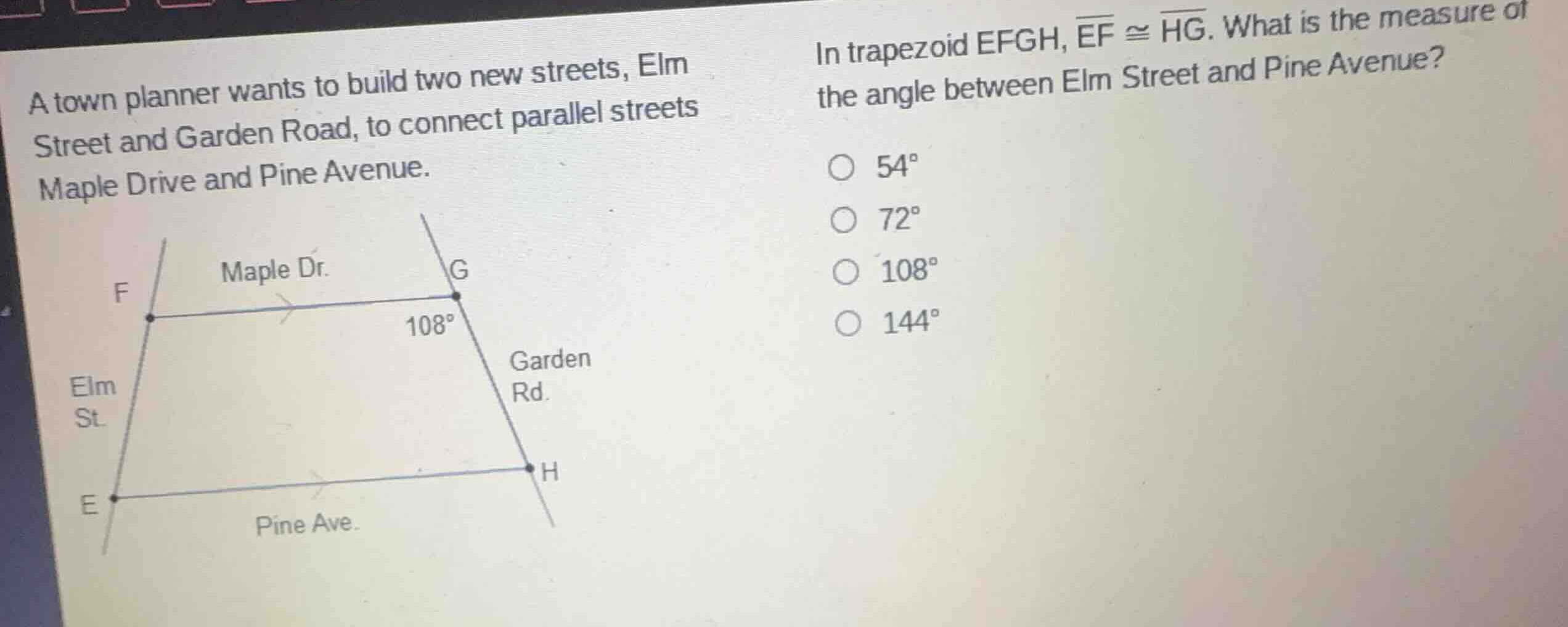
a town planner wants to build two new streets, elm street and garden road, to connect parallel streets maple drive and pine avenue.
in trapezoid efgh, $overline{ef} \cong \overline{hg}$. what is the measure of the angle between elm street and pine avenue?
$\bigcirc$ $54^\circ$
$\bigcirc$ $72^\circ$
$\bigcirc$ $108^\circ$
$\bigcirc$ $144^\circ$

Explanation:

Step1: Identify the trapezoid type

Since \( \overline{EF} \cong \overline{HG} \) and \( FG \parallel EH \) (Maple Dr and Pine Ave are parallel), EFGH is an isosceles trapezoid. In an isosceles trapezoid, consecutive angles between the bases are supplementary, and base angles are equal. Also, angles adjacent to each non - parallel side are supplementary.

Step2: Use supplementary angles property

We know that \( \angle FGH = 108^{\circ} \), and \( FG\parallel EH \). The angle between Garden Rd (HG) and Pine Ave (EH) and \( \angle FGH \) are same - side interior angles, so they are supplementary. But we need the angle between Elm St (EF) and Pine Ave (EH). In an isosceles trapezoid, \( \angle FEH \) and \( \angle FGH \) are supplementary? Wait, no. Wait, \( FG\parallel EH \), so \( \angle FGH+\angle GHE = 180^{\circ}\), but also, since \( EF\cong HG \), \( \angle FEH=\angle GHE \)? Wait, no, let's correct. In isosceles trapezoid EFGH with \( FG\parallel EH \) and \( EF = HG \), the base angles \( \angle FEH \) and \( \angle GHE \) are equal, and \( \angle EFG \) and \( \angle FGH \) are equal. Also, consecutive angles between the bases are supplementary. So \( \angle FGH+\angle GHE = 180^{\circ}\), and \( \angle FEH=\angle GHE \). Wait, but we can also note that the angle between Elm St (EF) and Pine Ave (EH) is \( \angle FEH \), and since \( FG\parallel EH \), \( \angle EFG+\angle FEH = 180^{\circ}\), but \( \angle EFG=\angle FGH = 108^{\circ}\)? No, wait, \( \angle FGH = 108^{\circ}\), and \( \angle FEH \) and \( \angle FGH \) are supplementary? Wait, no, let's look at the parallel lines. \( FG\) and \( EH \) are parallel, cut by transversal \( HG \), so \( \angle FGH+\angle GHE = 180^{\circ}\), so \( \angle GHE=180 - 108=72^{\circ}\). But since \( EF = HG \), the trapezoid is isosceles, so \( \angle FEH=\angle GHE \)? Wait, no, in isosceles trapezoid, the base angles (angles adjacent to each base) are equal. The bases are \( FG \) and \( EH \). So angles at \( F \) and \( G \) are adjacent to base \( FG \), angles at \( E \) and \( H \) are adjacent to base \( EH \). So \( \angle EFG=\angle FGH \) and \( \angle FEH=\angle GHE \). Also, \( \angle EFG+\angle FEH = 180^{\circ}\) (consecutive interior angles for parallel lines \( FG \) and \( EH \) cut by transversal \( EF \)). Wait, maybe a simpler way: in an isosceles trapezoid, the angle between the non - parallel side and the base is supplementary to the angle between the other non - parallel side and the same base? No, let's use the fact that the sum of adjacent angles along a leg is \( 180^{\circ}\). The leg here is \( FG \) and \( EH \) are bases, legs are \( EF \) and \( HG \). So for leg \( HG \), \( \angle FGH+\angle GHE = 180^{\circ}\), so \( \angle GHE = 180 - 108=72^{\circ}\). But the angle between Elm St (EF) and Pine Ave (EH) is \( \angle FEH \), and since \( EF = HG \), the trapezoid is isosceles, so \( \angle FEH=\angle GHE \)? Wait, no, in isosceles trapezoid, the base angles are equal. So angles at \( E \) and \( H \) (on base \( EH \)) are equal, angles at \( F \) and \( G \) (on base \( FG \)) are equal. And each angle on a base is supplementary to the angle on the other base. So \( \angle FGH+\angle FEH = 180^{\circ}\)? No, that's not right. Wait, \( FG\parallel EH \), so \( \angle EFG+\angle FEH = 180^{\circ}\) (consecutive interior angles), and \( \angle EFG=\angle FGH = 108^{\circ}\), so \( \angle FEH=180 - 108 = 72^{\circ}\). Yes, that makes sense. So the angle between Elm Street and Pine Avenue is \( 72^{\circ}\).

Answer:

\( 72^{\circ} \) (corresponding to the option \( 72^{\circ} \))