QUESTION IMAGE
Question
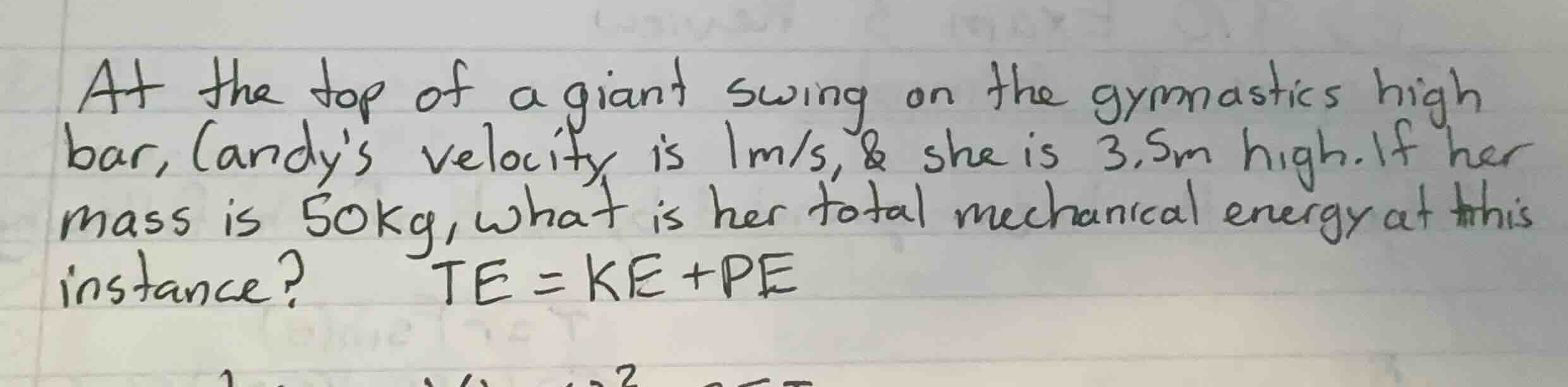
at the top of a giant swing on the gymnastics high bar, candys velocity is \\(1\text{ m/s}\\), & she is \\(3.5\text{ m}\\) high. if her mass is \\(50\text{ kg}\\), what is her total mechanical energy at this instance? \\(te = ke + pe\\)
Identify given values and constants
We extract the physical parameters from the problem statement:
- Mass of the gymnast, \(m = 50\text{ kg}\)
- Velocity at the top, \(v = 1\text{ m/s}\)
- Height above the reference level, \(h = 3.5\text{ m}\)
- Acceleration due to gravity, \(g \approx 9.8\text{ m/s}^2\) (or \(9.81\text{ m/s}^2\))
Calculate kinetic energy
Kinetic energy represents energy of motion:
Substituting the values:
Calculate potential energy
Potential energy represents stored gravitational energy:
Substituting the values:
(Note: If using \(g = 9.81\text{ m/s}^2\), \(PE = 1716.75\text{ J}\))
Sum to find total mechanical energy
Total mechanical energy is the sum of kinetic and potential energy:
Using \(g = 9.8\text{ m/s}^2\):
Using \(g = 9.81\text{ m/s}^2\):

Snap & solve any problem in the app
Get step-by-step solutions on Sovi AI
Photo-based solutions with guided steps
Explore more problems and detailed explanations
\(1740\text{ J}\) (or \(1741.75\text{ J}\) using \(g = 9.81\text{ m/s}^2\))