QUESTION IMAGE
Question
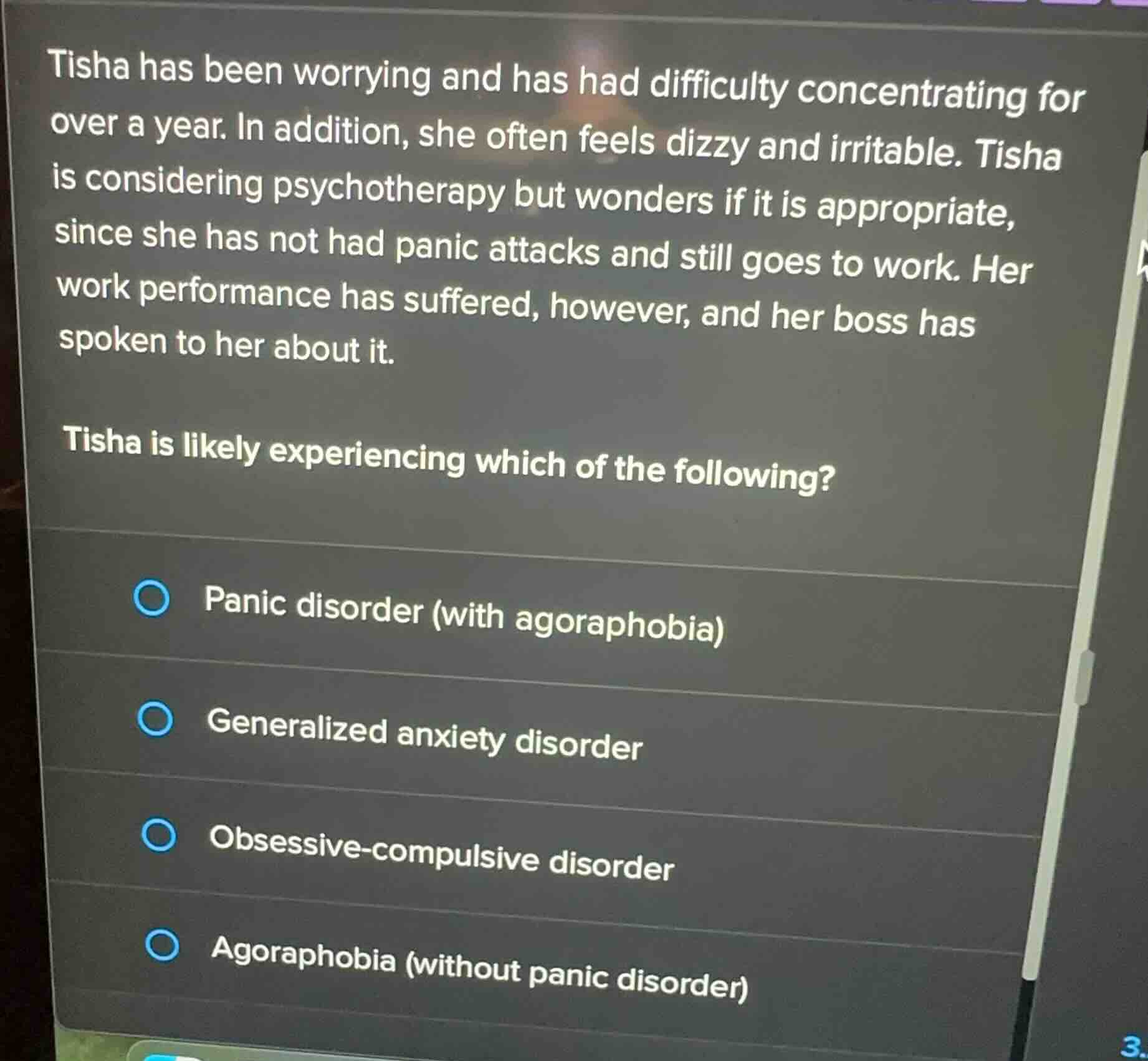
tisha has been worrying and has had difficulty concentrating for over a year. in addition, she often feels dizzy and irritable. tisha is considering psychotherapy but wonders if it is appropriate, since she has not had panic attacks and still goes to work. her work performance has suffered, however, and her boss has spoken to her about it.
tisha is likely experiencing which of the following?
panic disorder (with agoraphobia)
generalized anxiety disorder
obsessive-compulsive disorder
agoraphobia (without panic disorder)
Analyze the clinical presentation
Tisha presents with chronic worry and concentration difficulties lasting over a year. She also experiences physical symptoms including dizziness and irritability.
Evaluate DSM-5 duration criteria
Generalized anxiety disorder (GAD) requires excessive anxiety and worry occurring more days than not for at least 6 months. Tisha's symptoms have persisted for over a year, satisfying this timeline.
Assess associated physical symptoms
GAD requires at least three associated somatic or cognitive symptoms (one for children). Tisha exhibits difficulty concentrating, irritability, and dizziness (muscle tension/restlessness/sleep disturbance are also common), which align with GAD.
Rule out alternative diagnoses
- Panic disorder: Ruled out because Tisha explicitly states she has not had panic attacks.
- Obsessive-compulsive disorder: There is no mention of obsessions (intrusive, unwanted thoughts) or compulsions (repetitive behaviors).
- Agoraphobia: Ruled out because she still goes to work and there is no reported fear of public spaces or difficulty escaping.
Formulate diagnostic conclusion
Tisha's persistent, generalized worry and physical symptoms in the absence of panic attacks or situational phobias point directly to Generalized Anxiety Disorder.

Snap & solve any problem in the app
Get step-by-step solutions on Sovi AI
Photo-based solutions with guided steps
Explore more problems and detailed explanations
- (A) Panic disorder (with agoraphobia)
- (B) Generalized anxiety disorder (Correct answer)
- (C) Obsessive-compulsive disorder
- (D) Agoraphobia (without panic disorder)