QUESTION IMAGE
Question
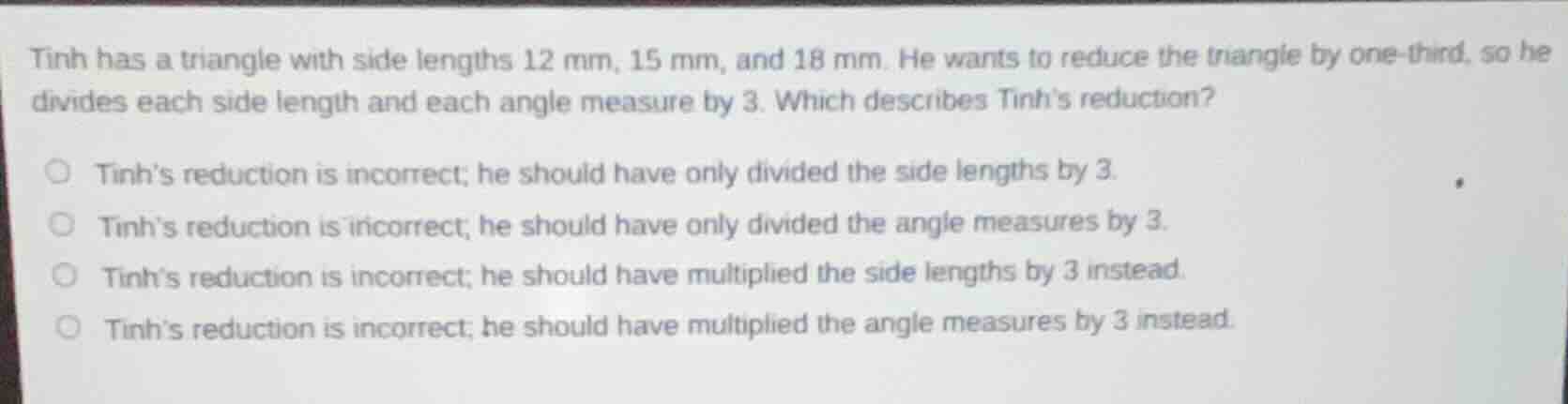
tinh has a triangle with side lengths 12 mm, 15 mm, and 18 mm. he wants to reduce the triangle by one-third, so he divides each side length and each angle measure by 3. which describes tinhs reduction?
tinhs reduction is incorrect; he should have only divided the side lengths by 3.
tinhs reduction is incorrect; he should have only divided the angle measures by 3.
tinhs reduction is incorrect; he should have multiplied the side lengths by 3 instead.
tinhs reduction is incorrect; he should have multiplied the angle measures by 3 instead.
Analyze the geometric reduction process
Tinh wants to reduce a triangle by a scale factor of \(\frac{1}{3}\). Under a geometric dilation (reduction or enlargement), the side lengths of the figure are scaled proportionally, but the angle measures must remain constant to preserve the shape of the figure.
Evaluate the effect on angle measures
Using the Triangle Angle Sum Theorem, we know that the sum of the interior angles of any triangle is always exactly \(180^\circ\). If Tinh divides each angle measure by \(3\), the sum of the new angles would be:
A triangle cannot have an interior angle sum of \(60^\circ\). Therefore, dividing the angle measures is mathematically impossible and incorrect.
Determine the correct reduction method
To correctly perform a reduction, only the side lengths should be divided by \(3\) (multiplied by \(\frac{1}{3}\)). The corresponding angles of the reduced triangle must remain congruent to the original angles to maintain similarity. Thus, Tinh's reduction is incorrect because he should have only divided the side lengths by \(3\).

Snap & solve any problem in the app
Get step-by-step solutions on Sovi AI
Photo-based solutions with guided steps
Explore more problems and detailed explanations
- (A) Tinh's reduction is incorrect; he should have only divided the side lengths by 3. (Correct answer)
- (B) Tinh's reduction is incorrect; he should have only divided the angle measures by 3.
- (C) Tinh's reduction is incorrect; he should have multiplied the side lengths by 3 instead.
- (D) Tinh's reduction is incorrect; he should have multiplied the angle measures by 3 instead.