QUESTION IMAGE
Question
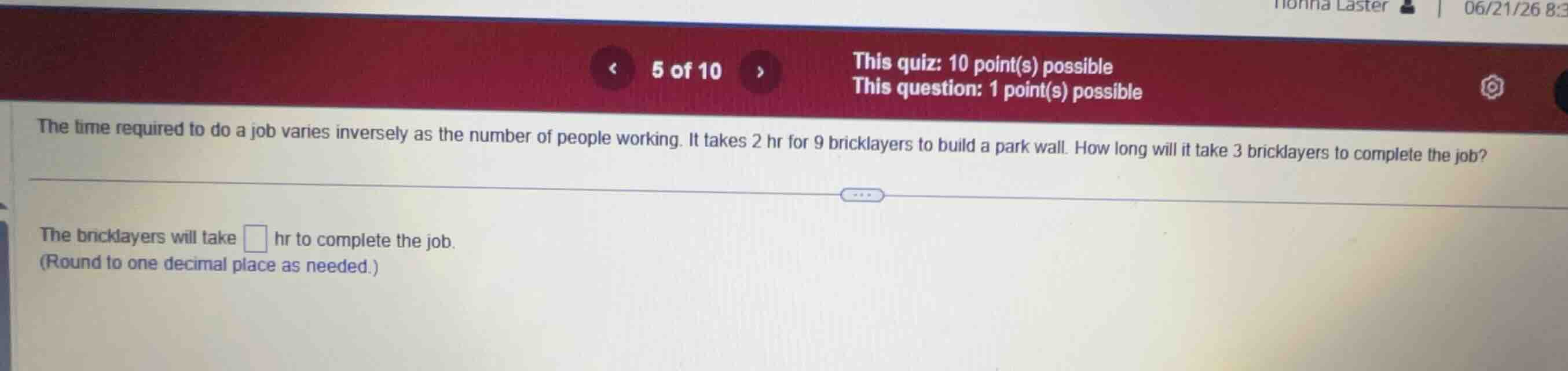
the time required to do a job varies inversely as the number of people working. it takes 2 hr for 9 bricklayers to build a park wall. how long will it take 3 bricklayers to complete the job?
the bricklayers will take hr to complete the job.
(round to one decimal place as needed.)
Define variables and relationship
Let \(t\) represent the time in hours required to complete the job, and let \(n\) represent the number of people working. Since the time varies inversely as the number of people, we can model this relationship using the Inverse Variation formula:
where \(k\) is the Constant of Variation.
Find the constant of variation
We are given that it takes \(2\text{ hr}\) for \(9\) bricklayers to build the wall. Substituting \(t = 2\) and \(n = 9\) into our variation equation allows us to solve for \(k\):
Set up the specific equation
Now that we have found the constant of variation \(k = 18\), we can write the specific equation that models this situation:
Calculate the time for 3 bricklayers
We need to find how long it will take \(3\) bricklayers to complete the job. Substituting \(n = 3\) into our equation:
State the final result
The time required for \(3\) bricklayers to complete the job is exactly \(6\text{ hr}\).

Snap & solve any problem in the app
Get step-by-step solutions on Sovi AI
Photo-based solutions with guided steps
Explore more problems and detailed explanations
The bricklayers will take <blank>6</blank> hr to complete the job.
(Round to one decimal place as needed.)