QUESTION IMAGE
Question
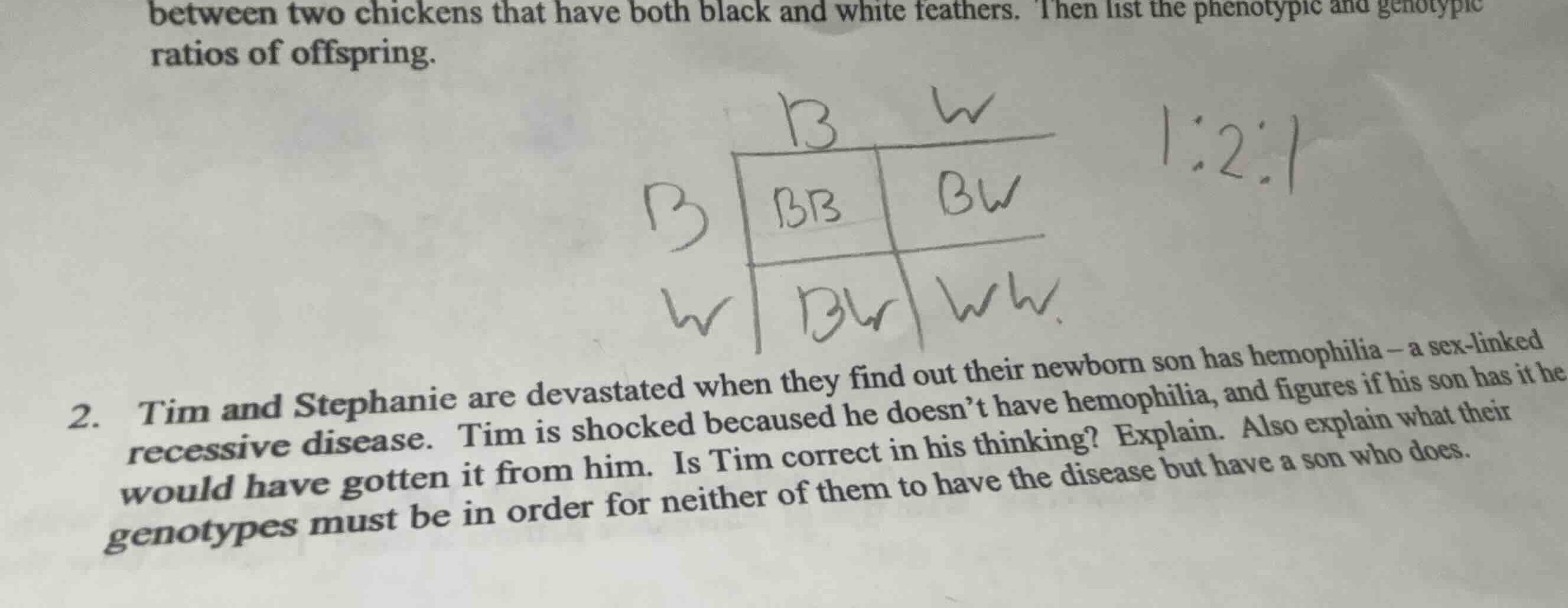
- tim and stephanie are devastated when they find out their newborn son has hemophilia - a sex-linked recessive disease. tim is shocked becaused he doesnt have hemophilia, and figures if his son has it he would have gotten it from him. is tim correct in his thinking? explain. also explain what their genotypes must be in order for neither of them to have the disease but have a son who does.
Analyze sex-linked inheritance of hemophilia
Hemophilia is an X-linked recessive disorder. A son inherits his Y chromosome from his father (Tim) and his X chromosome from his mother (Stephanie). Therefore, a son cannot inherit an X-linked trait from his father.
Evaluate Tim's thinking
Tim is incorrect. Since he does not have hemophilia, his genotype is \(X^H Y\). He passed his Y chromosome to his son, which does not carry the gene for hemophilia. The son's affected X chromosome (\(X^h\)) must have come from his mother, Stephanie.
Determine parental genotypes
For neither parent to have hemophilia but to have an affected son (\(X^h Y\)):
- Tim must be unaffected: \(X^H Y\)
- Stephanie must be an unaffected carrier: \(X^H X^h\)

Snap & solve any problem in the app
Get step-by-step solutions on Sovi AI
Photo-based solutions with guided steps
Explore more problems and detailed explanations
Tim is incorrect. Hemophilia is an X-linked recessive disease, meaning the gene is located on the X chromosome. A son inherits his Y chromosome from his father and his X chromosome from his mother. Therefore, the son inherited the hemophilia allele from his mother, Stephanie, not from Tim.
For neither parent to have the disease but have a son who does, their genotypes must be:
- Tim (Father): \(X^H Y\) (unaffected)
- Stephanie (Mother): \(X^H X^h\) (unaffected carrier)