QUESTION IMAGE
Question
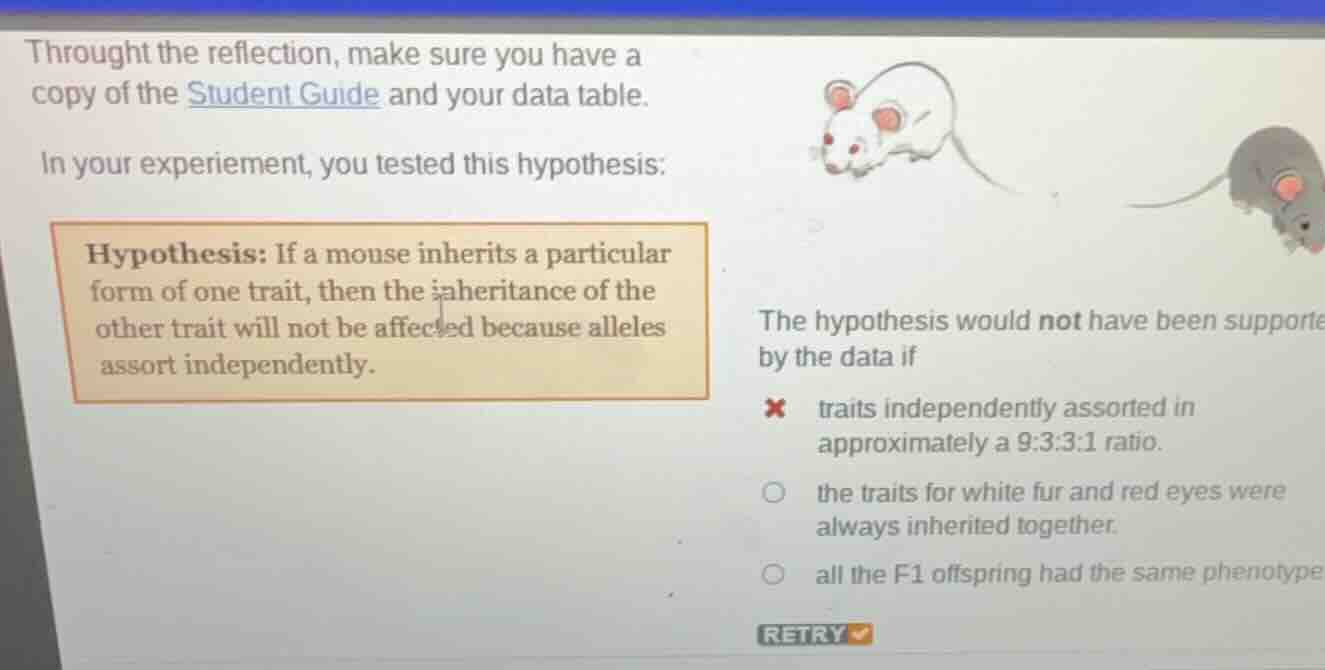
throught the reflection, make sure you have a copy of the student guide and your data table.
in your experiement, you tested this hypothesis:
hypothesis: if a mouse inherits a particular form of one trait, then the inheritance of the other trait will not be affected because alleles assort independently.
the hypothesis would not have been supported by the data if
traits independently assorted in approximately a 9:3:3:1 ratio.
the traits for white fur and red eyes were always inherited together.
all the f1 offspring had the same phenotype.
Analyze the stated hypothesis
The hypothesis states: "If a mouse inherits a particular form of one trait, then the inheritance of the other trait will not be affected because alleles assort independently." This is a direct statement of Mendel's Law of Independent Assortment, which we study in Mendels Hypothesis and Dihybrid Cross.
Determine what refutes independent assortment
Independent assortment means that the alleles of two different genes get sorted into gametes independently of one another. If two traits are always inherited together, it means the genes are physically linked on the same chromosome (genetic linkage) and do not assort independently.
Evaluate the given options
- Option 1: "traits independently assorted in approximately a 9:3:3:1 ratio." This ratio actually supports independent assortment in a dihybrid cross.
- Option 2: "the traits for white fur and red eyes were always inherited together." If they are always inherited together, they do not assort independently, which directly refutes the hypothesis.
- Option 3: "all the F1 offspring had the same phenotype." This is expected in a cross of true-breeding parents and does not disprove independent assortment.

Snap & solve any problem in the app
Get step-by-step solutions on Sovi AI
Photo-based solutions with guided steps
Explore more problems and detailed explanations
- (A) traits independently assorted in approximately a 9:3:3:1 ratio.
- (B) the traits for white fur and red eyes were always inherited together. (Correct answer)
- (C) all the F1 offspring had the same phenotype.