QUESTION IMAGE
Question
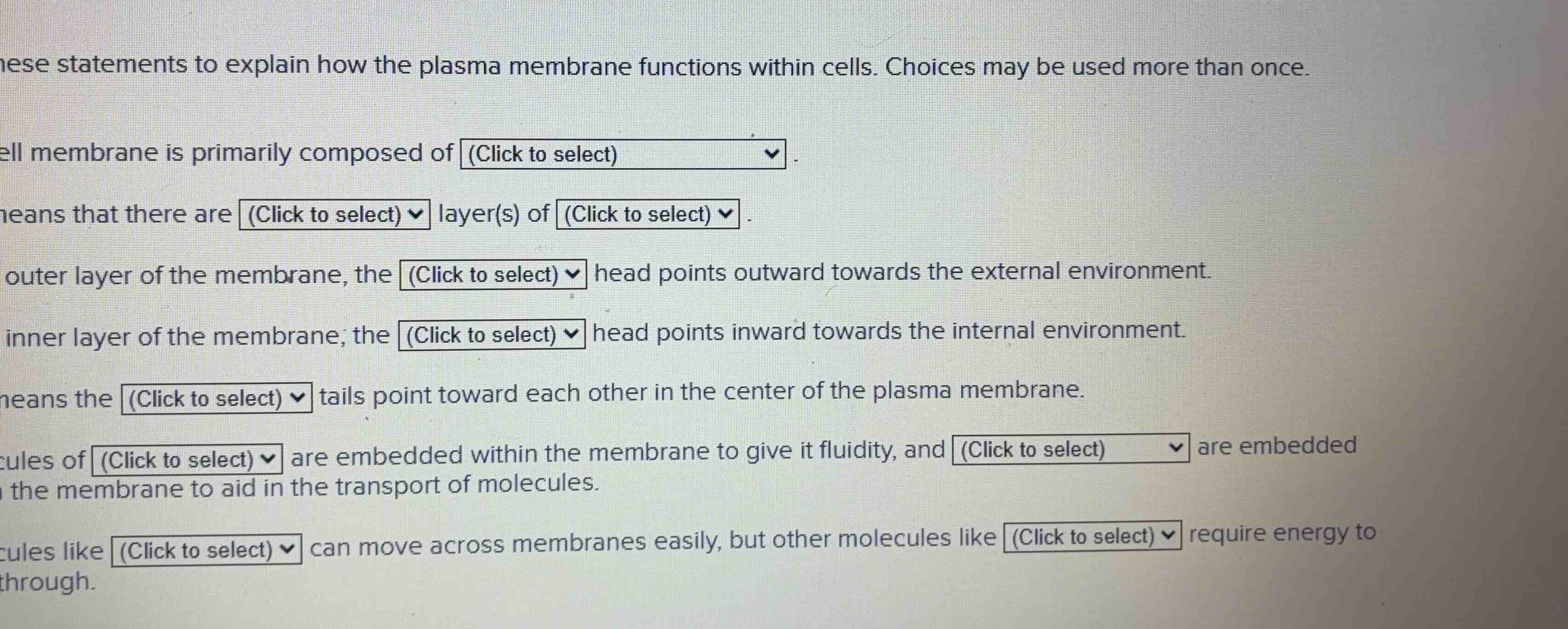
these statements to explain how the plasma membrane functions within cells. choices may be used more than once.
ell membrane is primarily composed of (click to select)
means that there are (click to select) layer(s) of (click to select).
outer layer of the membrane, the (click to select) head points outward towards the external environment.
inner layer of the membrane, the (click to select) head points inward towards the internal environment.
means the (click to select) tails point toward each other in the center of the plasma membrane.
cules of (click to select) are embedded within the membrane to give it fluidity, and (click to select) are embedded the membrane to aid in the transport of molecules.
cules like (click to select) can move across membranes easily, but other molecules like (click to select) require energy to through.
Identify the primary composition of the cell membrane
The cell membrane is primarily composed of a phospholipid bilayer. Phospholipids are amphipathic molecules containing a hydrophilic head and two hydrophobic tails.
Determine the bilayer structure and orientation
Using the Selective Permeability knowledge point, we analyze how the amphipathic nature of phospholipids dictates their arrangement in an aqueous environment:
- There are two layers of phospholipids.
- In the outer layer, the hydrophilic (polar) head points outward towards the external aqueous environment.
- In the inner layer, the hydrophilic (polar) head points inward towards the internal aqueous environment (cytosol).
- This means the hydrophobic (nonpolar) tails point toward each other in the center of the membrane, shielded from water.
Identify embedded membrane components
- Molecules of cholesterol are embedded within the hydrophobic core of the animal cell membrane to regulate and maintain its fluidity.
- Proteins (specifically transmembrane or transport proteins) are embedded across the membrane to aid in the transport of specific molecules.
Analyze membrane transport dynamics
- Small, nonpolar molecules like oxygen (or carbon dioxide) can move across membranes easily via simple diffusion.
- Large or highly charged polar molecules like glucose (or ions) cannot easily cross the hydrophobic core and require energy (active transport) or transport proteins to pass through.

Snap & solve any problem in the app
Get step-by-step solutions on Sovi AI
Photo-based solutions with guided steps
Explore more problems and detailed explanations
Complete these statements to explain how the plasma membrane functions within cells. Choices may be used more than once.
The cell membrane is primarily composed of <blank>phospholipids</blank>.
This means that there are <blank>two</blank> layer(s) of <blank>phospholipids</blank>.
In the outer layer of the membrane, the <blank>hydrophilic</blank> head points outward towards the external environment.
In the inner layer of the membrane, the <blank>hydrophilic</blank> head points inward towards the internal environment.
This means the <blank>hydrophobic</blank> tails point toward each other in the center of the plasma membrane.
Molecules of <blank>cholesterol</blank> are embedded within the membrane to give it fluidity, and <blank>proteins</blank> are embedded within the membrane to aid in the transport of molecules.
Molecules like <blank>oxygen</blank> can move across membranes easily, but other molecules like <blank>glucose</blank> require energy to pass through.