QUESTION IMAGE
Question
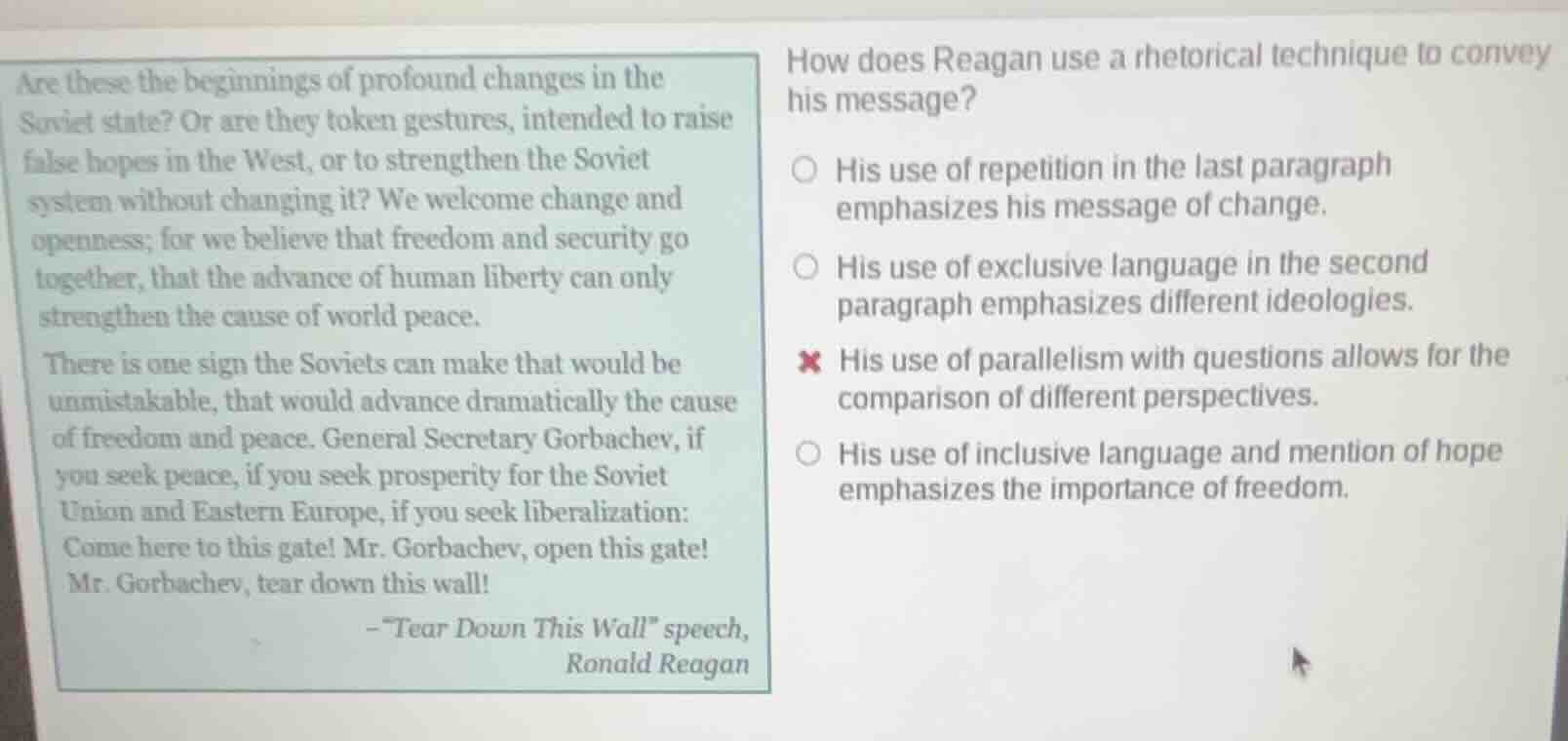
are these the beginnings of profound changes in the soviet state? or are they token gestures, intended to raise false hopes in the west, or to strengthen the soviet system without changing it? we welcome change and openness; for we believe that freedom and security go together, that the advance of human liberty can only strengthen the cause of world peace.
there is one sign the soviets can make that would be unmistakable, that would advance dramatically the cause of freedom and peace. general secretary gorbachev, if you seek peace, if you seek prosperity for the soviet union and eastern europe, if you seek liberalization: come here to this gate! mr. gorbachev, open this gate! mr. gorbachev, tear down this wall!
-\tear down this wall\ speech, ronald reagan
how does reagan use a rhetorical technique to convey his message?
his use of repetition in the last paragraph emphasizes his message of change.
his use of exclusive language in the second paragraph emphasizes different ideologies.
his use of parallelism with questions allows for the comparison of different perspectives.
his use of inclusive language and mention of hope emphasizes the importance of freedom.
Analyze the rhetorical structure of the first paragraph
The first paragraph contains two rhetorical questions: "Are these the beginnings of profound changes in the Soviet state? Or are they token gestures...?" Following these questions, Reagan shifts to inclusive pronouns: "We welcome change and openness; for we believe that freedom and security go together..." This use of Inclusive Language ("we", "our") unites the speaker and the audience under shared values of freedom and peace.
Evaluate the options based on the text
- Option 1: "His use of repetition in the last paragraph..." The last paragraph uses parallel structures ("if you seek...", "Mr. Gorbachev...") rather than simple repetition to emphasize change.
- Option 2: "His use of exclusive language in the second paragraph..." The second paragraph addresses Gorbachev directly ("if you seek peace...") rather than using exclusive language to emphasize different ideologies.
- Option 3: "His use of parallelism with questions..." This option is marked with a red cross in the image, indicating it is incorrect because the questions do not primarily serve to compare different perspectives.
- Option 4: "His use of inclusive language and mention of hope..." In the first paragraph, Reagan uses Inclusive Language ("We welcome...", "we believe...") alongside the mention of "hope" ("false hopes", "freedom and security") to emphasize the collective importance of freedom.
Confirm the correct rhetorical technique
By using Inclusive Language ("we"), Reagan establishes a common ground with his audience, emphasizing that the pursuit of liberty and peace is a shared human endeavor. This directly supports his message of promoting global freedom.

Snap & solve any problem in the app
Get step-by-step solutions on Sovi AI
Photo-based solutions with guided steps
Explore more problems and detailed explanations
- (A) His use of repetition in the last paragraph emphasizes his message of change.
- (B) His use of exclusive language in the second paragraph emphasizes different ideologies.
- (C) His use of parallelism with questions allows for the comparison of different perspectives.
- (D) His use of inclusive language and mention of hope emphasizes the importance of freedom. (Correct answer)