QUESTION IMAGE
Question
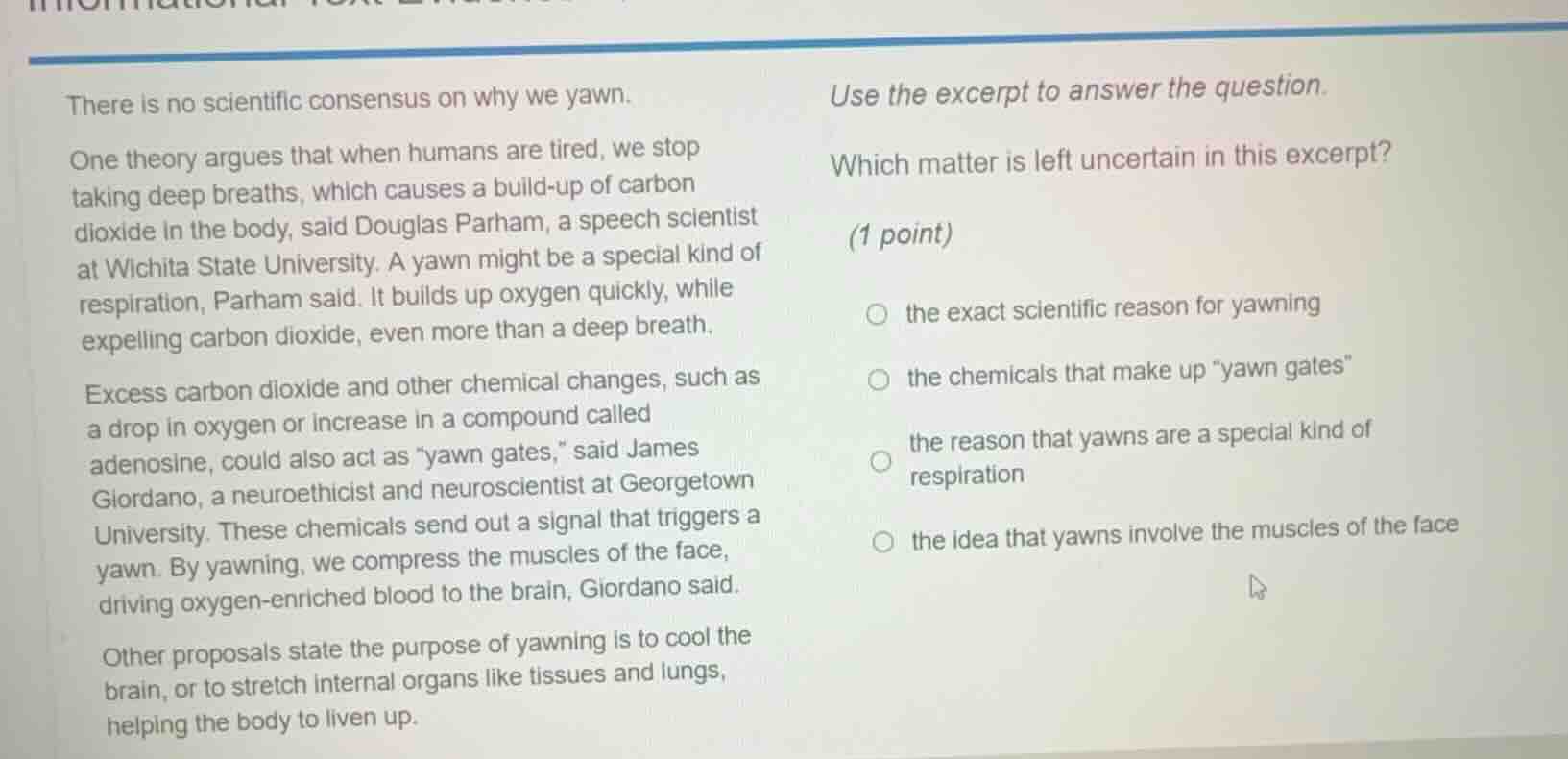
there is no scientific consensus on why we yawn.
one theory argues that when humans are tired, we stop taking deep breaths, which causes a build - up of carbon dioxide in the body, said douglas parham, a speech scientist at wichita state university. a yawn might be a special kind of respiration, parham said. it builds up oxygen quickly, while expelling carbon dioxide, even more than a deep breath.
excess carbon dioxide and other chemical changes, such as a drop in oxygen or increase in a compound called adenosine, could also act as \yawn gates,\ said james giordano, a neuroethicist and neuroscientist at georgetown university. these chemicals send out a signal that triggers a yawn. by yawning, we compress the muscles of the face, driving oxygen - enriched blood to the brain, giordano said.
other proposals state the purpose of yawning is to cool the brain, or to stretch internal organs like tissues and lungs, helping the body to liven up.
use the excerpt to answer the question.
which matter is left uncertain in this excerpt?
(1 point)
○ the exact scientific reason for yawning
○ the chemicals that make up \yawn gates\
○ the reason that yawns are a special kind of respiration
○ the idea that yawns involve the muscles of the face
The opening line states there is no scientific consensus on why we yawn. The excerpt only presents competing theories about yawning, not a confirmed exact reason. The other options are either addressed in the text or not mentioned, while the core uncertainty is the definitive scientific cause of yawning.

Snap & solve any problem in the app
Get step-by-step solutions on Sovi AI
Photo-based solutions with guided steps
Explore more problems and detailed explanations
the exact scientific reason for yawning