QUESTION IMAGE
Question
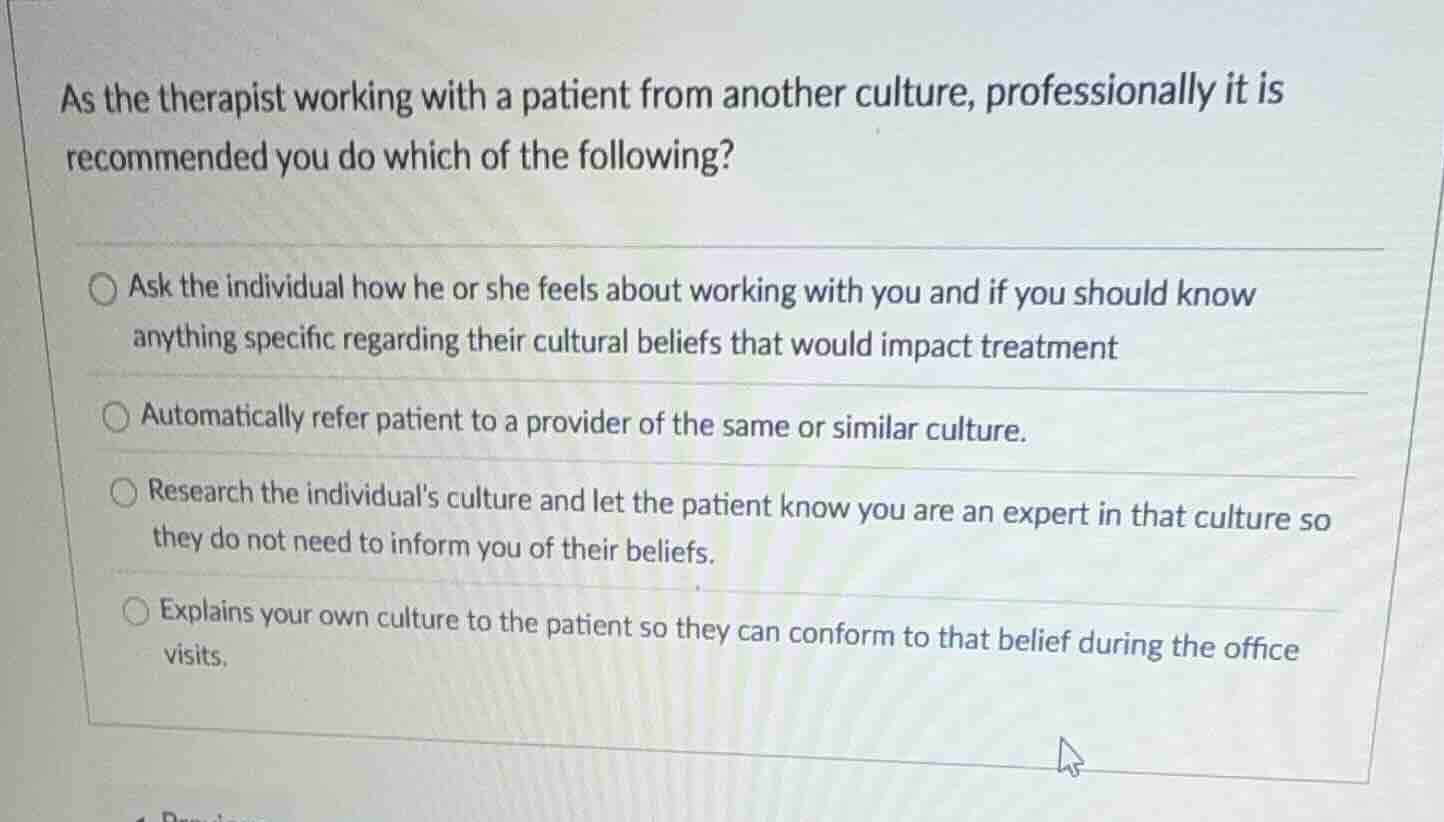
as the therapist working with a patient from another culture, professionally it is recommended you do which of the following?
- ask the individual how he or she feels about working with you and if you should know anything specific regarding their cultural beliefs that would impact treatment
- automatically refer patient to a provider of the same or similar culture.
- research the individuals culture and let the patient know you are an expert in that culture so they do not need to inform you of their beliefs.
- explains your own culture to the patient so they can conform to that belief during the office visits.
🆕 New Concept Discovered: Cultural Humility in Therapy
Collaborative, open inquiry over assumed expertise
Step 1: Analyze the core concept of cultural competence and humility
In clinical psychology and therapy, working with clients from diverse backgrounds requires cultural humility. This approach emphasizes:
- Openness and collaboration: Actively inviting the client to share their unique perspective rather than assuming we know everything about their background.
- Client-centered care: Recognizing the client as the expert on their own lived experience and cultural values.
- Avoiding assumptions: Not assuming that a client fits a generalized cultural stereotype.
Step 2: Evaluate the given options
- Option 1: "Ask the individual how he or she feels about working with you and if you should know anything specific regarding their cultural beliefs that would impact treatment"
- Analysis: This aligns perfectly with cultural humility. It establishes an open, collaborative therapeutic alliance, addresses potential concerns about cross-cultural dynamics, and invites the client to share what is personally meaningful to them.
- Option 2: "Automatically refer patient to a provider of the same or similar culture."
- Analysis: This is unnecessary and often impractical. Therapists are trained to work across cultures, and automatically referring someone away solely based on cultural differences can feel rejecting to the patient.
- Option 3: "Research the individual's culture and let the patient know you are an expert in that culture so they do not need to inform you of their beliefs."
- Analysis: Claiming "expertise" over someone else's culture is counterproductive. It shuts down communication and ignores the fact that individuals within any cultural group vary widely (intra-group diversity).
- Option 4: "Explains your own culture to the patient so they can conform to that belief during the office visits."
- Analysis: This is unethical and culturally insensitive. Therapy should be client-centered, not require the client to conform to the therapist's cultural norms.

Snap & solve any problem in the app
Get step-by-step solutions on Sovi AI
Photo-based solutions with guided steps
Explore more problems and detailed explanations
Ask the individual how he or she feels about working with you and if you should know anything specific regarding their cultural beliefs that would impact treatment