QUESTION IMAGE
Question
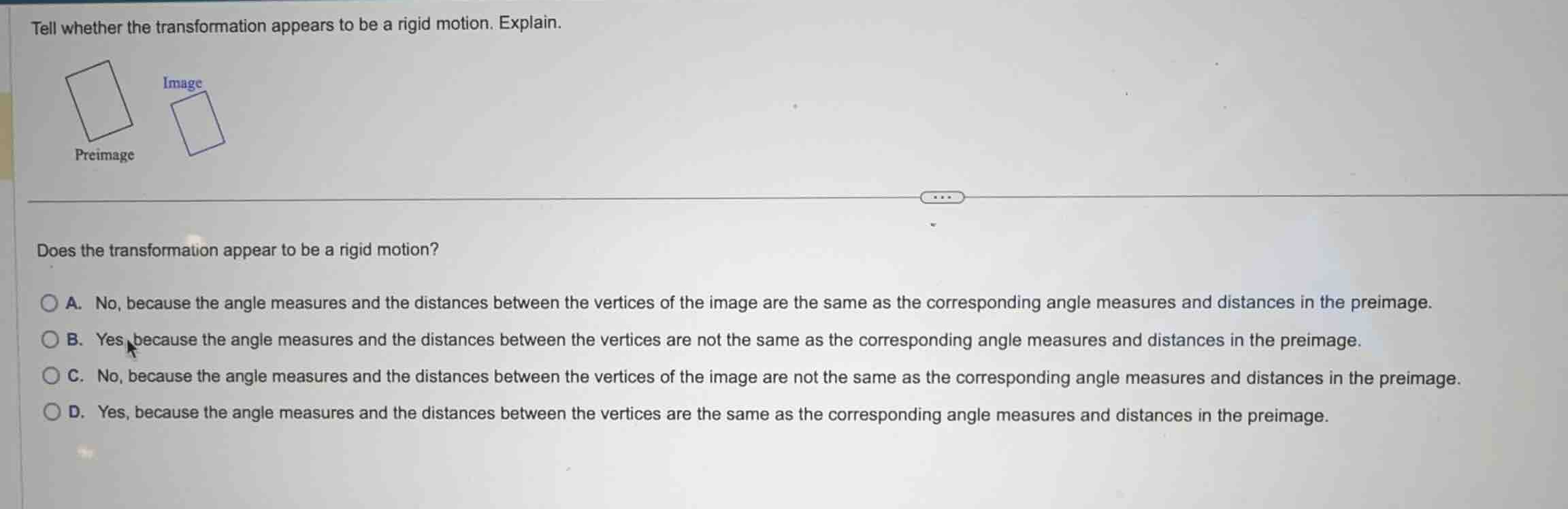
tell whether the transformation appears to be a rigid motion. explain.
preimage
image
does the transformation appear to be a rigid motion?
a. no, because the angle measures and the distances between the vertices of the image are the same as the corresponding angle measures and distances in the preimage.
b. yes, because the angle measures and the distances between the vertices are not the same as the corresponding angle measures and distances in the preimage.
c. no, because the angle measures and the distances between the vertices of the image are not the same as the corresponding angle measures and distances in the preimage.
d. yes, because the angle measures and the distances between the vertices are the same as the corresponding angle measures and distances in the preimage.
Analyze the preimage and image
The preimage and the image are congruent quadrilaterals that have the same shape and size. The transformation is a translation and a slight rotation, which preserves both lengths and angle measures.
Define rigid motion
A rigid motion is a transformation that preserves distance and angle measures, meaning the preimage and image are congruent.
Evaluate the given options
- Option A is incorrect because it states "No" while describing a rigid motion.
- Option B is incorrect because it states "Yes" but claims distances and angles are not preserved.
- Option C is incorrect because it states "No" and claims distances and angles are not preserved.
- Option D is correct because it states "Yes" and correctly explains that the angle measures and distances between the vertices are preserved.

Snap & solve any problem in the app
Get step-by-step solutions on Sovi AI
Photo-based solutions with guided steps
Explore more problems and detailed explanations
- A. No, because the angle measures and the distances between the vertices of the image are the same as the corresponding angle measures and distances in the preimage.
- B. Yes, because the angle measures and the distances between the vertices are not the same as the corresponding angle measures and distances in the preimage.
- C. No, because the angle measures and the distances between the vertices of the image are not the same as the corresponding angle measures and distances in the preimage.
- D. Yes, because the angle measures and the distances between the vertices are the same as the corresponding angle measures and distances in the preimage. (Correct answer)