QUESTION IMAGE
Question
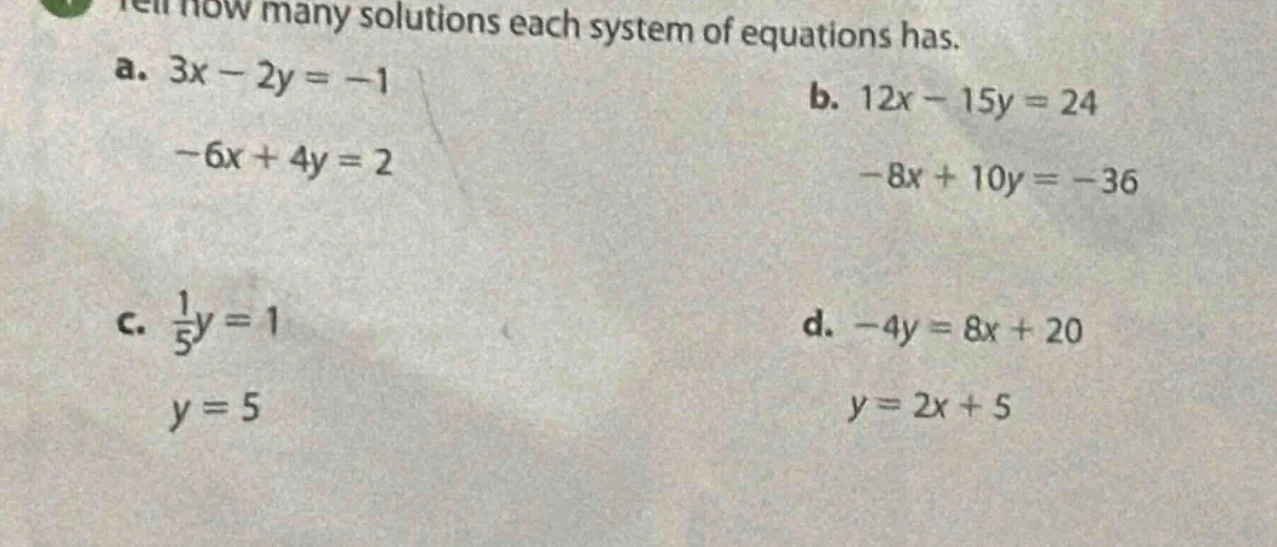
tell how many solutions each system of equations has.
a. $3x - 2y = -1$
$-6x + 4y = 2$
b. $12x - 15y = 24$
$-8x + 10y = -36$
c. $\frac{1}{5}y = 1$
$y = 5$
d. $-4y = 8x + 20$
$y = 2x + 5$
Part a
Step 1: Simplify the second equation
Notice that the second equation \(-6x + 4y = 2\) can be multiplied by \(-\frac{1}{2}\) to see its relation to the first equation.
Multiplying \(-6x + 4y = 2\) by \(-\frac{1}{2}\) gives \(3x - 2y=- 1\), which is identical to the first equation \(3x - 2y=-1\).
Step 2: Determine the number of solutions
When two equations in a system are identical, they represent the same line. So, there are infinitely many solutions.
Part b
Step 1: Analyze the slopes of the lines
Let's rewrite the equations in slope - intercept form \(y = mx + b\) (where \(m\) is the slope and \(b\) is the y - intercept).
For the first equation \(12x-15y = 24\), we have:
\(-15y=-12x + 24\)
\(y=\frac{-12x + 24}{-15}=\frac{4}{5}x-\frac{8}{5}\)
For the second equation \(-8x + 10y=-36\), we have:
\(10y = 8x-36\)
\(y=\frac{8x-36}{10}=\frac{4}{5}x-\frac{18}{5}\)
Step 2: Compare slopes and y - intercepts
The slopes of both lines are equal (\(m=\frac{4}{5}\)), but the y - intercepts (\(-\frac{8}{5}\) and \(-\frac{18}{5}\)) are different. This means the lines are parallel and never intersect. So, there are no solutions.
Part c
Step 1: Solve the first equation
For the equation \(\frac{1}{5}y = 1\), multiply both sides by 5:
\(y=1\times5 = 5\)
Step 2: Compare with the second equation
The second equation is \(y = 5\). Both equations represent the same horizontal line \(y = 5\). So, there are infinitely many solutions.
Part d

Snap & solve any problem in the app
Get step-by-step solutions on Sovi AI
Photo-based solutions with guided steps
Explore more problems and detailed explanations
s:
a. Infinitely many solutions
b. No solutions
c. Infinitely many solutions
d. One solution