QUESTION IMAGE
Question
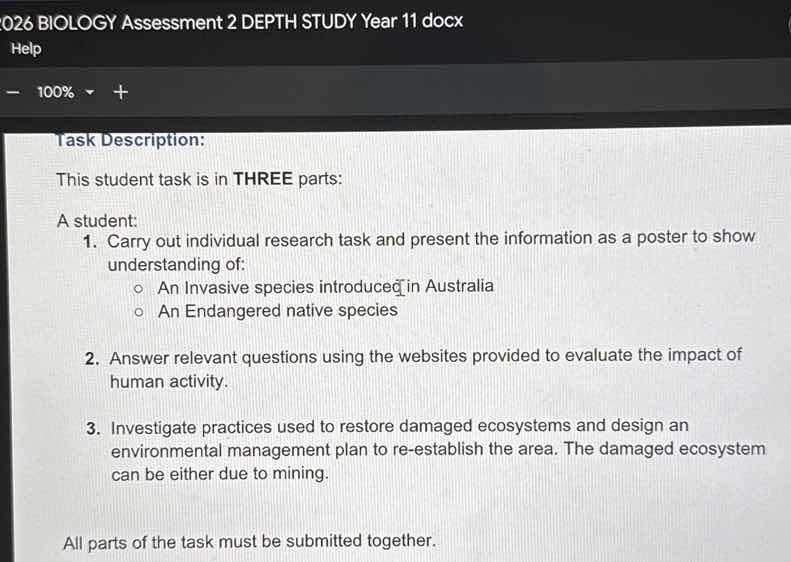
task description:
this student task is in three parts:
a student:
- carry out individual research task and present the information as a poster to show understanding of:
- an invasive species introduced in australia
- an endangered native species
- answer relevant questions using the websites provided to evaluate the impact of human activity.
- investigate practices used to restore damaged ecosystems and design an environmental management plan to re-establish the area. the damaged ecosystem can be either due to mining.
all parts of the task must be submitted together.
Analyze the task requirements
The document outlines a three-part biology depth study task for Year 11 students. To help a student tackle this assignment, we need to break down each part of the task description and provide a structured, actionable guide on how to complete it.
Outline Part 1: Poster design
Part 1 requires researching and presenting a poster on:
- An invasive species introduced in Australia (e.g., Cane Toad, European Rabbit, or Prickly Pear).
- An endangered native species (e.g., Bilby, Koala, or Regent Honeyeater).
The poster should visually and textually compare their ecological impacts, adaptations, and population pressures.
Outline Part 2: Evaluating human impact
Part 2 requires answering questions using provided web resources to evaluate how human activities (such as land clearing, urbanization, or agriculture) affect these species and their broader ecosystems.
Outline Part 3: Restoration plan
Part 3 requires investigating ecological restoration practices and designing an environmental management plan to re-establish a damaged ecosystem, specifically focusing on an area degraded by mining activities.
Synthesize guidance
Provide a clear, step-by-step framework that a high school student can follow to successfully complete all three components of this assessment.

Snap & solve any problem in the app
Get step-by-step solutions on Sovi AI
Photo-based solutions with guided steps
Explore more problems and detailed explanations
To successfully complete this Year 11 Biology Depth Study, you can follow this structured guide to address each of the three required parts:
Part 1: Research & Poster Presentation
Select one invasive species and one endangered native Australian species to research.
- Invasive Species Examples: Cane Toad (Rhinella marina), European Wild Rabbit (Oryctolagus cuniculus), or Red Fox (Vulpes vulpes).
- Endangered Native Species Examples: Greater Bilby (Macrotis lagotis), Koala (Phascolarctos cinereus), or Regent Honeyeater (Anthochaera phrygia).
Poster Layout Strategy
- Introduction: Define what makes a species "invasive" versus "endangered" in the Australian context.
- Invasive Species Profile: Detail its origin, introduction method, adaptations that allow it to thrive, and its negative impacts on local food webs and biodiversity.
- Endangered Species Profile: Detail its habitat, ecological niche, adaptations, and the specific threats causing its decline (e.g., habitat loss, feral predators).
- Visuals: Include distribution maps, food web diagrams showing altered trophic pathways, and clear images of both species.
---
Part 2: Evaluating Human Activity Impact
Use the research links provided by your teacher to analyze how human actions alter ecosystems. Focus your evaluation on:
- Habitat Fragmentation: How roads, agriculture, and urban development isolate native populations.
- Introduced Pressures: How human-mediated introduction of feral species disrupts native predator-prey dynamics.
- Data Analysis: Extract population trends, distribution changes, and statistical evidence from the websites to support your arguments.
---
Part 3: Environmental Management Plan (Mining Site Restoration)
Design a management plan to restore a terrestrial ecosystem damaged by mining activities (such as open-cut coal or mineral sand mining).
Key Components of Your Plan
- Site Assessment: Describe the physical damage (soil compaction, removal of topsoil, loss of vegetation canopy).
- Landform Reconstruction: Outline steps to re-shape the landscape, stabilize slopes, and prevent erosion.
- Soil Rehabilitation: Detail how topsoil will be replaced or enriched with organic matter and essential microbes to support plant life.
- Revegetation: Select native pioneer plant species that can tolerate harsh conditions, followed by secondary successional species to rebuild the canopy.
- Fauna Return & Monitoring: Describe how to encourage native wildlife to return (e.g., installing nesting boxes) and establish a long-term monitoring schedule to measure biodiversity recovery.