QUESTION IMAGE
Question
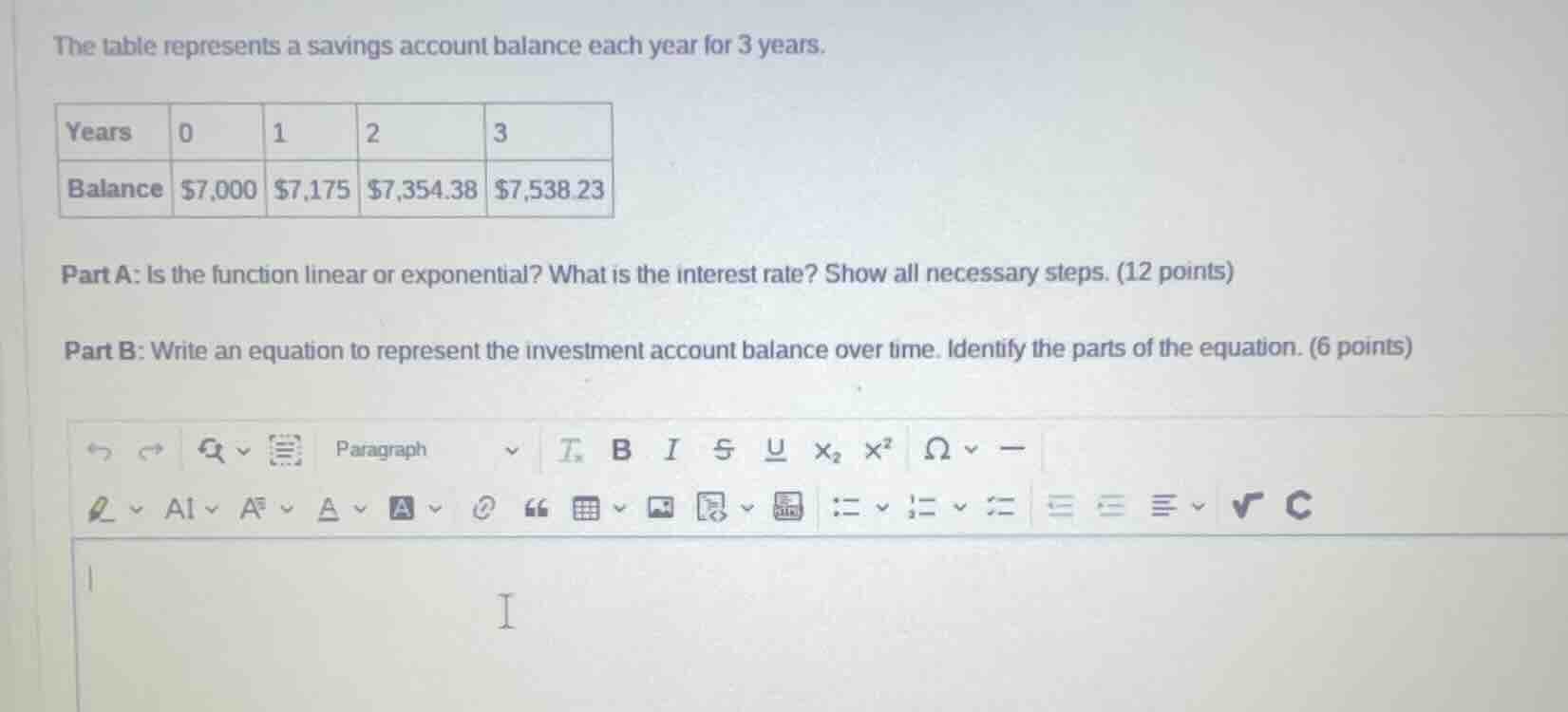
the table represents a savings account balance each year for 3 years.
\
$$\begin{tabular}{|l|l|l|l|l|}
\\hline
years & 0 & 1 & 2 & 3 \\\\
\\hline
balance & \\$7,000 & \\$7,175 & \\$7,354.38 & \\$7,538.23 \\\\
\\hline
\\end{tabular}$$
part a: is the function linear or exponential? what is the interest rate? show all necessary steps. (12 points)
part b: write an equation to represent the investment account balance over time. identify the parts of the equation. (6 points)
Determine function type
Using the Compound Interest Formula knowledge point
$$
LATEXBLOCK0
$$
The constant ratio indicates an exponential function.
Calculate interest rate
Using the Compound Interest Formula knowledge point
$$
LATEXBLOCK1
$$
Formulate the equation
Using the Compound Interest Formula knowledge point
$$
A(t) = 7000(1.025)^t
$$
Identify equation parts
Using the Compound Interest Formula knowledge point
- \(A(t)\): Balance after \(t\) years.
- \(7000\): Initial principal balance.
- \(1.025\): Growth factor.
- \(t\): Time in years.

Snap & solve any problem in the app
Get step-by-step solutions on Sovi AI
Photo-based solutions with guided steps
Explore more problems and detailed explanations
Part A
- Function Type: Exponential, because the balance increases by a constant multiplier of \(1.025\) each year rather than a constant addition.
- Interest Rate: \(2.5\%\) per year.
Part B
- Equation: \(A(t) = 7000(1.025)^t\)
- Parts of the Equation:
- \(A(t)\) represents the account balance after \(t\) years.
- \(7000\) represents the initial deposit (principal amount).
- \(1.025\) represents the growth factor (where \(1 + 0.025\) accounts for the \(2.5\%\) annual interest rate).
- \(t\) represents the time elapsed in years.