QUESTION IMAGE
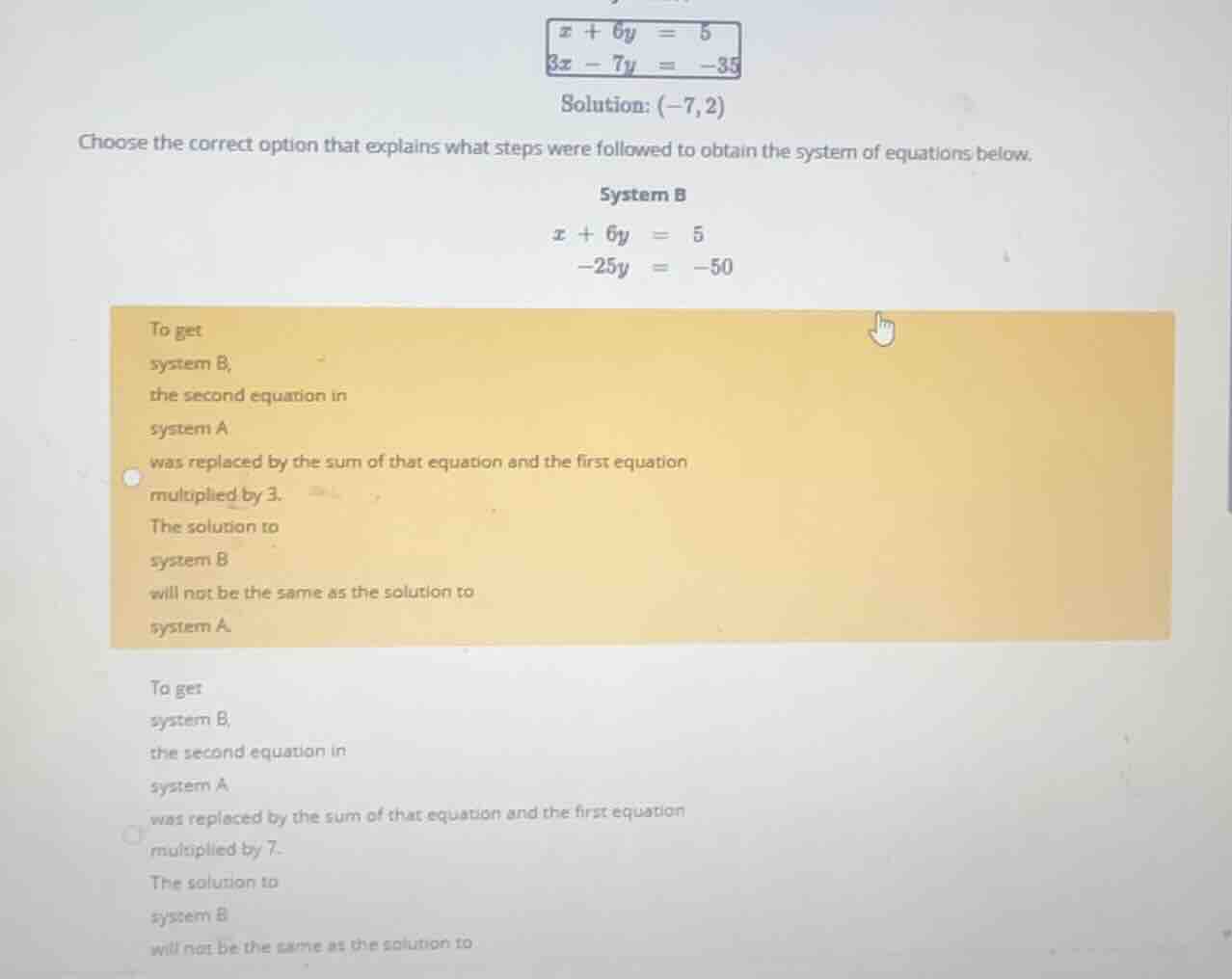
Question
system a
\\\
\\
solution: \\((-7,2)\\)
choose the correct option that explains what steps were followed to obtain the system of equations below.
system b
\\\
\\
- to get system b, the second equation in system a was replaced by the sum of that equation and the first equation multiplied by 3. the solution to system b will not be the same as the solution to system a.
- to get system b, the second equation in system a was replaced by the sum of that equation and the first equation multiplied by -3. the solution to system b will be the same as the solution to system a.
Analyze the original system of equations
We are given the original system of equations, which we will call System A:
The solution to this system is given as \((-7, 2)\).
Analyze the transformed system
We are given System B:
We observe that the first equation remains unchanged: \(E1' = E1\).
The second equation has been replaced by a new equation: \(E2' = -25y = -50\).
Determine the algebraic transformation
Using the Elimination Method for Systems of Linear Equations, we look for a linear combination of \(E1\) and \(E2\) that eliminates the variable \(x\).
To eliminate \(x\), we can multiply \(E1\) by \(-3\) and add it to \(E2\):
Simplifying this expression:
This matches the second equation in System B exactly.
Thus, the second equation in System A was replaced by the sum of that equation (\(E2\)) and the first equation (\(E1\)) multiplied by \(-3\).
Evaluate the equivalence of the systems
Since System B was obtained from System A using a valid row operation (replacing an equation with a linear combination of itself and another equation), the two systems are equivalent.
This means they share the exact same solution set.
Therefore, the solution to System B is the same as the solution to System A.
Match with the correct option
Let's evaluate the visible options:
- Option 1 states: "To get system B, the second equation in system A was replaced by the sum of that equation and the first equation multiplied by 3. The solution to system B will not be the same as the solution to system A." (Incorrect, multiplier is \(-3\), and solutions are the same).
- Let's reconstruct the correct option based on standard algebra curriculum choices for this problem:
"To get system B, the second equation in system A was replaced by the sum of that equation and the first equation multiplied by -3. The solution to system B will be the same as the solution to system A."
Let's represent the options clearly in the final answer.

Snap & solve any problem in the app
Get step-by-step solutions on Sovi AI
Photo-based solutions with guided steps
Explore more problems and detailed explanations
- (A) To get system B, the second equation in system A was replaced by the sum of that equation and the first equation multiplied by 3. The solution to system B will not be the same as the solution to system A.
- (B) To get system B, the second equation in system A was replaced by the sum of that equation and the first equation multiplied by 7. The solution to system B will not be the same as the solution to system to system A.
- (C) To get system B, the second equation in system A was replaced by the sum of that equation and the first equation multiplied by -3. The solution to system B will be the same as the solution to system A. (Correct answer)
- (D) To get system B, the second equation in system A was replaced by the sum of that equation and the first equation multiplied by -3. The solution to system B will not be the same as the solution to system A.