QUESTION IMAGE
Question
svlc algebra 1a - standard (15260)
representing relationships
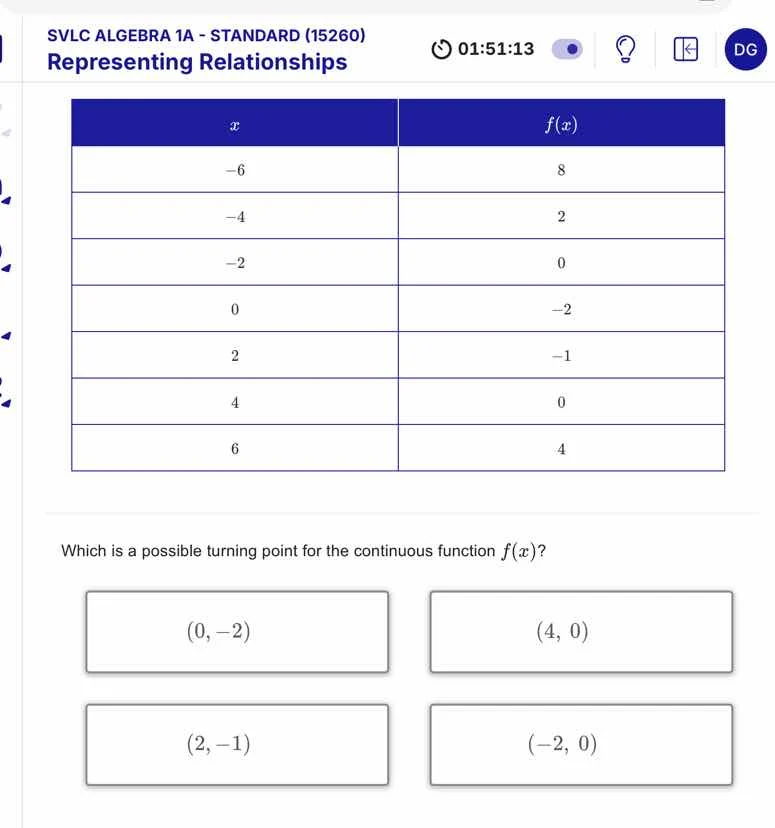
| $x$ | $f(x)$ |
|---|---|
| $-4$ | $2$ |
| $-2$ | $0$ |
| $0$ | $-2$ |
| $2$ | $-1$ |
| $4$ | $0$ |
| $6$ | $4$ |
which is a possible turning point for the continuous function $f(x)$?
options:
$(0, -2)$
$(4, 0)$
$(2, -1)$
$(-2, 0)$
Step1: Understand Turning Point
A turning point of a function is a point where the function changes its direction (from increasing to decreasing or vice - versa). To identify a possible turning point, we analyze the behavior of the function (increasing or decreasing) around each given point by looking at the values of \(x\) and \(f(x)\) in the table.
Step2: Analyze Behavior Around (0, - 2)
- For \(x=-2\), \(f(-2) = 0\); for \(x = 0\), \(f(0)=-2\); for \(x = 2\), \(f(2)=-1\).
- From \(x=-2\) to \(x = 0\) (moving from left to right, \(x\) increases), \(f(x)\) changes from \(0\) to \(-2\) (decreasing). From \(x = 0\) to \(x = 2\), \(f(x)\) changes from \(-2\) to \(-1\) (increasing). So the function changes from decreasing to increasing at \(x = 0\)? Wait, no, let's check other points.
Step3: Analyze Behavior Around (4, 0)
- For \(x = 2\), \(f(2)=-1\); for \(x = 4\), \(f(4)=0\); for \(x = 6\), \(f(6)=4\).
- From \(x = 2\) to \(x = 4\), \(f(x)\) changes from \(-1\) to \(0\) (increasing). From \(x = 4\) to \(x = 6\), \(f(x)\) changes from \(0\) to \(4\) (increasing). So the function is increasing on both sides of \(x = 4\), not a turning point.
Step4: Analyze Behavior Around (2, - 1)
- For \(x = 0\), \(f(0)=-2\); for \(x = 2\), \(f(2)=-1\); for \(x = 4\), \(f(4)=0\).
- From \(x = 0\) to \(x = 2\), \(f(x)\) changes from \(-2\) to \(-1\) (increasing). From \(x = 2\) to \(x = 4\), \(f(x)\) changes from \(-1\) to \(0\) (increasing). So the function is increasing on both sides of \(x = 2\), not a turning point.
Step5: Analyze Behavior Around (- 2, 0)
- For \(x=-4\), \(f(-4) = 2\); for \(x=-2\), \(f(-2)=0\); for \(x = 0\), \(f(0)=-2\).
- From \(x=-4\) to \(x=-2\) (increasing \(x\)), \(f(x)\) changes from \(2\) to \(0\) (decreasing). From \(x=-2\) to \(x = 0\) (increasing \(x\)), \(f(x)\) changes from \(0\) to \(-2\) (decreasing). Wait, no, let's re - evaluate the behavior around (2, - 1) again. Wait, maybe we made a mistake. Let's check the slope (rate of change) between points.
The slope between two points \((x_1,y_1)\) and \((x_2,y_2)\) is \(m=\frac{y_2 - y_1}{x_2 - x_1}\)
- Between \((-2,0)\) and \((0,-2)\): \(m=\frac{-2 - 0}{0-(-2)}=\frac{-2}{2}=-1\) (decreasing)
- Between \((0,-2)\) and \((2,-1)\): \(m=\frac{-1-(-2)}{2 - 0}=\frac{1}{2}\) (increasing)
- Between \((2,-1)\) and \((4,0)\): \(m=\frac{0 - (-1)}{4 - 2}=\frac{1}{2}\) (increasing)
- Between \((4,0)\) and \((6,4)\): \(m=\frac{4 - 0}{6 - 4}=\frac{4}{2}=2\) (increasing)
- Between \((-4,2)\) and \((-2,0)\): \(m=\frac{0 - 2}{-2-(-4)}=\frac{-2}{2}=-1\) (decreasing)
- Between \((-6,8)\) and \((-4,2)\): \(m=\frac{2 - 8}{-4-(-6)}=\frac{-6}{2}=-3\) (decreasing)
Wait, the function changes from decreasing (from \(x=-6\) to \(x = 0\) with slopes negative) to increasing (from \(x = 0\) to \(x = 6\) with slopes positive)? No, from \(x = 0\) to \(x = 2\) slope is \(1/2\), \(x = 2\) to \(x = 4\) slope is \(1/2\), \(x = 4\) to \(x = 6\) slope is \(2\). But around \((2,-1)\): before \((2,-1)\) (from \(0,-2\) to \(2,-1\)) the slope is \(1/2\) (increasing), after \((2,-1)\) (from \(2,-1\) to \(4,0\)) the slope is \(1/2\) (still increasing). Around \((4,0)\): before (from \(2,-1\) to \(4,0\)) slope \(1/2\) (increasing), after (from \(4,0\) to \(6,4\)) slope \(2\) (increasing). Around \((-2,0)\): before (from \(-4,2\) to \(-2,0\)) slope \(-1\) (decreasing), after (from \(-2,0\) to \(0,-2\)) slope \(-1\) (decreasing). Around \((0,-2)\): before (from \(-2,0\) to \(0,-2\)) slope \(-1\) (decreasing), after (from \(0,-2\) to \(2,-1\)) slope \(1/2\) (increasing). Ah! So at \(x = 0\), the f…

Snap & solve any problem in the app
Get step-by-step solutions on Sovi AI
Photo-based solutions with guided steps
Explore more problems and detailed explanations
\((0,-2)\)