QUESTION IMAGE
Question
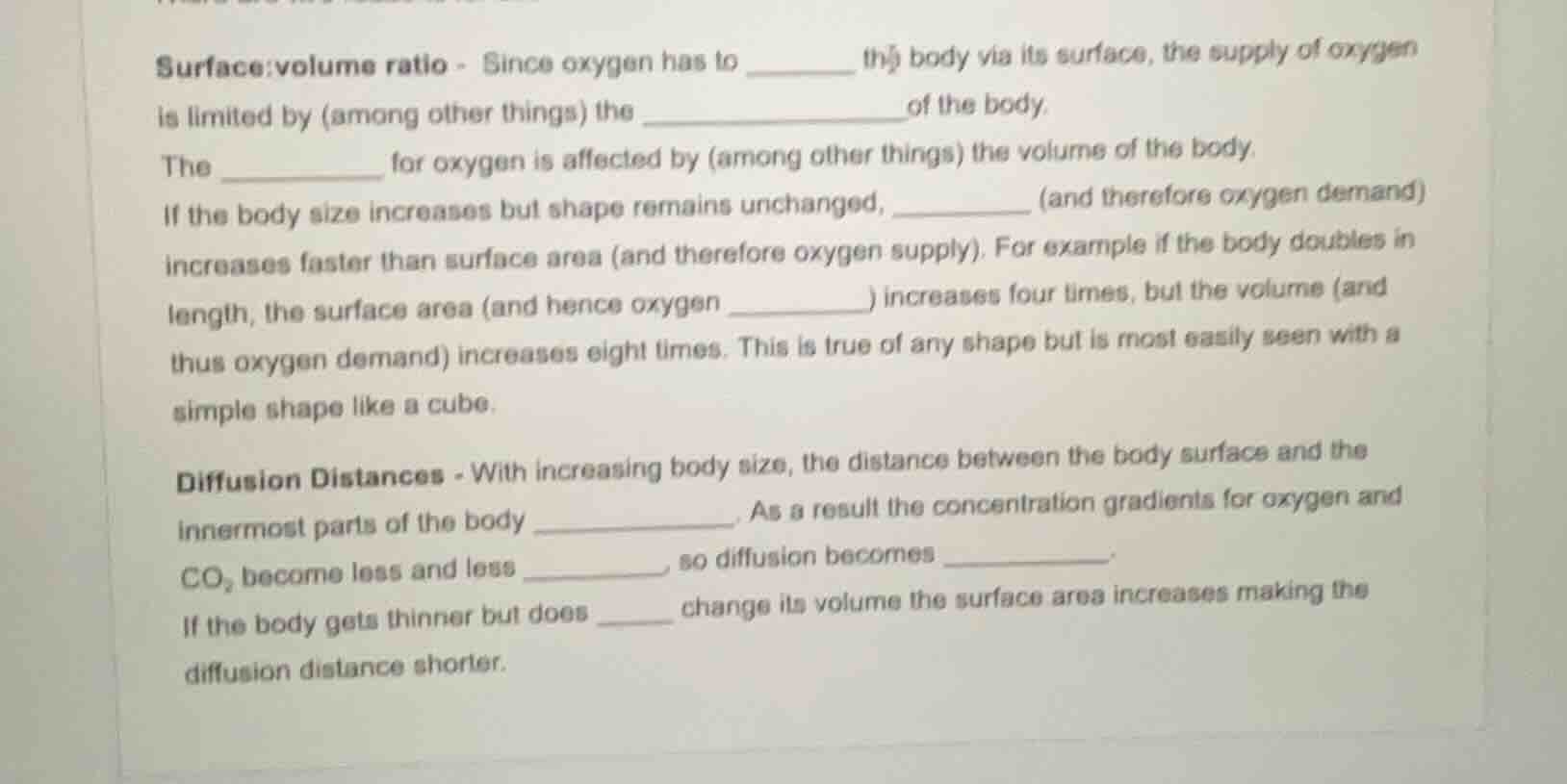
surface:volume ratio - since oxygen has to ______ the body via its surface, the supply of oxygen is limited by (among other things) the ______ of the body.
the ________ for oxygen is affected by (among other things) the volume of the body.
if the body size increases but shape remains unchanged, ______ (and therefore oxygen demand) increases faster than surface area (and therefore oxygen supply). for example if the body doubles in length, the surface area (and hence oxygen ______) increases four times, but the volume (and thus oxygen demand) increases eight times. this is true of any shape but is most easily seen with a simple shape like a cube.
diffusion distances - with increasing body size, the distance between the body surface and the innermost parts of the body ______. as a result the concentration gradients for oxygen and \\(\text{co}_2\\) become less and less ____ so diffusion becomes ______.
if the body gets thinner but does ________ change its volume the surface area increases making the diffusion distance shorter.
Analyze surface area to volume ratio
We apply the concept of Surface Area to Volume Ratio to fill in the first paragraph.
- Oxygen must enter or penetrate the body via its surface, so the first blank is "enter" (or "diffuse into").
- The supply of oxygen is limited by the surface area of the body.
- The demand for oxygen is affected by the volume of the body.
- If body size increases but shape remains unchanged, volume (and therefore oxygen demand) increases faster than surface area (and therefore oxygen supply).
- If the body doubles in length, the surface area (and hence oxygen supply) increases four times, but the volume (and thus oxygen demand) increases eight times.
Analyze diffusion distances
We apply the concept of Gas Exchange and diffusion principles to fill in the second paragraph.
- With increasing body size, the distance between the body surface and the innermost parts of the body increases.
- As a result, the concentration gradients for oxygen and \(CO_2\) become less and less steep, so diffusion becomes slower (or less efficient).
- If the body gets thinner but does not change its volume, the surface area increases, making the diffusion distance shorter.

Snap & solve any problem in the app
Get step-by-step solutions on Sovi AI
Photo-based solutions with guided steps
Explore more problems and detailed explanations
Surface:volume ratio - Since oxygen has to <blank>enter</blank> the body via its surface, the supply of oxygen is limited by (among other things) the <blank>surface area</blank> of the body.
The <blank>demand</blank> for oxygen is affected by (among other things) the volume of the body.
If the body size increases but shape remains unchanged, <blank>volume</blank> (and therefore oxygen demand) increases faster than surface area (and therefore oxygen supply). For example if the body doubles in length, the surface area (and hence oxygen <blank>supply</blank>) increases four times, but the volume (and thus oxygen demand) increases eight times. This is true of any shape but is most easily seen with a simple shape like a cube.
Diffusion Distances - With increasing body size, the distance between the body surface and the innermost parts of the body <blank>increases</blank>. As a result the concentration gradients for oxygen and \(\text{CO}_2\) become less and less <blank>steep</blank> so diffusion becomes <blank>slower</blank>.
If the body gets thinner but does not <blank>change</blank> its volume the surface area increases making the diffusion distance shorter.