QUESTION IMAGE
Question
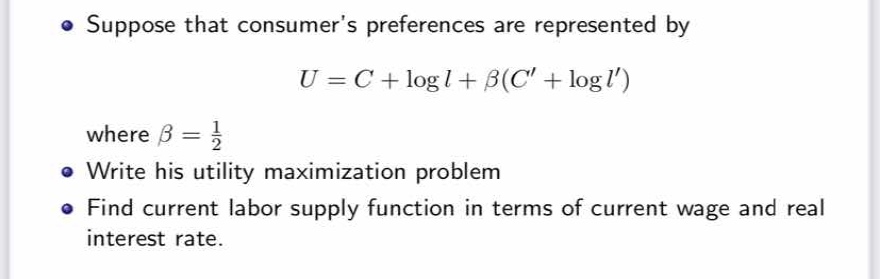
suppose that consumers preferences are represented by
\\u = c + \log l + \beta(c + \log l)\\
where \\(\beta = \frac{1}{2}\\)
- write his utility maximization problem
- find current labor supply function in terms of current wage and real interest rate.
Formulate the intertemporal budget constraint
The consumer lives for two periods (current and future). In each period, they have a time endowment of \(h\) which is split between labor \(N\) (or \(N'\)) and leisure \(l\) (or \(l'\)), so \(N = h - l\) and \(N' = h - l'\).
Let \(w\) be the current real wage, \(w'\) be the future real wage, \(T\) be the current real tax, \(T'\) be the future real tax, and \(r\) be the real interest rate.
The lifetime budget constraint is:
Rearranging this gives the standard formulation of the lifetime budget constraint:
Let \(we\) denote the consumer's lifetime wealth:
Write the utility maximization problem
Using the Utility Maximization and Two-Period Macroeconomic Model concepts, we formulate the optimization problem. The consumer chooses current consumption \(C\), future consumption \(C'\), current leisure \(l\), and future leisure \(l'\) to maximize lifetime utility subject to the lifetime budget constraint:
where \(\beta = \frac{1}{2}\).
Solve for current leisure using marginal conditions
To find the optimal choices, we equate the marginal rate of substitution between current leisure and current consumption to their relative price (the wage rate \(w\)):
The relative price of leisure in terms of consumption is the real wage \(w\). Thus, the optimality condition is:
Derive the current labor supply function
Since the total time endowment is \(h\), the current labor supply \(N^s\) is the remaining time after choosing leisure:
Substituting the optimal leisure \(l = \frac{1}{w}\) into the labor supply equation yields:
This function shows that current labor supply depends positively on the current wage \(w\) and is independent of the real interest rate \(r\) due to the quasi-linear utility structure.

Snap & solve any problem in the app
Get step-by-step solutions on Sovi AI
Photo-based solutions with guided steps
Explore more problems and detailed explanations
Question 1
The utility maximization problem is:
Question 2
The current labor supply function is: