QUESTION IMAGE
Question
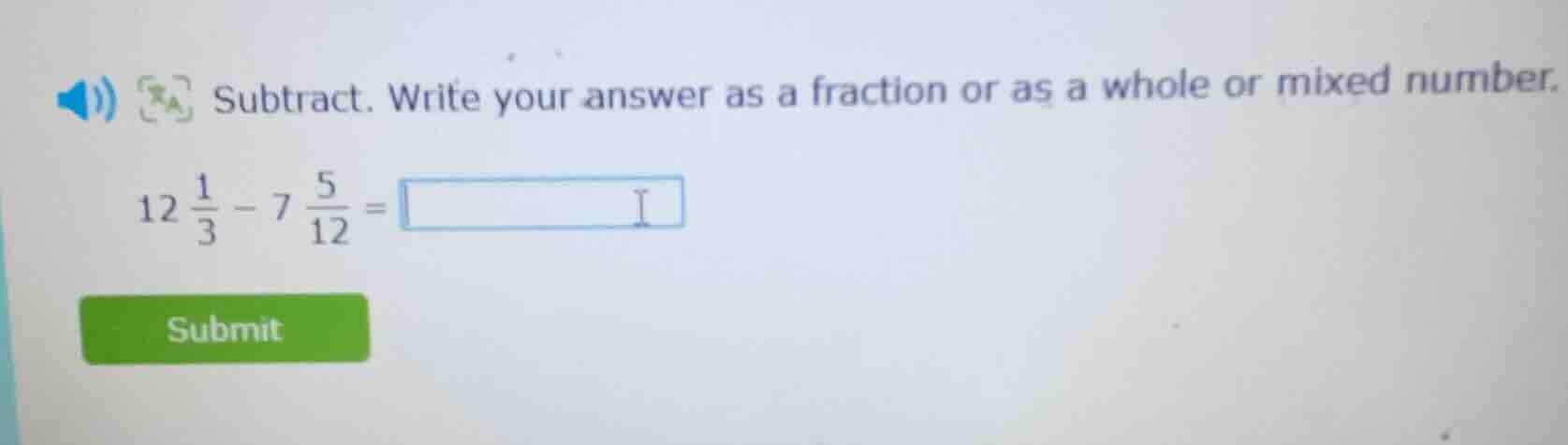
subtract. write your answer as a fraction or as a whole or mixed number. 12\frac{1}{3} - 7\frac{5}{12} = \square
Step1: Convert mixed numbers to improper fractions
First, convert \(12\frac{1}{3}\) to an improper fraction. The formula for converting a mixed number \(a\frac{b}{c}\) to an improper fraction is \(\frac{a\times c + b}{c}\). So for \(12\frac{1}{3}\), we have \(a = 12\), \(b = 1\), \(c = 3\). Then \(12\frac{1}{3}=\frac{12\times3 + 1}{3}=\frac{36 + 1}{3}=\frac{37}{3}\).
Next, convert \(7\frac{5}{12}\) to an improper fraction. Using the same formula, \(a = 7\), \(b = 5\), \(c = 12\). So \(7\frac{5}{12}=\frac{7\times12 + 5}{12}=\frac{84 + 5}{12}=\frac{89}{12}\).
Step2: Find a common denominator
The denominators are 3 and 12. The least common denominator (LCD) of 3 and 12 is 12. So we need to convert \(\frac{37}{3}\) to a fraction with denominator 12. To do this, multiply the numerator and denominator by 4 (since \(12\div3 = 4\)). So \(\frac{37}{3}=\frac{37\times4}{3\times4}=\frac{148}{12}\).
Step3: Subtract the fractions
Now we have \(\frac{148}{12}-\frac{89}{12}\). When subtracting fractions with the same denominator, we subtract the numerators and keep the denominator the same. So \(\frac{148 - 89}{12}=\frac{59}{12}\).
Step4: Convert back to a mixed number (if needed)
Now convert \(\frac{59}{12}\) to a mixed number. Divide 59 by 12: \(12\times4 = 48\), \(59 - 48 = 11\). So \(\frac{59}{12}=4\frac{11}{12}\)? Wait, no, wait. Wait, originally we had \(12\frac{1}{3}-7\frac{5}{12}\). Let's check again. Maybe a better way is to subtract the whole numbers and the fractions separately, but we need to borrow if the fraction part of the minuend is less than the fraction part of the subtrahend.
Let's try that method. \(12\frac{1}{3}=11 + 1\frac{1}{3}=11+\frac{4}{12}\) (since \(\frac{1}{3}=\frac{4}{12}\)). Then \(11\frac{4}{12}-7\frac{5}{12}\)? Wait, no, that's not right. Wait, \(12\frac{1}{3}=11 + 1 + \frac{1}{3}=11+\frac{3}{3}+\frac{1}{3}=11+\frac{4}{3}\)? No, better to do:
\(12\frac{1}{3}=12+\frac{1}{3}\), \(7\frac{5}{12}=7+\frac{5}{12}\).
Subtract the whole numbers: \(12 - 7 = 5\).
Subtract the fractions: \(\frac{1}{3}-\frac{5}{12}\). But \(\frac{1}{3}=\frac{4}{12}\), so \(\frac{4}{12}-\frac{5}{12}=-\frac{1}{12}\). So we need to borrow 1 from the whole number part. So \(12\frac{1}{3}=11 + 1+\frac{1}{3}=11+\frac{3}{3}+\frac{1}{3}=11+\frac{4}{3}\)? Wait, no, \(12\frac{1}{3}=11 + (1+\frac{1}{3})=11+\frac{4}{3}\)? No, \(12\frac{1}{3}=11 + \frac{4}{3}\) is wrong. Wait, \(12\frac{1}{3}=11 + 1\frac{1}{3}=11+\frac{4}{3}\)? No, \(1\frac{1}{3}=\frac{4}{3}\), so yes. Then \(11\frac{4}{3}-7\frac{5}{12}\). Now subtract the whole numbers: \(11 - 7 = 4\). Subtract the fractions: \(\frac{4}{3}-\frac{5}{12}\). Convert \(\frac{4}{3}\) to twelfths: \(\frac{16}{12}\). Then \(\frac{16}{12}-\frac{5}{12}=\frac{11}{12}\). Then the whole number part is 4, so \(4+\frac{11}{12}=4\frac{11}{12}\)? Wait, but earlier when we did improper fractions, we got \(\frac{59}{12}\), and \(\frac{59}{12}=4\frac{11}{12}\)? Wait, no, \(12\times4 = 48\), \(59 - 48 = 11\), so \(\frac{59}{12}=4\frac{11}{12}\). Wait, but let's check with the first method. Wait, when we did \(12\frac{1}{3}=\frac{37}{3}=\frac{148}{12}\), \(7\frac{5}{12}=\frac{89}{12}\), then \(\frac{148}{12}-\frac{89}{12}=\frac{59}{12}\). Then \(\frac{59}{12}=4\frac{11}{12}\) (since \(12\times4 = 48\), \(59 - 48 = 11\)). But wait, \(12 - 7 = 5\), but we had to borrow 1, so \(5 - 1 = 4\), and the fraction part is \(\frac{4}{12}-\frac{5}{12}=-\frac{1}{12}\), so we borrow 1 from the 5, making it 4, and add \(\frac{12}{12}\) to the fraction, so \(\frac{4}{12}+\frac{12}{12}=\frac{16}{12}\), then \(\frac{16}{12}-\…

Snap & solve any problem in the app
Get step-by-step solutions on Sovi AI
Photo-based solutions with guided steps
Explore more problems and detailed explanations
\(4\frac{11}{12}\)