QUESTION IMAGE
Question
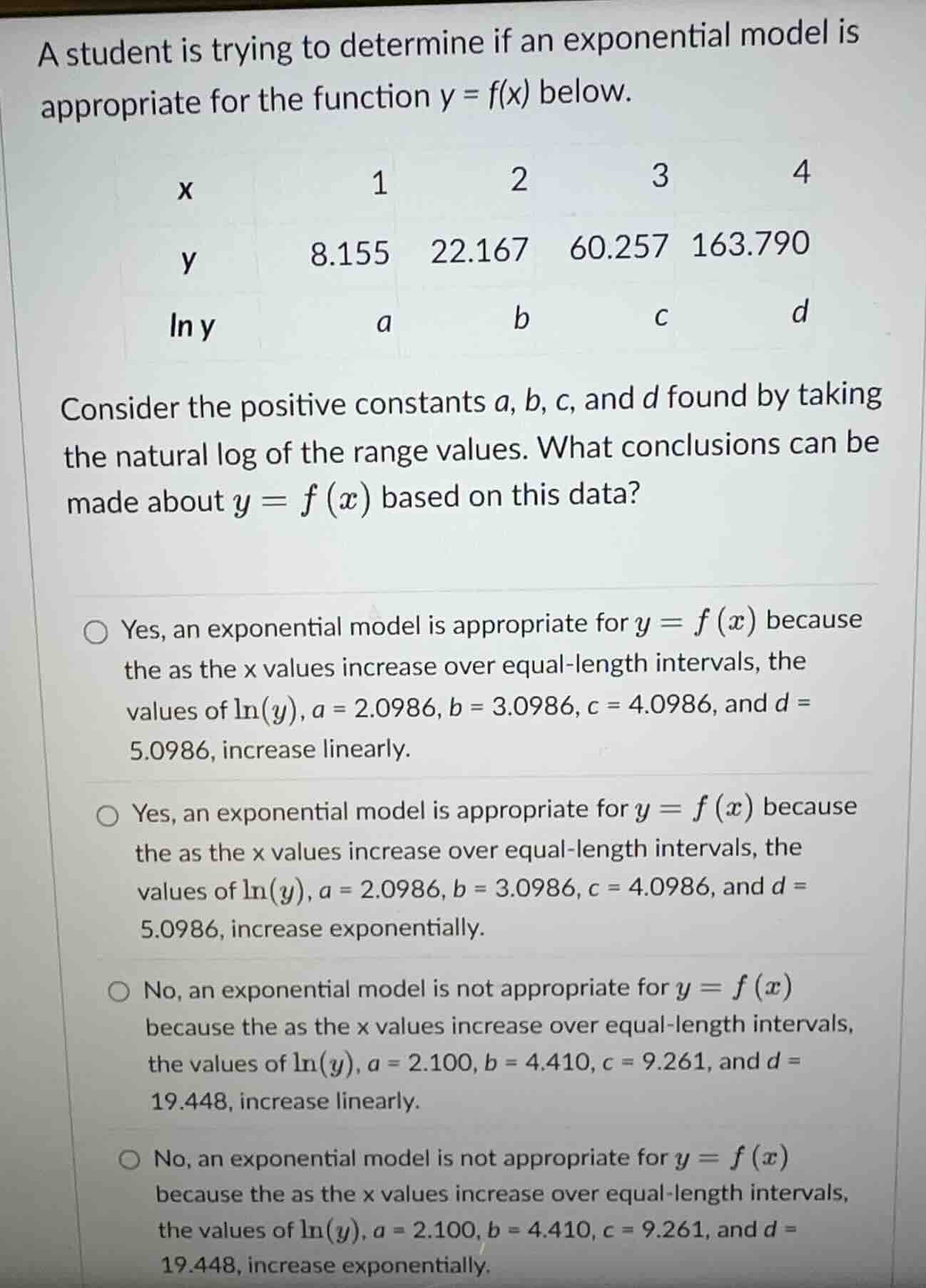
a student is trying to determine if an exponential model is appropriate for the function \\(y = f(x)\\) below.
\\(\
$$\begin{array}{ccccc} x & 1 & 2 & 3 & 4 \\\\ y & 8.155 & 22.167 & 60.257 & 163.790 \\\\ \\ln y & a & b & c & d \\end{array}$$
\\)
consider the positive constants \\(a\\), \\(b\\), \\(c\\), and \\(d\\) found by taking the natural log of the range values. what conclusions can be made about \\(y = f(x)\\) based on this data?
- yes, an exponential model is appropriate for \\(y = f(x)\\) because as the \\(x\\) values increase over equal-length intervals, the values of \\(\ln(y)\\), \\(a = 2.0986\\), \\(b = 3.0986\\), \\(c = 4.0986\\), and \\(d = 5.0986\\), increase linearly.
- yes, an exponential model is appropriate for \\(y = f(x)\\) because as the \\(x\\) values increase over equal-length intervals, the values of \\(\ln(y)\\), \\(a = 2.0986\\), \\(b = 3.0986\\), \\(c = 4.0986\\), and \\(d = 5.0986\\), increase exponentially.
- no, an exponential model is not appropriate for \\(y = f(x)\\) because as the \\(x\\) values increase over equal-length intervals, the values of \\(\ln(y)\\), \\(a = 2.100\\), \\(b = 4.410\\), \\(c = 9.261\\), and \\(d = 19.448\\), increase linearly.
- no, an exponential model is not appropriate for \\(y = f(x)\\) because as the \\(x\\) values increase over equal-length intervals, the values of \\(\ln(y)\\), \\(a = 2.100\\), \\(b = 4.410\\), \\(c = 9.261\\), and \\(d = 19.448\\), increase exponentially.
Calculate natural logarithms of y
Using the Logarithmic Models and Exponential Equations knowledge points
$$
LATEXBLOCK0
$$
Analyze the rate of change
Using the Exponential Equations knowledge point
$$
LATEXBLOCK1
$$
Determine model appropriateness
Using the Logarithmic Models knowledge point
$$
LATEXBLOCK2
$$

Snap & solve any problem in the app
Get step-by-step solutions on Sovi AI
Photo-based solutions with guided steps
Explore more problems and detailed explanations
- (A) Yes, an exponential model is appropriate for \(y = f(x)\) because the as the \(x\) values increase over equal-length intervals, the values of \(\ln(y)\), \(a = 2.0986\), \(b = 3.0986\), \(c = 4.0986\), and \(d = 5.0986\), increase linearly. (Correct answer)
- (B) Yes, an exponential model is appropriate for \(y = f(x)\) because the as the \(x\) values increase over equal-length intervals, the values of \(\ln(y)\), \(a = 2.0986\), \(b = 3.0986\), \(c = 4.0986\), and \(d = 5.0986\), increase exponentially.
- (C) No, an exponential model is not appropriate for \(y = f(x)\) because the as the \(x\) values increase over equal-length intervals, the values of \(\ln(y)\), \(a = 2.100\), \(b = 4.410\), \(c = 9.261\), and \(d = 19.448\), increase linearly.
- (D) No, an exponential model is not appropriate for \(y = f(x)\) because the as the \(x\) values increase over equal-length intervals, the values of \(\ln(y)\), \(a = 2.100\), \(b = 4.410\), \(c = 9.261\), and \(d = 19.448\), increase exponentially.