QUESTION IMAGE
Question
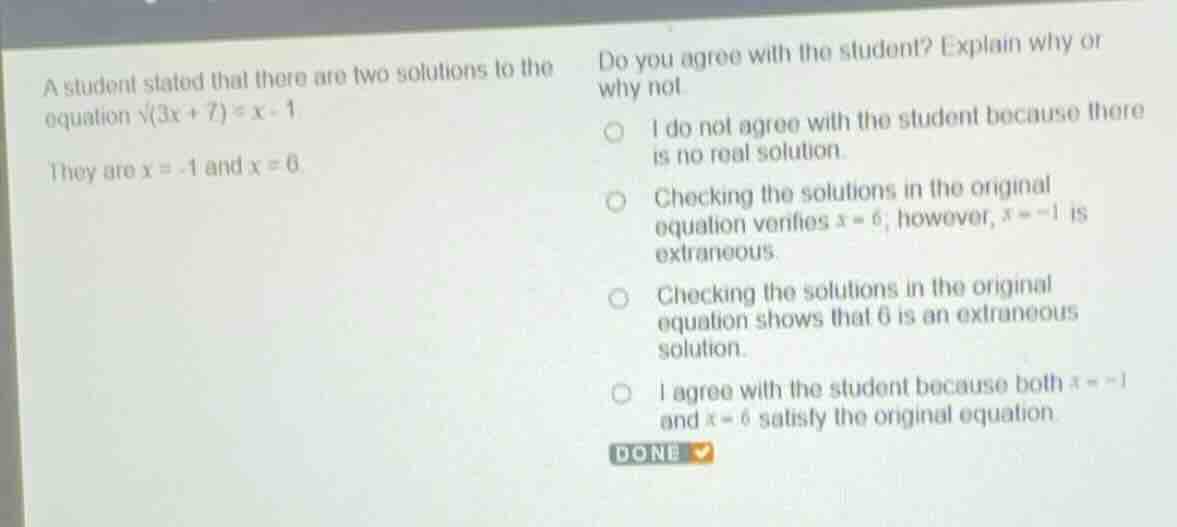
a student stated that there are two solutions to the equation \\(\sqrt{3x + 7} = x - 1\\).
they are \\(x = -1\\) and \\(x = 6\\).
do you agree with the student? explain why or why not.
- i do not agree with the student because there is no real solution.
- checking the solutions in the original equation verifies \\(x = 6\\); however, \\(x = -1\\) is extraneous.
- checking the solutions in the original equation shows that 6 is an extraneous solution.
- i agree with the student because both \\(x = -1\\) and \\(x = 6\\) satisfy the original equation.
<pre_analysis>
{
"quality": "clear",
"question_count": 1,
"skills_matched": [
"step_cot",
"multiple_choice_formatter",
"explain_then_answer",
"tutor",
"mastery_adaptive_brevity"
],
"needs_drawing": false,
"concepts_used": [
"Solving Radical Equations",
"Extraneous Solutions"
],
"new_concepts": [],
"current_concepts": [
"Solving Radical Equations",
"Extraneous Solutions",
"Equation Verification"
]
}
</pre_analysis>
<reasoning>
Solve the radical equation
Using the Solving Radical Equations knowledge point
\[
\]
Verify the solutions
Using the Extraneous Solutions and Equation Verification knowledge points
\[
\]
</reasoning>
<answer>
<mcq-option>I do not agree with the student because there is no real solution.</mcq-option>
<mcq-correct>Checking the solutions in the original equation verifies \(x = 6\); however, \(x = -1\) is extraneous.</mcq-correct>
<mcq-option>Checking the solutions in the original equation shows that 6 is an extraneous solution.</mcq-option>
<mcq-option>I agree with the student because both \(x = -1\) and \(x = 6\) satisfy the original equation.</mcq-option>
</answer>
<post_analysis>
{
"subject": "Mathematics",
"question_type": "Multiple Choice",
"knowledge_point": [
"Mathematics",
"Algebra",
"Solving Radical Equations"
]
}
</post_analysis>
Snap & solve any problem in the app
Get step-by-step solutions on Sovi AI
Photo-based solutions with guided steps
Explore more problems and detailed explanations
<pre_analysis>
{
"quality": "clear",
"question_count": 1,
"skills_matched": [
"step_cot",
"multiple_choice_formatter",
"explain_then_answer",
"tutor",
"mastery_adaptive_brevity"
],
"needs_drawing": false,
"concepts_used": [
"Solving Radical Equations",
"Extraneous Solutions"
],
"new_concepts": [],
"current_concepts": [
"Solving Radical Equations",
"Extraneous Solutions",
"Equation Verification"
]
}
</pre_analysis>
<reasoning>
Solve the radical equation
Using the Solving Radical Equations knowledge point
\[
\]
Verify the solutions
Using the Extraneous Solutions and Equation Verification knowledge points
\[
\]
</reasoning>
<answer>
<mcq-option>I do not agree with the student because there is no real solution.</mcq-option>
<mcq-correct>Checking the solutions in the original equation verifies \(x = 6\); however, \(x = -1\) is extraneous.</mcq-correct>
<mcq-option>Checking the solutions in the original equation shows that 6 is an extraneous solution.</mcq-option>
<mcq-option>I agree with the student because both \(x = -1\) and \(x = 6\) satisfy the original equation.</mcq-option>
</answer>
<post_analysis>
{
"subject": "Mathematics",
"question_type": "Multiple Choice",
"knowledge_point": [
"Mathematics",
"Algebra",
"Solving Radical Equations"
]
}
</post_analysis>