QUESTION IMAGE
Question
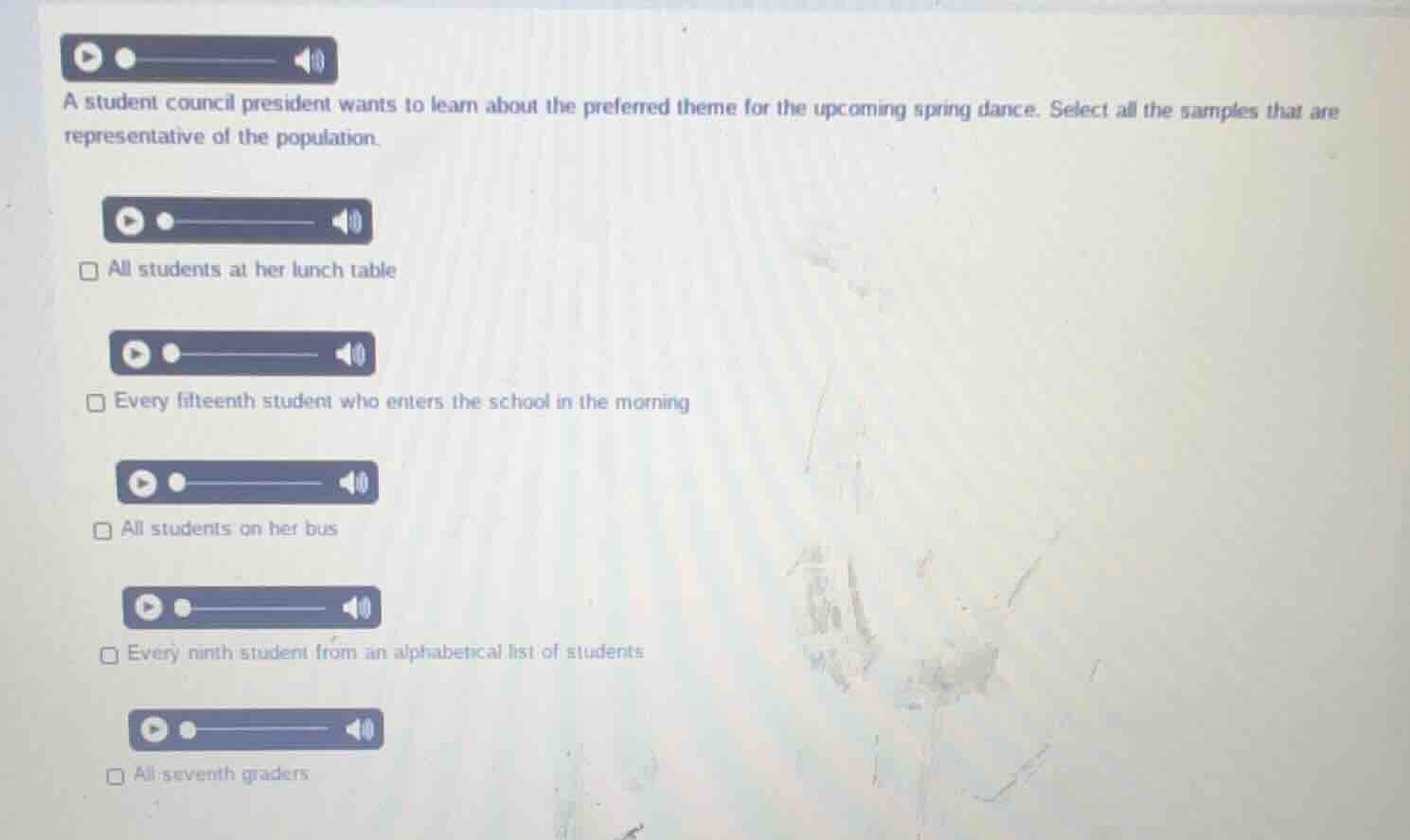
a student council president wants to learn about the preferred theme for the upcoming spring dance. select all the samples that are representative of the population.
- all students at her lunch table
- every fifteenth student who enters the school in the morning
- all students on her bus
- every ninth student from an alphabetical list of students
- all seventh graders
<pre_analysis>
{
"quality": "clear",
"question_count": 1,
"skills_matched": [
"direct_cot",
"multiple_choice_formatter",
"explain_then_answer",
"quick"
],
"needs_drawing": false,
"concepts_used": [],
"new_concepts": [
"Representative Samples",
"Random Sampling"
],
"current_concepts": [
"Representative Samples",
"Random Sampling",
"Biased Sampling"
]
}
</pre_analysis>
<reasoning>
Identify the target population and criteria for representative samples
The target population is all students in the school who would attend the spring dance. A representative sample must be unbiased, giving every student in the population an equal chance of being selected.
Evaluate each sampling method for bias
- All students at her lunch table: Biased. This is a convenience sample of friends or peers who likely share similar preferences.
- Every fifteenth student who enters the school in the morning: Representative. This systematic random sampling method captures a diverse cross-section of the entire student body entering the school.
- All students on her bus: Biased. This is a convenience sample limited only to students living in a specific geographic area who ride that bus.
- Every ninth student from an alphabetical list of students: Representative. This systematic random sampling method uses a complete, unbiased list of the entire population.
- All seventh graders: Biased. This excludes students from other grade levels (e.g., sixth and eighth graders) who are also part of the school population.
Select the unbiased, representative options
The representative samples are:
- "Every fifteenth student who enters the school in the morning"
- "Every ninth student from an alphabetical list of students"
</reasoning>
<answer>
<mcq-option>All students at her lunch table</mcq-option>
<mcq-correct>Every fifteenth student who enters the school in the morning</mcq-correct>
<mcq-option>All students on her bus</mcq-option>
<mcq-correct>Every ninth student from an alphabetical list of students</mcq-correct>
<mcq-option>All seventh graders</mcq-option>
</answer>
<post_analysis>
{
"subject": "Mathematics",
"question_type": "Multiple Choice",
"knowledge_point": [
"Mathematics",
"Statistics",
"Representative Samples"
]
}
</post_analysis>
Snap & solve any problem in the app
Get step-by-step solutions on Sovi AI
Photo-based solutions with guided steps
Explore more problems and detailed explanations
<pre_analysis>
{
"quality": "clear",
"question_count": 1,
"skills_matched": [
"direct_cot",
"multiple_choice_formatter",
"explain_then_answer",
"quick"
],
"needs_drawing": false,
"concepts_used": [],
"new_concepts": [
"Representative Samples",
"Random Sampling"
],
"current_concepts": [
"Representative Samples",
"Random Sampling",
"Biased Sampling"
]
}
</pre_analysis>
<reasoning>
Identify the target population and criteria for representative samples
The target population is all students in the school who would attend the spring dance. A representative sample must be unbiased, giving every student in the population an equal chance of being selected.
Evaluate each sampling method for bias
- All students at her lunch table: Biased. This is a convenience sample of friends or peers who likely share similar preferences.
- Every fifteenth student who enters the school in the morning: Representative. This systematic random sampling method captures a diverse cross-section of the entire student body entering the school.
- All students on her bus: Biased. This is a convenience sample limited only to students living in a specific geographic area who ride that bus.
- Every ninth student from an alphabetical list of students: Representative. This systematic random sampling method uses a complete, unbiased list of the entire population.
- All seventh graders: Biased. This excludes students from other grade levels (e.g., sixth and eighth graders) who are also part of the school population.
Select the unbiased, representative options
The representative samples are:
- "Every fifteenth student who enters the school in the morning"
- "Every ninth student from an alphabetical list of students"
</reasoning>
<answer>
<mcq-option>All students at her lunch table</mcq-option>
<mcq-correct>Every fifteenth student who enters the school in the morning</mcq-correct>
<mcq-option>All students on her bus</mcq-option>
<mcq-correct>Every ninth student from an alphabetical list of students</mcq-correct>
<mcq-option>All seventh graders</mcq-option>
</answer>
<post_analysis>
{
"subject": "Mathematics",
"question_type": "Multiple Choice",
"knowledge_point": [
"Mathematics",
"Statistics",
"Representative Samples"
]
}
</post_analysis>