QUESTION IMAGE
Question
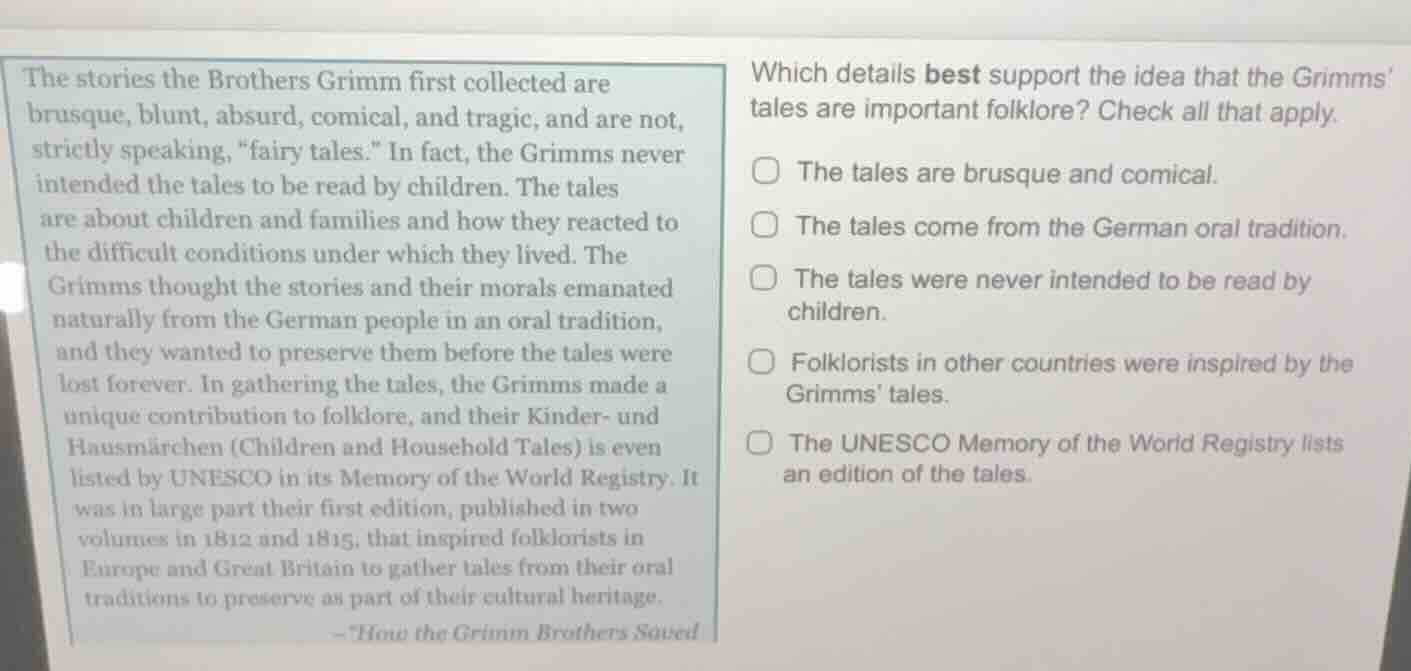
the stories the brothers grimm first collected are brusque, blunt, absurd, comical, and tragic, and are not, strictly speaking, \fairy tales.\ in fact, the grimms never intended the tales to be read by children. the tales are about children and families and how they reacted to the difficult conditions under which they lived. the grimms thought the stories and their morals emanated naturally from the german people in an oral tradition, and they wanted to preserve them before the tales were lost forever. in gathering the tales, the grimms made a unique contribution to folklore, and their kinder- und hausmärchen (children and household tales) is even listed by unesco in its memory of the world registry. it was in large part their first edition, published in two volumes in 1812 and 1815, that inspired folklorists in europe and great britain to gather tales from their oral traditions to preserve as part of their cultural heritage.
- \how the grimm brothers saved\
which details best support the idea that the grimms tales are important folklore? check all that apply.
the tales are brusque and comical.
the tales come from the german oral tradition.
the tales were never intended to be read by children.
folklorists in other countries were inspired by the grimms tales.
the unesco memory of the world registry lists an edition of the tales.
Analyze the core claim
The question asks which details from the text best support the idea that the Grimms' tales are important folklore. We need to look for evidence in the passage showing their cultural value, preservation of oral traditions, and global impact on the study of folklore.
Evaluate each option against the text
- "The tales are brusque and comical."
- Analysis: This describes the style/tone of the stories, not why they are considered important folklore.
- "The tales come from the German oral tradition."
- Analysis: The text states the Grimms believed the stories "emanated naturally from the German people in an oral tradition" and they wanted to "preserve them before the tales were lost forever." This directly connects the tales to authentic cultural folklore.
- "The tales were never intended to be read by children."
- Analysis: This is an interesting historical fact about their target audience, but it does not support their status as important folklore.
- "Folklorists in other countries were inspired by the Grimms' tales."
- Analysis: The text explicitly mentions that their work "inspired folklorists in Europe and Great Britain to gather tales from their oral traditions to preserve as part of their cultural heritage." This demonstrates their immense international importance to the field of folklore.
- "The UNESCO Memory of the World Registry lists an edition of the tales."
- Analysis: The text states that their collection "is even listed by UNESCO in its Memory of the World Registry." This official global recognition directly supports their status as highly significant cultural folklore.
Synthesize the correct choices
Using our analysis of Grimm Brothers Analysis and Grimms Fairy Tales Evolution, the three details that directly support the historical and cultural importance of the tales as folklore are:
- They come from the German oral tradition.
- They inspired folklorists in other countries to preserve their own heritage.
- They are recognized globally by UNESCO.

Snap & solve any problem in the app
Get step-by-step solutions on Sovi AI
Photo-based solutions with guided steps
Explore more problems and detailed explanations
- The tales are brusque and comical.
- The tales come from the German oral tradition. (Correct answer)
- The tales were never intended to be read by children.
- Folklorists in other countries were inspired by the Grimms' tales. (Correct answer)
- The UNESCO Memory of the World Registry lists an edition of the tales. (Correct answer)