QUESTION IMAGE
Question
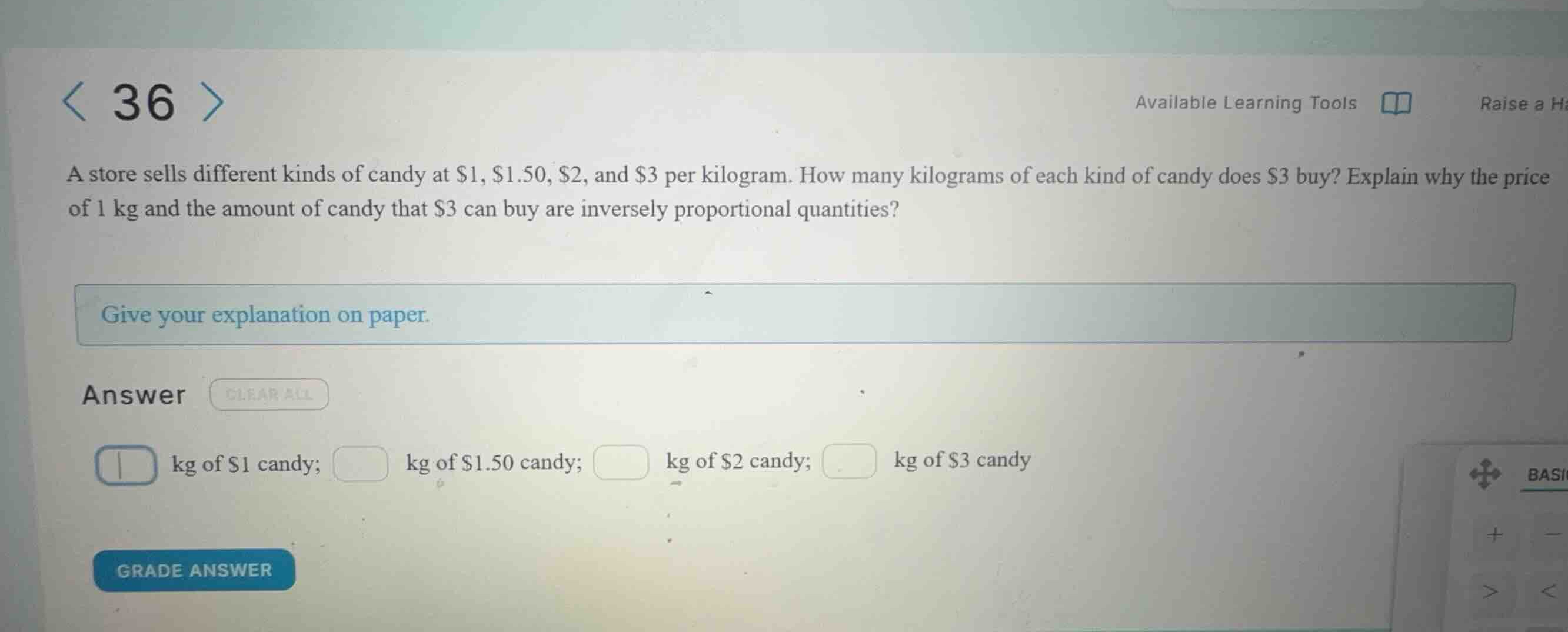
a store sells different kinds of candy at \\$1, \\$1.50, \\$2, and \\$3 per kilogram. how many kilograms of each kind of candy does \\$3 buy? explain why the price of 1 kg and the amount of candy that \\$3 can buy are inversely proportional quantities?
give your explanation on paper.
answer
kg of \\$1 candy; kg of \\$1.50 candy; kg of \\$2 candy; kg of \\$3 candy
Calculate the amount of each candy
Using the Inverse Proportionality and Inverse Variation knowledge points
Explain the inverse relationship
Using the Inverse Proportionality and Inverse Variation knowledge points
Since their product is a constant value of \(3\), the quantities are inversely proportional.

Snap & solve any problem in the app
Get step-by-step solutions on Sovi AI
Photo-based solutions with guided steps
Explore more problems and detailed explanations
A store sells different kinds of candy at \$1, \$1.50, \$2, and \$3 per kilogram. How many kilograms of each kind of candy does \$3 buy? Explain why the price of 1 kg and the amount of candy that \$3 can buy are inversely proportional quantities?
<blank>3</blank> kg of \$1 candy;