QUESTION IMAGE
Question
space-age water conservation
(excerpt)
nasas need to conserve water in space has long supported terrestrial water-purification techniques.
1 the more difficult a problem is for nasa, the more solutions it eventually produces for the rest of us.
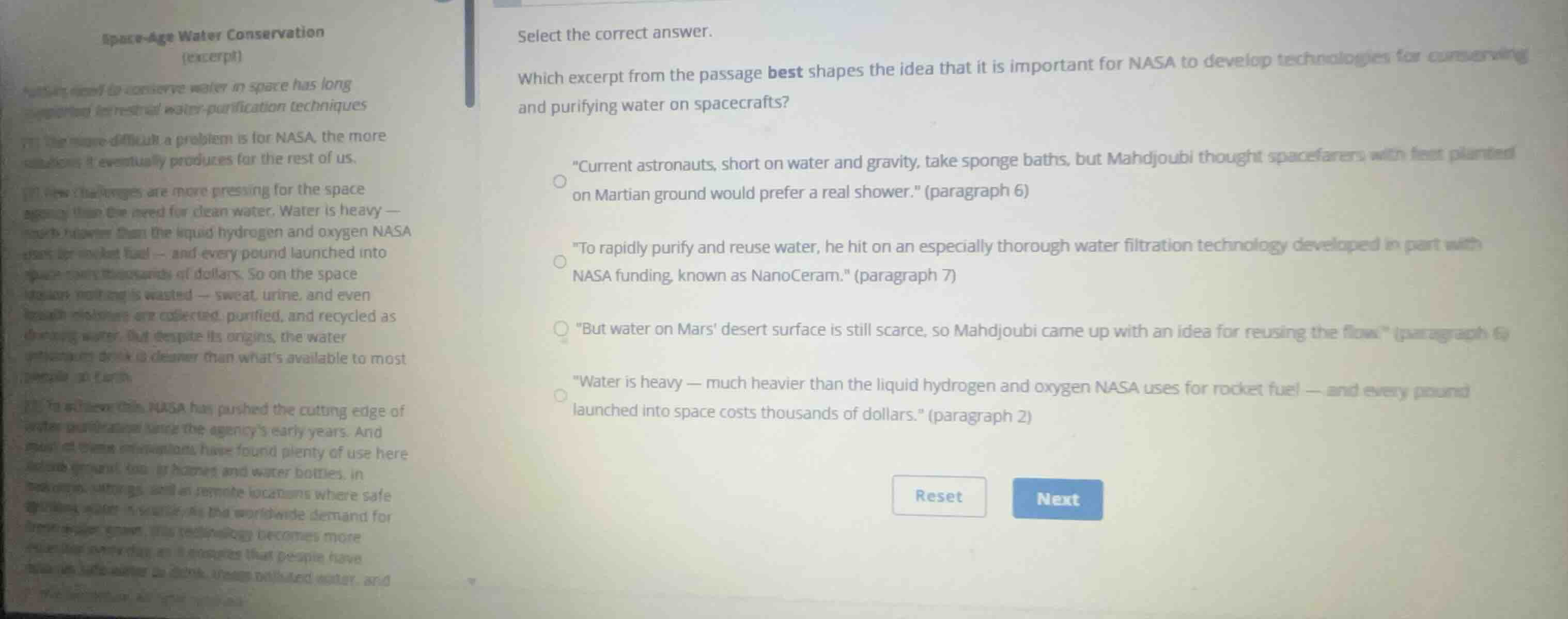
2 few challenges are more pressing for the space agency than the need for clean water. water is heavy - much heavier than the liquid hydrogen and oxygen nasa uses for rocket fuel - and every pound launched into space costs thousands of dollars. so on the space station nothing is wasted - sweat, urine, and even breath moisture are collected, purified, and recycled as drinking water. but despite its origins, the water astronauts drink is cleaner than whats available to most people on earth.
3 to achieve this, nasa has pushed the cutting edge of water purification since the agencys early years. and most of these innovations have found plenty of use here on the ground, too, in homes and water bottles, in industrial settings, and in remote locations where safe drinking water is scarce. as the worldwide demand for fresh water grows, this technology becomes more essential every day, as it ensures that people have access to safe water to drink, free of polluted water, and other contaminants.
select the correct answer.
which excerpt from the passage best shapes the idea that it is important for nasa to develop technologies for conserving and purifying water on spacecrafts?
\current astronauts, short on water and gravity, take sponge baths, but mahdjoubi thought spacefarers with feet planted on martian ground would prefer a real shower.\ (paragraph 6)
\to rapidly purify and reuse water, he hit on an especially thorough water filtration technology developed in part with nasa funding, known as nanoceram.\ (paragraph 7)
\but water on mars desert surface is still scarce, so mahdjoubi came up with an idea for reusing the flow.\ (paragraph 6)
\water is heavy - much heavier than the liquid hydrogen and oxygen nasa uses for rocket fuel - and every pound launched into space costs thousands of dollars.\ (paragraph 2)
Analyze the core idea of the question
The question asks which excerpt best shapes the idea that it is important for NASA to develop technologies for conserving and purifying water on spacecrafts. This requires finding evidence that explains the necessity, cost, or critical nature of water management during space missions.
Evaluate the given options
- Option 1 discusses astronaut preferences for showers on Mars, which is about comfort rather than the fundamental importance of NASA's conservation technology.
- Option 2 describes a specific filtration technology (NanoCeram) developed with NASA funding, but does not explain why it is so critical to develop such systems on spacecrafts.
- Option 3 mentions water scarcity on Mars' surface, which focuses on planetary conditions rather than spacecraft constraints.
- Option 4 states: "Water is heavy — much heavier than the liquid hydrogen and oxygen NASA uses for rocket fuel — and every pound launched into space costs thousands of dollars." This directly establishes the critical economic and physical constraints of launching water, explaining why conservation and purification on spacecrafts are absolutely essential.

Snap & solve any problem in the app
Get step-by-step solutions on Sovi AI
Photo-based solutions with guided steps
Explore more problems and detailed explanations
- "Current astronauts, short on water and gravity, take sponge baths, but Mahdjoubi thought spacefarers with feet planted on Martian ground would prefer a real shower." (paragraph 6)
- "To rapidly purify and reuse water, he hit on an especially thorough water filtration technology developed in part with NASA funding, known as NanoCeram." (paragraph 7)
<mcq-option>"But water on Mars' desert surface is still scarce, so Mahdjoubi came up with an idea for reusing the flow" (paragraph 6)</mcq-correct>
- "Water is heavy — much heavier than the liquid hydrogen and oxygen NASA uses for rocket fuel — and every pound launched into space costs thousands of dollars." (paragraph 2) (Correct answer)