Sovi.AI - AI Math Tutor

Scan to solve math questions

QUESTION IMAGE

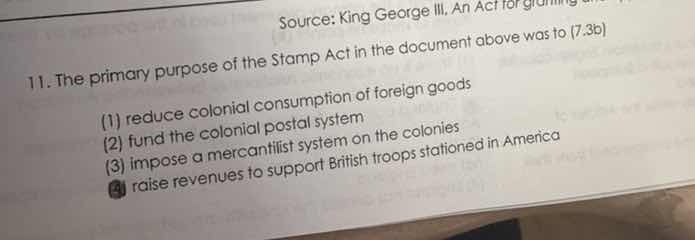
source: king george iii, an act for granting and... 11. the primary pur…

Question

source: king george iii, an act for granting and...

  1. the primary purpose of the stamp act in the document above was to (7.3b)

(1) reduce colonial consumption of foreign goods
(2) fund the colonial postal system
(3) impose a mercantilist system on the colonies
(4) raise revenues to support british troops stationed in america

Explanation:

Response

<pre_analysis>
{
"quality": "clear",
"question_count": 1,
"skills_matched": [
"direct_cot",
"multiple_choice_formatter",
"explain_then_answer",
"tutor"
],
"needs_drawing": false,
"concepts_used": [
"American Revolution"
],
"new_concepts": [
"Stamp Act",
"British Colonial Taxation"
],
"current_concepts": [
"American Revolution",
"Stamp Act",
"British Colonial Taxation"
]
}
</pre_analysis>

<reasoning>

Analyze the historical context of the Stamp Act

The Stamp Act of 1765 was passed by the British Parliament under King George III following the expensive French and Indian War (Seven Years' War). The British Empire faced substantial national debt and the ongoing cost of defending its newly expanded North American territories. This connects directly to the broader tensions of the American Revolution.

Identify the primary legislative intent

The British government maintained a standing army of soldiers in North America to protect the frontier from Native American uprisings and foreign threats. To offset these defense expenditures, Parliament designed the Stamp Act to raise revenue directly from the colonists by requiring a tax stamp on all paper goods, legal documents, newspapers, and playing cards.

Evaluate the given options

  • Option (1) is incorrect because the act was not a protective tariff meant to discourage foreign trade.
  • Option (2) is incorrect because the revenue was not intended to finance local postal infrastructure.
  • Option (3) is incorrect because mercantilism was already the established economic framework; the act was a direct internal tax rather than a structural imposition of mercantilism.
  • Option (4) correctly identifies that the primary purpose was to raise revenue to pay for the defense and protection of the colonies by British troops.

</reasoning>

<answer>
<mcq-option>(1) reduce colonial consumption of foreign goods</mcq-option>
<mcq-option>(2) fund the colonial postal system</mcq-option>
<mcq-option>(3) impose a mercantilist system on the colonies</mcq-option>
<mcq-correct>(4) raise revenues to support British troops stationed in America</mcq-correct>
</answer>

<post_analysis>
{
"subject": "Social Science",
"question_type": "Multiple Choice",
"knowledge_point": [
"Social Science",
"History",
"Stamp Act"
]
}
</post_analysis>

Answer:

<pre_analysis>
{
"quality": "clear",
"question_count": 1,
"skills_matched": [
"direct_cot",
"multiple_choice_formatter",
"explain_then_answer",
"tutor"
],
"needs_drawing": false,
"concepts_used": [
"American Revolution"
],
"new_concepts": [
"Stamp Act",
"British Colonial Taxation"
],
"current_concepts": [
"American Revolution",
"Stamp Act",
"British Colonial Taxation"
]
}
</pre_analysis>

<reasoning>

Analyze the historical context of the Stamp Act

The Stamp Act of 1765 was passed by the British Parliament under King George III following the expensive French and Indian War (Seven Years' War). The British Empire faced substantial national debt and the ongoing cost of defending its newly expanded North American territories. This connects directly to the broader tensions of the American Revolution.

Identify the primary legislative intent

The British government maintained a standing army of soldiers in North America to protect the frontier from Native American uprisings and foreign threats. To offset these defense expenditures, Parliament designed the Stamp Act to raise revenue directly from the colonists by requiring a tax stamp on all paper goods, legal documents, newspapers, and playing cards.

Evaluate the given options

  • Option (1) is incorrect because the act was not a protective tariff meant to discourage foreign trade.
  • Option (2) is incorrect because the revenue was not intended to finance local postal infrastructure.
  • Option (3) is incorrect because mercantilism was already the established economic framework; the act was a direct internal tax rather than a structural imposition of mercantilism.
  • Option (4) correctly identifies that the primary purpose was to raise revenue to pay for the defense and protection of the colonies by British troops.

</reasoning>

<answer>
<mcq-option>(1) reduce colonial consumption of foreign goods</mcq-option>
<mcq-option>(2) fund the colonial postal system</mcq-option>
<mcq-option>(3) impose a mercantilist system on the colonies</mcq-option>
<mcq-correct>(4) raise revenues to support British troops stationed in America</mcq-correct>
</answer>

<post_analysis>
{
"subject": "Social Science",
"question_type": "Multiple Choice",
"knowledge_point": [
"Social Science",
"History",
"Stamp Act"
]
}
</post_analysis>