QUESTION IMAGE
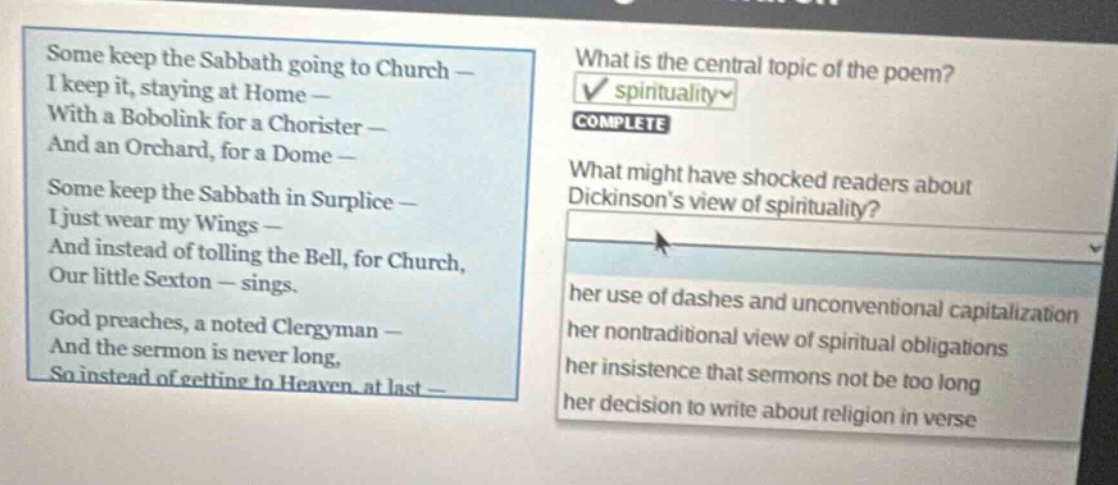
Question
some keep the sabbath going to church —
i keep it, staying at home —
with a bobolink for a chorister —
and an orchard, for a dome —
some keep the sabbath in surplice —
i just wear my wings —
and instead of tolling the bell, for church,
our little sexton — sings.
god preaches, a noted clergyman —
and the sermon is never long,
so instead of getting to heaven, at last —
what is the central topic of the poem?
v spirituality
complete
what might have shocked readers about dickinsons view of spirituality?
- her use of dashes and unconventional capitalization
- her nontraditional view of spiritual obligations
- her insistence that sermons not be too long
- her decision to write about religion in verse
⚡ Using what you learned: close reading methods for poetic texts
Step 1: Analyze the question prompt
The question asks what might have shocked readers about Emily Dickinson's view of spirituality. This means we need to focus specifically on the content of her beliefs and religious practices as expressed in the poem, rather than her poetic style or punctuation.
Step 2: Examine the poem's content
In the poem, Dickinson contrasts traditional religious practices with her own personal, nature-based worship:
- "Some keep the Sabbath going to Church – / I keep it, staying at Home –"
- "Some keep the Sabbath in Surplice – / I just wear my Wings –"
- "God preaches, a noted Clergyman – / And the sermon is never long,"
Instead of attending formal church services, wearing formal vestments (a surplice), and listening to human preachers, she finds her spiritual connection directly in nature (with a bird for a choir member and an orchard as her church dome).
Step 3: Evaluate the options
- her use of dashes and unconventional capitalization: While true of her style, this describes her punctuation and grammar, not her view of spirituality.
- her nontraditional view of spiritual obligations: This directly addresses her view of spirituality. During her time, attending physical church services on the Sabbath was considered a strict moral and social obligation. Her choice to stay home and find God in nature was highly unconventional and would have shocked traditional 19th-century readers.
- her insistence that sermons not be too long: This is a minor, lighthearted detail in the poem rather than the core, shocking aspect of her spiritual worldview.
- her decision to write about religion in verse: Writing about religion in poetry was extremely common in the 19th century and would not have shocked readers.

Snap & solve any problem in the app
Get step-by-step solutions on Sovi AI
Photo-based solutions with guided steps
Explore more problems and detailed explanations
her nontraditional view of spiritual obligations