QUESTION IMAGE
Question
solving a quadratic equation
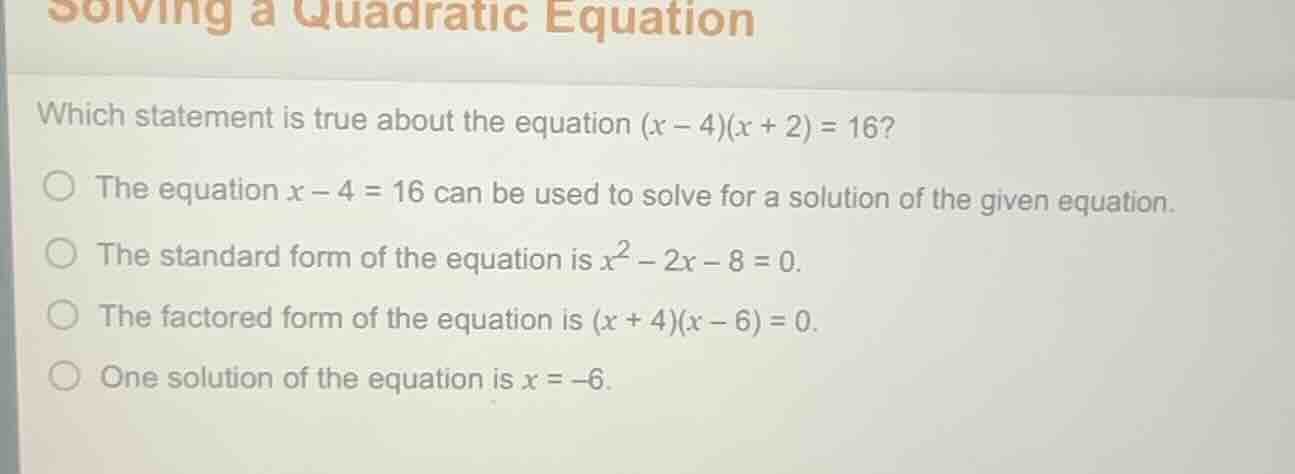
which statement is true about the equation (x - 4)(x + 2) = 16?
the equation x - 4 = 16 can be used to solve for a solution of the given equation.
the standard form of the equation is x² - 2x - 8 = 0.
the factored form of the equation is (x + 4)(x - 6) = 0.
one solution of the equation is x = -6.
Step1: Analyze the first option
The given equation is \((x - 4)(x + 2)=16\). This is not a product of two factors equal to zero, so we can't set \(x - 4 = 16\) directly to solve for a solution. So the first option is false.
Step2: Find the standard form
First, expand \((x - 4)(x + 2)\):
Then set it equal to 16: \(x^{2}-2x - 8=16\), and subtract 16 from both sides to get the standard form: \(x^{2}-2x - 24 = 0\). So the second option is false.
Step3: Factor the standard form
We have the equation \(x^{2}-2x - 24 = 0\). We need to find two numbers that multiply to \(- 24\) and add up to \(-2\). The numbers are \(-6\) and \(4\) since \(-6\times4=-24\) and \(-6 + 4=-2\). So the factored form is \((x + 4)(x - 6)=0\)? Wait, no, let's check: \((x + 4)(x - 6)=x^{2}-6x+4x - 24=x^{2}-2x - 24\), yes. Wait, but let's check the fourth option. Let's substitute \(x=-6\) into the original equation \((x - 4)(x + 2)\):
Wait, maybe I made a mistake. Wait, let's solve the equation \((x - 4)(x + 2)=16\). Expand it: \(x^{2}-2x - 8 = 16\), so \(x^{2}-2x - 24=0\). Factor it: we need two numbers \(a\) and \(b\) such that \(a\times b=-24\) and \(a + b=-2\). The numbers are \(4\) and \(-6\) (since \(4\times(-6)=-24\) and \(4+(-6)=-2\)). So the factored form is \((x + 4)(x - 6)=0\). Now check the fourth option: substitute \(x = - 6\) into \((x - 4)(x + 2)\): \((-6-4)(-6 + 2)=(-10)\times(-4)=40
eq16\). Now check the third option's factored form \((x + 4)(x - 6)=0\), if we set each factor to zero: \(x+4 = 0\) gives \(x=-4\), \(x - 6=0\) gives \(x = 6\). Wait, maybe I made a mistake in expansion. Wait, original equation: \((x - 4)(x + 2)=16\). Let's substitute \(x=-6\): \((-6 - 4)(-6 + 2)=(-10)\times(-4)=40
eq16\). Substitute \(x = 6\): \((6 - 4)(6 + 2)=(2)\times(8)=16\), which works. Substitute \(x=-4\): \((-4 - 4)(-4 + 2)=(-8)\times(-2)=16\), which also works. Wait, the third option says the factored form is \((x + 4)(x - 6)=0\), which is correct because when we set \((x + 4)(x - 6)=0\), the solutions are \(x=-4\) and \(x = 6\), and both satisfy the original equation \((x - 4)(x + 2)=16\) (as we checked: for \(x=-4\), \((-4-4)(-4 + 2)=(-8)\times(-2)=16\); for \(x = 6\), \((6 - 4)(6 + 2)=2\times8=16\)). Wait, but let's re - check the fourth option: if \(x=-6\), \((-6-4)(-6 + 2)=(-10)\times(-4)=40
eq16\), so \(x=-6\) is not a solution. Now, let's re - examine the third option: the factored form of the equation \((x - 4)(x + 2)=16\) can be found by first converting it to standard form \(x^{2}-2x - 24 = 0\), and factoring gives \((x + 4)(x - 6)=0\) (since \(x^{2}-2x - 24=(x + 4)(x - 6)\)). So the third option is correct? Wait, but let's check the second option again. The standard form: \((x - 4)(x + 2)=16\) expands to \(x^{2}-2x - 8 = 16\), so \(x^{2}-2x - 24=0\), not \(x^{2}-2x - 8 = 0\). So the second option is wrong. The first option is wrong. The fourth option: \(x=-6\) is not a solution. The third option: the factored form \((x + 4)(x - 6)=0\) is correct because when we solve \((x + 4)(x - 6)=0\), we get \(x=-4\) and \(x = 6\), and both satisfy the original equation. Wait, maybe I made a mistake in the fourth option. Let's check \(x=-6\) in the original equation: \((-6-4)(-6 + 2)=(-10)\times(-4)=40
eq16\), so \(x=-6\) is not a solution. So the correct option is the third one? Wait, no, wait the third option says "The factored form of the equa…

Snap & solve any problem in the app
Get step-by-step solutions on Sovi AI
Photo-based solutions with guided steps
Explore more problems and detailed explanations
The correct option is: The factored form of the equation is \((x + 4)(x - 6)=0\).