Sovi.AI - AI Math Tutor

Scan to solve math questions

QUESTION IMAGE

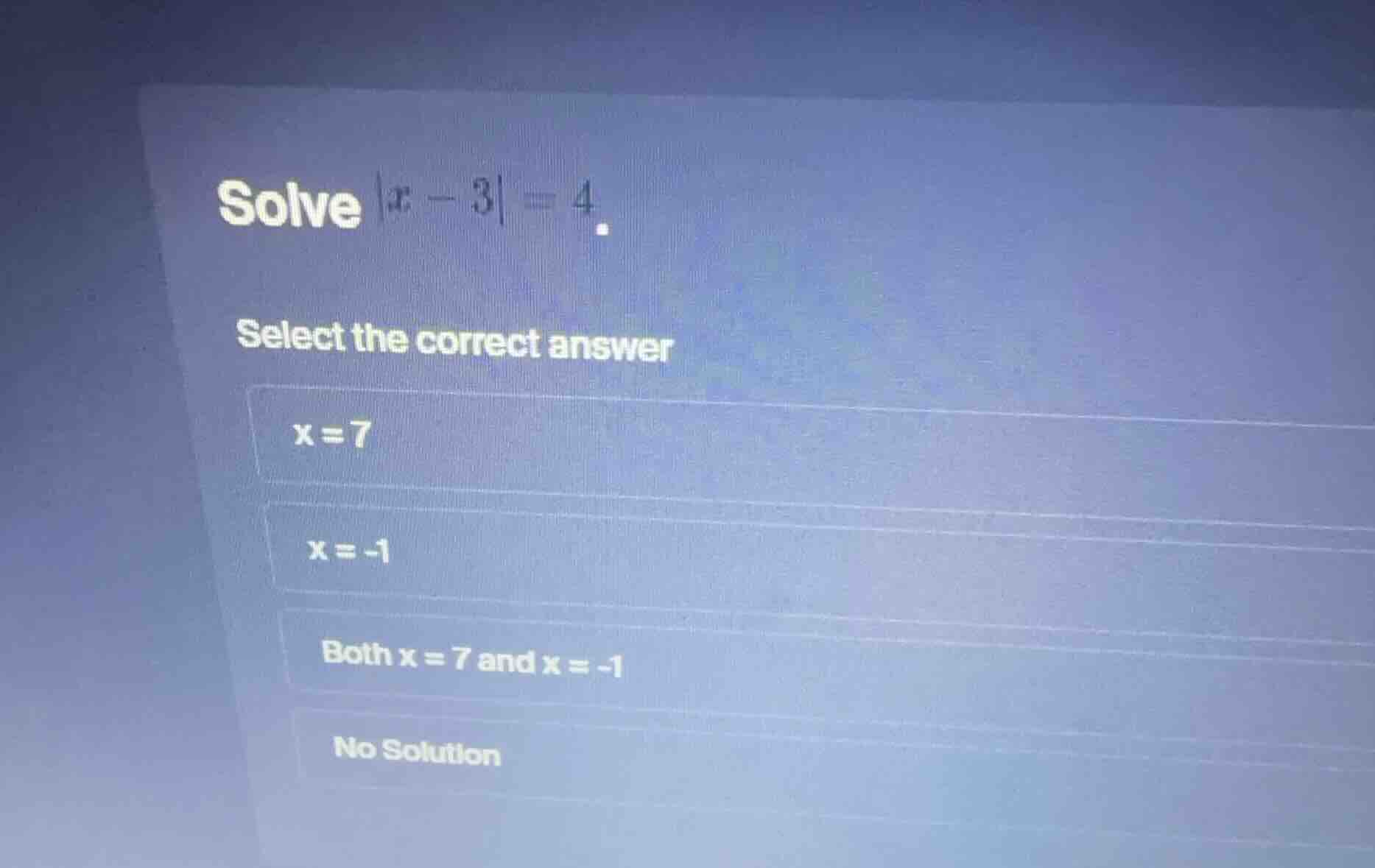
solve \\(|x - 3| = 4\\). select the correct answer \\(x = 7\\) \\(x = -…

Question

solve \\(|x - 3| = 4\\).

select the correct answer

\\(x = 7\\)

\\(x = -1\\)

both \\(x = 7\\) and \\(x = -1\\)

no solution

Explanation:

Response

<pre_analysis>
{
"quality": "clear",
"question_count": 1,
"skills_matched": [
"step_cot",
"multiple_choice_formatter",
"explain_then_answer",
"tutor"
],
"needs_drawing": true,
"concepts_used": [],
"new_concepts": [
"Absolute Value Equations"
],
"current_concepts": [
"Absolute Value Equations",
"Linear Equations"
]
}
</pre_analysis>

<reasoning>

Set up the absolute value cases

An absolute value equation of the form \(|u| = c\) (where \(c \ge 0\)) splits into two separate linear equations:
\[
u = c \quad \text{or} \quad u = -c
\]
For the given equation \(|x - 3| = 4\), we set up the two cases:
\[
x - 3 = 4 \quad \text{or} \quad x - 3 = -4
\]

Solve the first case

To solve the first equation, add \(3\) to both sides:
\[
x - 3 = 4 \implies x = 4 + 3 \implies x = 7
\]

Solve the second case

To solve the second equation, add \(3\) to both sides:
\[
x - 3 = -4 \implies x = -4 + 3 \implies x = -1
\]

Verify the solutions

Substitute both values back into the original equation to check validity:

  • For \(x = 7\): \(|7 - 3| = |4| = 4\) (True)
  • For \(x = -1\): \(|-1 - 3| = |-4| = 4\) (True)

Both values are valid solutions.
</reasoning>

<answer>
<mcq-option>x = 7</mcq-option>
<mcq-option>x = -1</mcq-option>
<mcq-correct>Both x = 7 and x = -1</mcq-correct>
<mcq-option>No Solution</mcq-option>
</answer>

<plot>
{
"elements": [
{
"type": "functiongraph",
"params": [
{
"js": "Math.abs(x - 3)",
"latex": "|x - 3|"
},
-5,
11
],
"properties": {
"strokeColor": "#8C55F2",
"strokeWidth": 3,
"name": "y = |x - 3|",
"withLabel": true
}
},
{
"type": "functiongraph",
"params": [
{
"js": "4",
"latex": "4"
},
-5,
11
],
"properties": {
"strokeColor": "#F2557F",
"strokeWidth": 2,
"strokeDash": 1,
"name": "y = 4",
"withLabel": true
}
},
{
"type": "point",
"params": [
[7, 4]
],
"properties": {
"name": "(7, 4)",
"size": 4,
"color": "#5583F2",
"withLabel": true
}
},
{
"type": "point",
"params": [
[-1, 4]
],
"properties": {
"name": "(-1, 4)",
"size": 4,
"color": "#5583F2",
"withLabel": true
}
}
]
}
</plot>

<post_analysis>
{
"subject": "Mathematics",
"question_type": "Multiple Choice",
"knowledge_point": [
"Mathematics",
"Algebra",
"Absolute Value Equations"
]
}
</post_analysis>

Answer:

<pre_analysis>
{
"quality": "clear",
"question_count": 1,
"skills_matched": [
"step_cot",
"multiple_choice_formatter",
"explain_then_answer",
"tutor"
],
"needs_drawing": true,
"concepts_used": [],
"new_concepts": [
"Absolute Value Equations"
],
"current_concepts": [
"Absolute Value Equations",
"Linear Equations"
]
}
</pre_analysis>

<reasoning>

Set up the absolute value cases

An absolute value equation of the form \(|u| = c\) (where \(c \ge 0\)) splits into two separate linear equations:
\[
u = c \quad \text{or} \quad u = -c
\]
For the given equation \(|x - 3| = 4\), we set up the two cases:
\[
x - 3 = 4 \quad \text{or} \quad x - 3 = -4
\]

Solve the first case

To solve the first equation, add \(3\) to both sides:
\[
x - 3 = 4 \implies x = 4 + 3 \implies x = 7
\]

Solve the second case

To solve the second equation, add \(3\) to both sides:
\[
x - 3 = -4 \implies x = -4 + 3 \implies x = -1
\]

Verify the solutions

Substitute both values back into the original equation to check validity:

  • For \(x = 7\): \(|7 - 3| = |4| = 4\) (True)
  • For \(x = -1\): \(|-1 - 3| = |-4| = 4\) (True)

Both values are valid solutions.
</reasoning>

<answer>
<mcq-option>x = 7</mcq-option>
<mcq-option>x = -1</mcq-option>
<mcq-correct>Both x = 7 and x = -1</mcq-correct>
<mcq-option>No Solution</mcq-option>
</answer>

<plot>
{
"elements": [
{
"type": "functiongraph",
"params": [
{
"js": "Math.abs(x - 3)",
"latex": "|x - 3|"
},
-5,
11
],
"properties": {
"strokeColor": "#8C55F2",
"strokeWidth": 3,
"name": "y = |x - 3|",
"withLabel": true
}
},
{
"type": "functiongraph",
"params": [
{
"js": "4",
"latex": "4"
},
-5,
11
],
"properties": {
"strokeColor": "#F2557F",
"strokeWidth": 2,
"strokeDash": 1,
"name": "y = 4",
"withLabel": true
}
},
{
"type": "point",
"params": [
[7, 4]
],
"properties": {
"name": "(7, 4)",
"size": 4,
"color": "#5583F2",
"withLabel": true
}
},
{
"type": "point",
"params": [
[-1, 4]
],
"properties": {
"name": "(-1, 4)",
"size": 4,
"color": "#5583F2",
"withLabel": true
}
}
]
}
</plot>

<post_analysis>
{
"subject": "Mathematics",
"question_type": "Multiple Choice",
"knowledge_point": [
"Mathematics",
"Algebra",
"Absolute Value Equations"
]
}
</post_analysis>