QUESTION IMAGE
Question
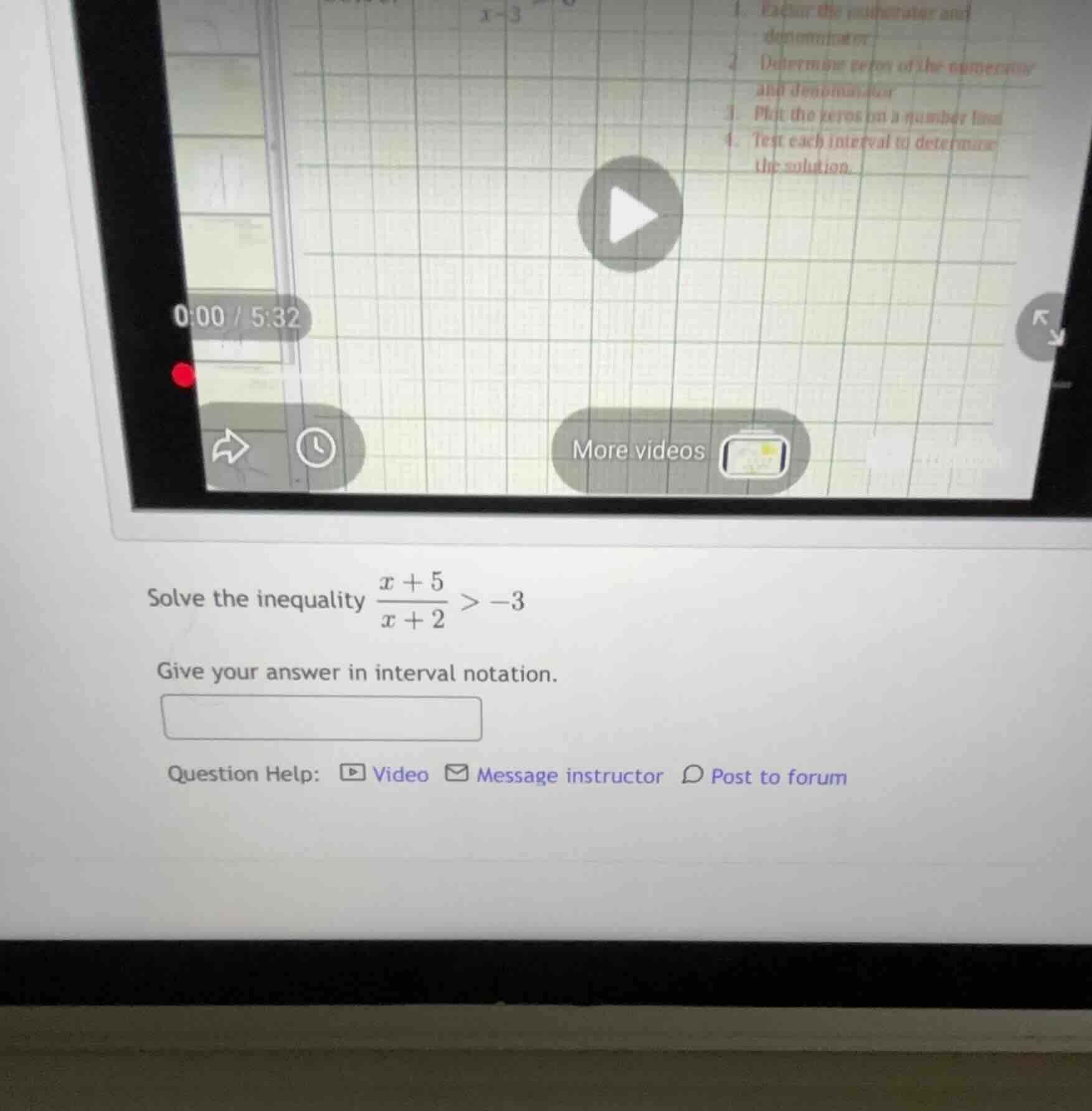
solve the inequality \\(\frac{x + 5}{x + 2} > -3\\)
give your answer in interval notation.
🆕 New Concept Discovered: Solving Rational Inequalities
Finding critical values and testing intervals on a number line.
Step 1: Set the inequality to zero
To solve a rational inequality, we must first move all terms to one side so that we are comparing the expression to zero.
Add \(3\) to both sides:
Step 2: Combine into a single fraction
To combine the terms, find a common denominator, which is \(x + 2\):
Step 3: Find the critical points
The critical points occur where the numerator is zero or the denominator is zero. These points divide the number line into test intervals.
- Numerator equals zero:
- Denominator equals zero:
Our critical points are \(x = -2.75\) and \(x = -2\).
Step 4: Test the intervals
We divide the number line into three intervals based on our critical points:
- \((-\infty, -2.75)\)
- \((-2.75, -2)\)
- \((-2, \infty)\)
We test a value from each interval in our simplified inequality \(\frac{4x + 11}{x + 2} > 0\):
- For \((-\infty, -2.75)\), test \(x = -3\):
- For \((-2.75, -2)\), test \(x = -2.5\):
- For \((-2, \infty)\), test \(x = 0\):
Step 5: Write the solution in interval notation
Since the inequality is strictly greater than (\(>\)), we do not include the boundary points where the expression equals zero or is undefined.
The inequality is true on the intervals \((-\infty, -2.75)\) and \((-2, \infty)\).
Converting \(-2.75\) back to a fraction gives \(-\frac{11}{4}\).

Snap & solve any problem in the app
Get step-by-step solutions on Sovi AI
Photo-based solutions with guided steps
Explore more problems and detailed explanations