QUESTION IMAGE
Question
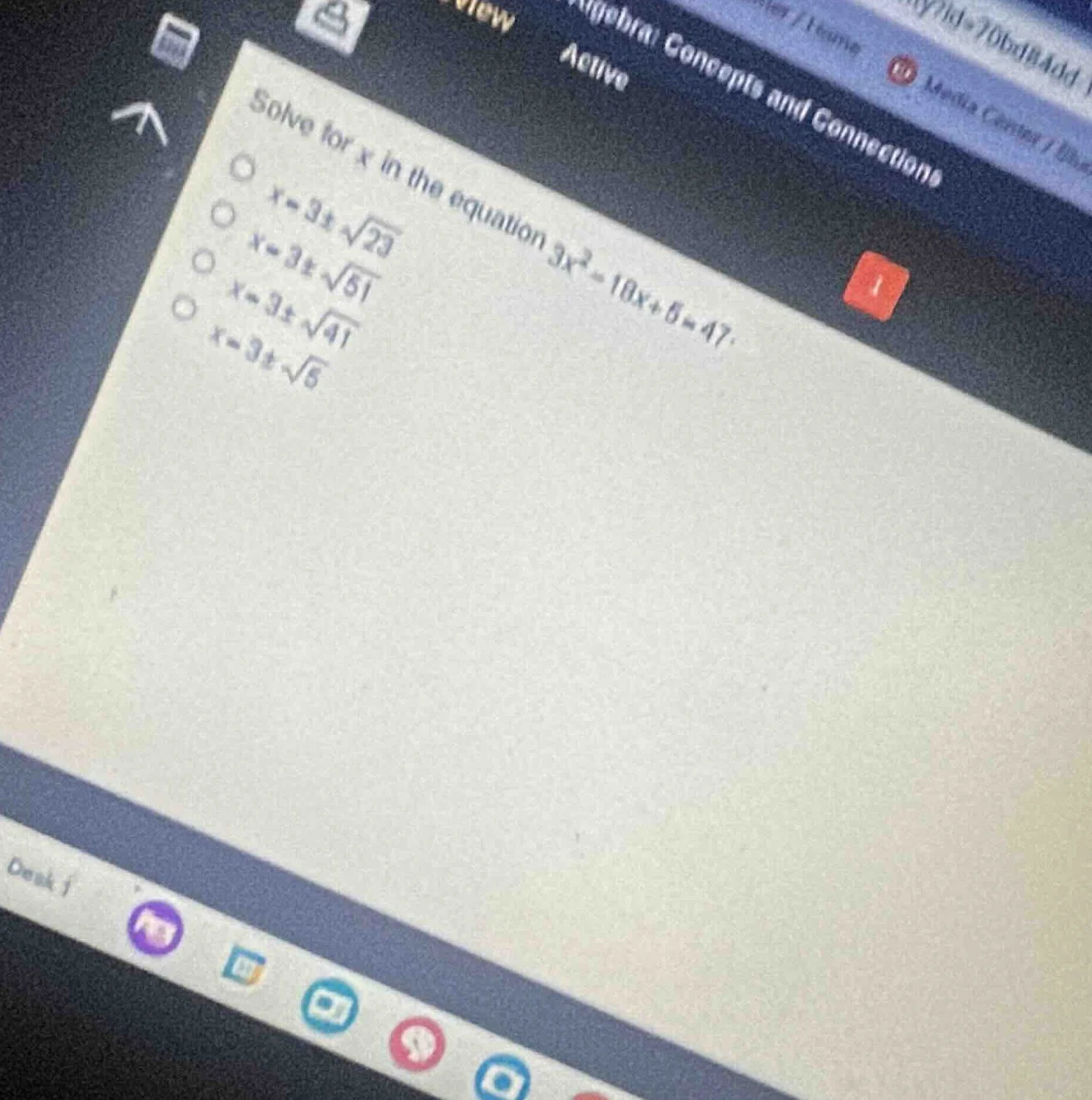
solve for x in the equation $3x^2 - 10x + 5 = 47$.
$\bigcirc$ $x = 3 \pm \sqrt{23}$
$\bigcirc$ $x = 3 \pm \sqrt{51}$
$\bigcirc$ $x = 3 \pm \sqrt{41}$
$\bigcirc$ $x = 3 \pm \sqrt{5}$
Step1: Rearrange the equation
First, we need to set the equation \(3x^2 - 18x + 5 = 47\) to standard quadratic form \(ax^2+bx+c = 0\). Subtract 47 from both sides:
\(3x^2 - 18x + 5 - 47 = 0\)
\(3x^2 - 18x - 42 = 0\)
We can simplify this equation by dividing all terms by 3:
\(x^2 - 6x - 14 = 0\) (Wait, there seems to be a mistake here. Wait, original equation is \(3x^2 - 18x + 5 = 47\)? Wait, no, looking back, the original equation is \(3x^2 - 18x + 5 = 47\)? Wait, the user's image shows \(3x^2 - 18x + 5 = 47\)? Wait, no, maybe I misread. Wait, the equation is \(3x^2 - 18x + 5 = 47\)? Wait, let's check again. Wait, the user's problem: "Solve for x in the equation \(3x^2 - 18x + 5 = 47\)". Wait, maybe the original equation was \(3x^2 - 18x + 5 = 47\). Let's proceed.
Wait, no, maybe the original equation is \(3x^2 - 18x + 5 = 47\). Let's rearrange:
Subtract 47 from both sides: \(3x^2 - 18x + 5 - 47 = 0\) → \(3x^2 - 18x - 42 = 0\). Divide by 3: \(x^2 - 6x - 14 = 0\). Wait, but the answer choices have \(x = 3 \pm \sqrt{...}\). Wait, maybe I made a mistake in the coefficient. Wait, maybe the original equation is \(3x^2 - 18x + 5 = 47\)? Wait, no, let's check the answer choices. The answer choices are \(x = 3 \pm \sqrt{23}\), \(x = 3 \pm \sqrt{51}\), \(x = 3 \pm \sqrt{41}\), \(x = 3 \pm \sqrt{5}\). Wait, maybe the original equation is \(3x^2 - 18x + 5 = 47\)? Wait, no, let's use the quadratic formula. For a quadratic equation \(ax^2 + bx + c = 0\), the solutions are \(x = \frac{-b \pm \sqrt{b^2 - 4ac}}{2a}\).
Wait, maybe the original equation is \(3x^2 - 18x + 5 = 47\). Let's rearrange:
\(3x^2 - 18x + 5 - 47 = 0\) → \(3x^2 - 18x - 42 = 0\). Divide by 3: \(x^2 - 6x - 14 = 0\). Then \(a = 1\), \(b = -6\), \(c = -14\). Then discriminant \(D = b^2 - 4ac = (-6)^2 - 4(1)(-14) = 36 + 56 = 92\). Then \(x = \frac{6 \pm \sqrt{92}}{2} = \frac{6 \pm 2\sqrt{23}}{2} = 3 \pm \sqrt{23}\). Ah, there we go. So the correct answer is \(x = 3 \pm \sqrt{23}\).
Wait, let's do it step by step correctly.
Step1: Rearrange the equation to standard form
Start with \(3x^2 - 18x + 5 = 47\). Subtract 47 from both sides:
\(3x^2 - 18x + 5 - 47 = 0\)
\(3x^2 - 18x - 42 = 0\)
Step2: Simplify the equation
Divide all terms by 3 to simplify:
\(\frac{3x^2}{3} - \frac{18x}{3} - \frac{42}{3} = 0\)
\(x^2 - 6x - 14 = 0\) (Wait, no, -42/3 is -14? Wait, no, 5 - 47 is -42, so -42/3 is -14. But then using quadratic formula: \(x = \frac{-b \pm \sqrt{b^2 - 4ac}}{2a}\). Here, \(a = 1\), \(b = -6\), \(c = -14\). Then \(D = (-6)^2 - 4(1)(-14) = 36 + 56 = 92\). Then \(x = \frac{6 \pm \sqrt{92}}{2} = \frac{6 \pm 2\sqrt{23}}{2} = 3 \pm \sqrt{23}\). So that's the first option.
Wait, but let's check again. Maybe the original equation was \(3x^2 - 18x + 5 = 47\). Yes, so the steps are:
- Subtract 47: \(3x^2 - 18x - 42 = 0\)
- Divide by 3: \(x^2 - 6x - 14 = 0\)
- Use quadratic formula: \(x = \frac{6 \pm \sqrt{36 + 56}}{2} = \frac{6 \pm \sqrt{92}}{2} = 3 \pm \sqrt{23}\)

Snap & solve any problem in the app
Get step-by-step solutions on Sovi AI
Photo-based solutions with guided steps
Explore more problems and detailed explanations
\(x = 3 \pm \sqrt{23}\) (Corresponding to the first option: \(x = 3 \pm \sqrt{23}\))