QUESTION IMAGE
Question
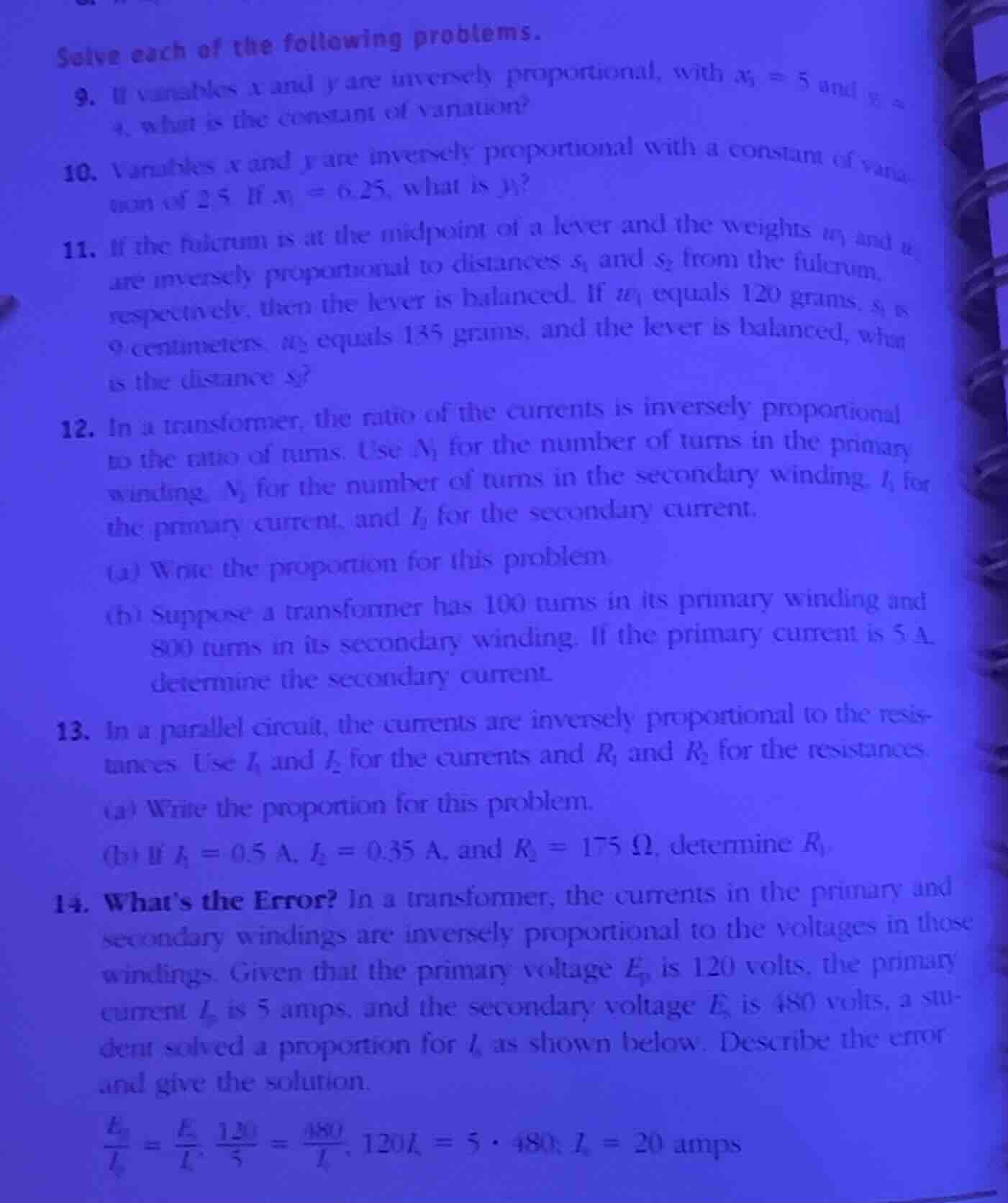
solve each of the following problems.
- if variables \\(x\\) and \\(y\\) are inversely proportional, with \\(x_1 = 5\\) and \\(y_1 = 4\\), what is the constant of variation?
- variables \\(x\\) and \\(y\\) are inversely proportional with a constant of variation of 2.5. if \\(x_1 = 6.25\\), what is \\(y_1\\)?
- if the fulcrum is at the midpoint of a lever and the weights \\(w_1\\) and \\(w_2\\) are inversely proportional to distances \\(s_1\\) and \\(s_2\\) from the fulcrum, respectively, then the lever is balanced. if \\(w_1\\) equals 120 grams, \\(s_1\\) is 9 centimeters, \\(w_2\\) equals 135 grams, and the lever is balanced, what is the distance \\(s_2\\)?
- in a transformer, the ratio of the currents is inversely proportional to the ratio of turns. use \\(n_1\\) for the number of turns in the primary winding, \\(n_2\\) for the number of turns in the secondary winding, \\(i_1\\) for the primary current, and \\(i_2\\) for the secondary current.
(a) write the proportion for this problem.
(b) suppose a transformer has 100 turns in its primary winding and 800 turns in its secondary winding. if the primary current is 5 a, determine the secondary current.
- in a parallel circuit, the currents are inversely proportional to the resistances. use \\(i_1\\) and \\(i_2\\) for the currents and \\(r_1\\) and \\(r_2\\) for the resistances.
(a) write the proportion for this problem.
(b) if \\(i_1 = 0.5\text{ a}\\), \\(i_2 = 0.35\text{ a}\\), and \\(r_2 = 175\\ \omega\\), determine \\(r_1\\).
- whats the error? in a transformer, the currents in the primary and secondary windings are inversely proportional to the voltages in those windings. given that the primary voltage \\(e_p\\) is 120 volts, the primary current \\(i_p\\) is 5 amps, and the secondary voltage \\(e_s\\) is 480 volts, a student solved a proportion for \\(i_s\\) as shown below. describe the error and give the solution.
\\\frac{e_p}{i_p} = \frac{e_s}{i_s}, \frac{120}{5} = \frac{480}{i_s}, 120 i_s = 5 \cdot 480, i_s = 20\text{ amps}\\
Solve inverse proportion problems 9, 10, and 11
Solve transformer and circuit proportion problems 12 and 13
Identify and correct the error in problem 14

Snap & solve any problem in the app
Get step-by-step solutions on Sovi AI
Photo-based solutions with guided steps
Explore more problems and detailed explanations
Question 9
\(20\)
Question 10
\(4\)
Question 11
\(8\text{ cm}\)
Question 12
(a) \(\frac{I_1}{I_2} = \frac{N_2}{N_1}\)
(b) \(0.625\text{ A}\)
Question 13
(a) \(\frac{I_1}{I_2} = \frac{R_2}{R_1}\)
(b) \(122.5\ \Omega\)
Question 14
Error: The student set up a direct proportion \(\frac{E_p}{I_s} = \frac{E_s}{I_p}\) instead of an inverse proportion \(\frac{I_p}{I_s} = \frac{E_s}{E_p}\).
Correct solution: \(1.25\text{ amps}\)