Sovi.AI - AI Math Tutor

Scan to solve math questions

QUESTION IMAGE

... small islands not capable of protecting themselves are the proper o…

Question

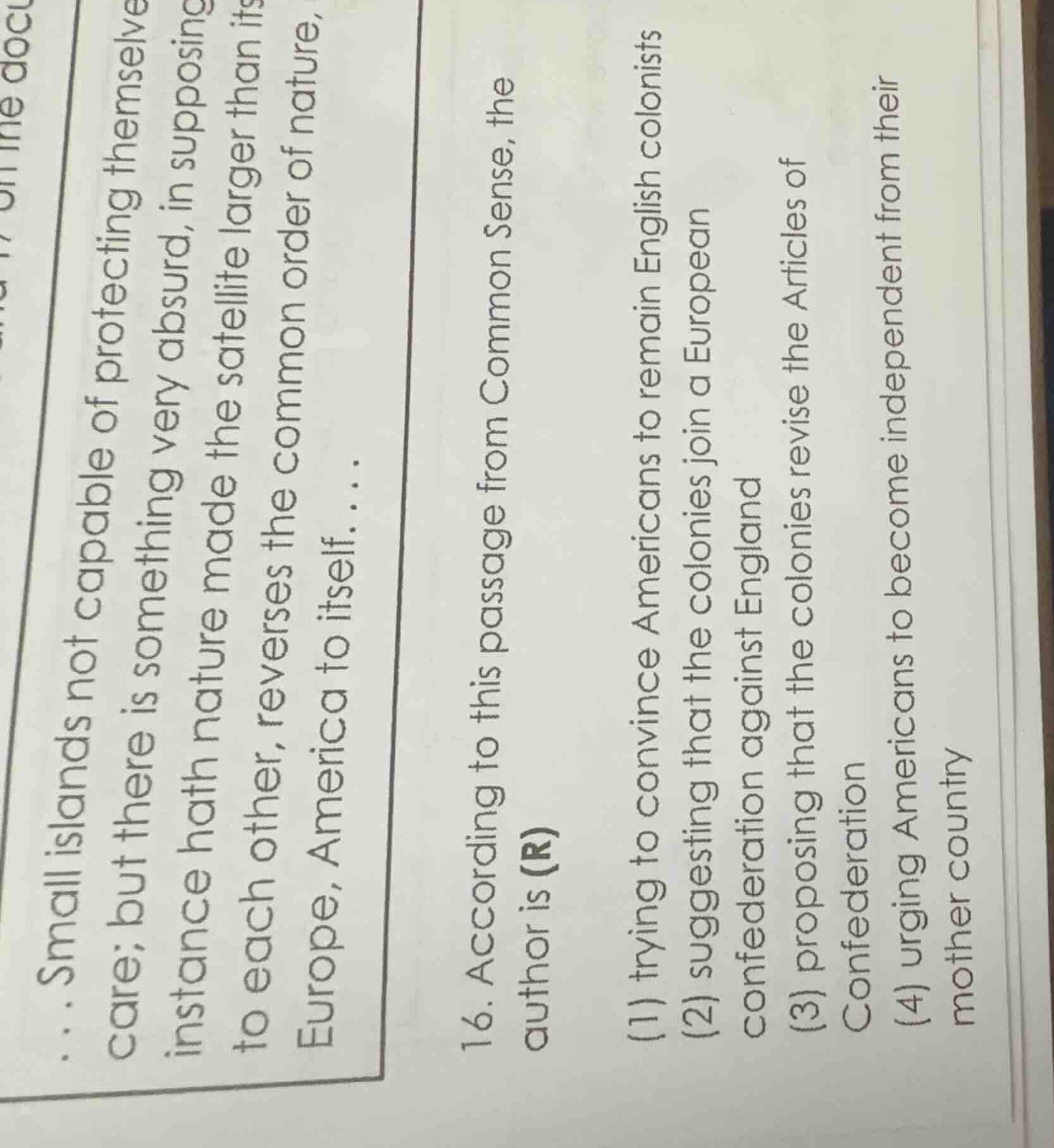
... small islands not capable of protecting themselves are the proper objects for government to take under their care; but there is something very absurd, in supposing a continent to be perpetually governed by an island. in no instance hath nature made the satellite larger than its primary planet, and as england and america, with respect to each other, reverses the common order of nature, it is evident they belong to different systems: england to europe, america to itself. . . .

  1. according to this passage from common sense, the author is (r)

(1) trying to convince americans to remain english colonists
(2) suggesting that the colonies join a european confederation against england
(3) proposing that the colonies revise the articles of confederation
(4) urging americans to become independent from their mother country

Explanation:

Response

<pre_analysis>
{
"quality": "clear",
"question_count": 1,
"skills_matched": [
"direct_cot",
"multiple_choice_formatter",
"explain_then_answer",
"tutor"
],
"needs_drawing": false,
"concepts_used": [
"American Revolution"
],
"new_concepts": [
"Thomas Paine Common Sense"
],
"current_concepts": [
"American Revolution",
"Thomas Paine Common Sense"
]
}
</pre_analysis>

<reasoning>

Analyze the source passage

The passage states: "...Small islands not capable of protecting themselves are the proper objects for kingdoms to take under their care; but there is something very absurd, in supposing a continent to be perpetually governed by an island. In no instance hath nature made the satellite larger than its primary planet, and as England and America, with respect to each other, reverses the common order of nature, it is evident they belong to different systems: England to Europe, America to itself..."

Identify the author's core argument

The excerpt is from Thomas Paine's famous 1776 pamphlet, Common Sense. Paine uses a natural analogy (planets and satellites) to argue that it is unnatural for a small island (England) to rule over a vast continent (America). He concludes that "America belong[s] to itself," which is a direct argument for independence.

Evaluate the given options

  • Option (1) suggests the author wants Americans to remain English colonists, which contradicts the text.
  • Option (2) mentions joining a European confederation, which is not supported by the text.
  • Option (3) mentions revising the Articles of Confederation, which did not exist when Common Sense was written in early 1776.
  • Option (4) states the author is urging Americans to become independent from their mother country, which aligns perfectly with "America to itself" and the historical context of the American Revolution.

</reasoning>

<answer>
<mcq-option>(1) trying to convince Americans to remain English colonists</mcq-option>
<mcq-option>(2) suggesting that the colonies join a European confederation against England</mcq-option>
<mcq-option>(3) proposing that the colonies revise the Articles of Confederation</mcq-option>
<mcq-correct>(4) urging Americans to become independent from their mother country</mcq-correct>
</answer>

<post_analysis>
{
"subject": "Social Science",
"question_type": "Multiple Choice",
"knowledge_point": [
"Social Science",
"History",
"American Revolution"
]
}
</post_analysis>

Answer:

<pre_analysis>
{
"quality": "clear",
"question_count": 1,
"skills_matched": [
"direct_cot",
"multiple_choice_formatter",
"explain_then_answer",
"tutor"
],
"needs_drawing": false,
"concepts_used": [
"American Revolution"
],
"new_concepts": [
"Thomas Paine Common Sense"
],
"current_concepts": [
"American Revolution",
"Thomas Paine Common Sense"
]
}
</pre_analysis>

<reasoning>

Analyze the source passage

The passage states: "...Small islands not capable of protecting themselves are the proper objects for kingdoms to take under their care; but there is something very absurd, in supposing a continent to be perpetually governed by an island. In no instance hath nature made the satellite larger than its primary planet, and as England and America, with respect to each other, reverses the common order of nature, it is evident they belong to different systems: England to Europe, America to itself..."

Identify the author's core argument

The excerpt is from Thomas Paine's famous 1776 pamphlet, Common Sense. Paine uses a natural analogy (planets and satellites) to argue that it is unnatural for a small island (England) to rule over a vast continent (America). He concludes that "America belong[s] to itself," which is a direct argument for independence.

Evaluate the given options

  • Option (1) suggests the author wants Americans to remain English colonists, which contradicts the text.
  • Option (2) mentions joining a European confederation, which is not supported by the text.
  • Option (3) mentions revising the Articles of Confederation, which did not exist when Common Sense was written in early 1776.
  • Option (4) states the author is urging Americans to become independent from their mother country, which aligns perfectly with "America to itself" and the historical context of the American Revolution.

</reasoning>

<answer>
<mcq-option>(1) trying to convince Americans to remain English colonists</mcq-option>
<mcq-option>(2) suggesting that the colonies join a European confederation against England</mcq-option>
<mcq-option>(3) proposing that the colonies revise the Articles of Confederation</mcq-option>
<mcq-correct>(4) urging Americans to become independent from their mother country</mcq-correct>
</answer>

<post_analysis>
{
"subject": "Social Science",
"question_type": "Multiple Choice",
"knowledge_point": [
"Social Science",
"History",
"American Revolution"
]
}
</post_analysis>