QUESTION IMAGE
Question
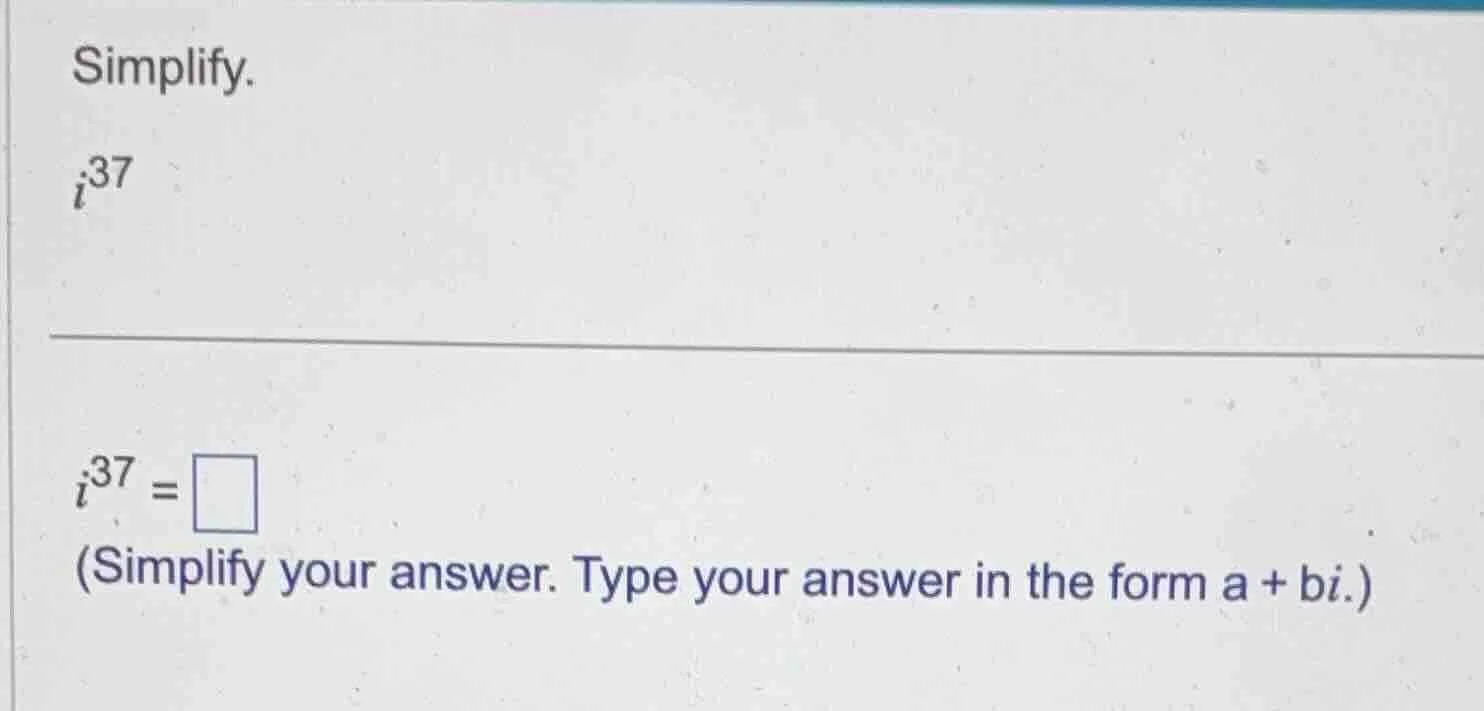
simplify.
$i^{37}$
$i^{37}=\square$
(simplify your answer. type your answer in the form $a + bi$.)
Step1: Recall the cycle of \(i\)
The imaginary unit \(i\) has a cyclic pattern: \(i^1 = i\), \(i^2 = -1\), \(i^3 = i^2 \cdot i = -i\), \(i^4 = (i^2)^2 = (-1)^2 = 1\), and then the cycle repeats every 4 powers. So we can use the property of exponents \(a^{m + n}=a^m\cdot a^n\) and the cycle of \(i\) to simplify \(i^{37}\).
First, we divide the exponent 37 by 4 to find the remainder. Let's perform the division: \(37\div4 = 9\) with a remainder of 1. In formula terms, we can write \(37 = 4\times9 + 1\).
Step2: Simplify using the cycle of \(i\)
Using the exponent rule \(i^{4k + r}= (i^4)^k\cdot i^r\), where \(k = 9\) and \(r = 1\) (since \(37 = 4\times9+1\)). We know that \(i^4 = 1\), so \((i^4)^9 = 1^9 = 1\). Then \(i^{37}=i^{4\times9 + 1}=(i^4)^9\cdot i^1\). Substituting the values we found, we get \(1^9\cdot i = 1\cdot i = i\). In the form \(a + bi\), \(a = 0\) and \(b = 1\), so it is \(0 + 1i\) or simply \(i\).

Snap & solve any problem in the app
Get step-by-step solutions on Sovi AI
Photo-based solutions with guided steps
Explore more problems and detailed explanations
\(0 + i\) (or \(i\))