QUESTION IMAGE
Question
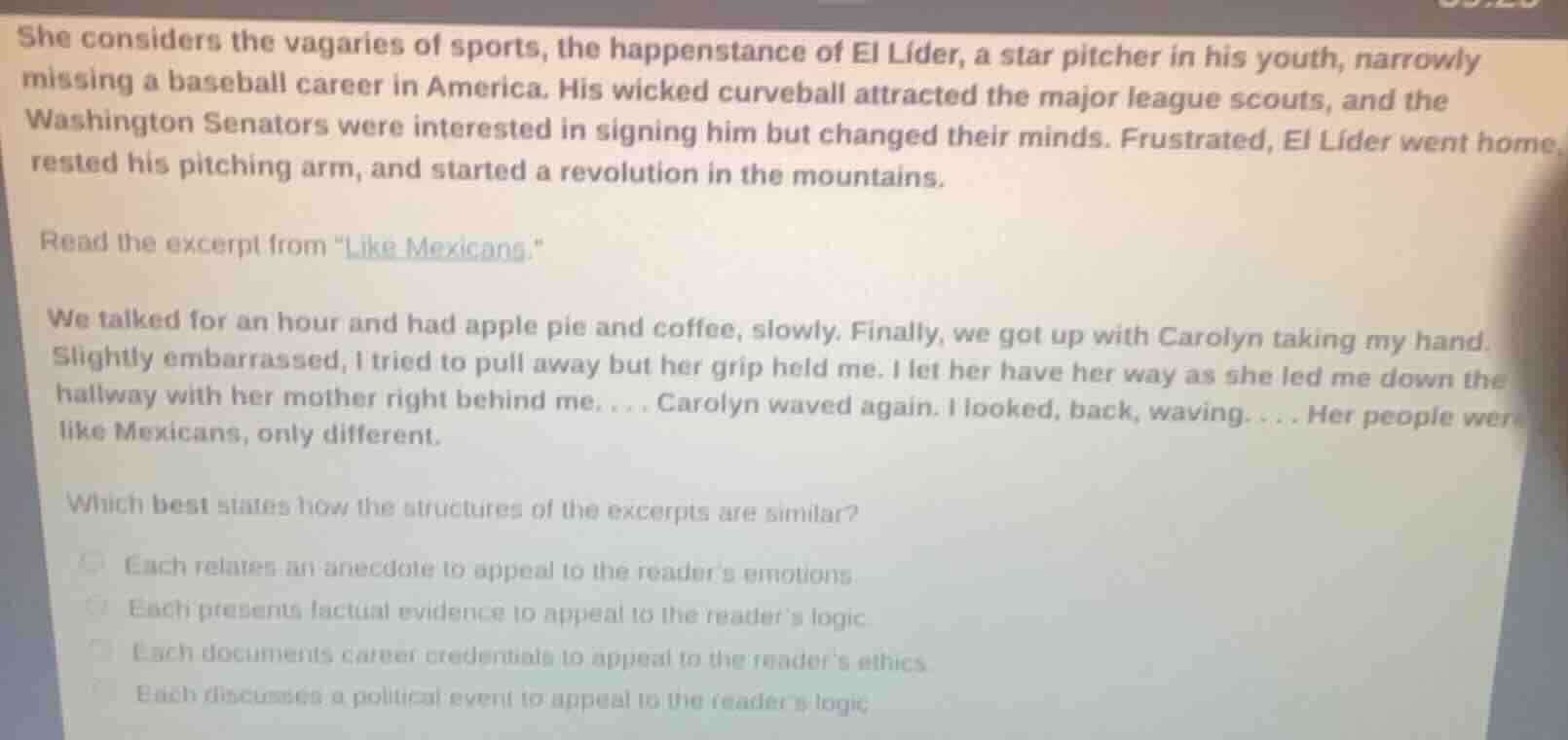
she considers the vagaries of sports, the happenstance of el líder, a star pitcher in his youth, narrowly missing a baseball career in america. his wicked curveball attracted the major league scouts, and the washington senators were interested in signing him but changed their minds. frustrated, el líder went home, rested his pitching arm, and started a revolution in the mountains.
read the excerpt from \like mexicans.\
we talked for an hour and had apple pie and coffee, slowly. finally, we got up with carolyn taking my hand. slightly embarrassed, i tried to pull away but her grip held me. i let her have her way as she led me down the hallway with her mother right behind me.... carolyn waved again. i looked, back, waving.... her people were like mexicans, only different.
which best states how the structures of the excerpts are similar?
each relates an anecdote to appeal to the readers emotions.
each presents factual evidence to appeal to the readers logic.
each documents career credentials to appeal to the readers ethics.
each discusses a political event to appeal to the readers logic.
Analyze the first excerpt
Using the Dreaming in Cuban Analysis and Anecdote Function knowledge points
The first excerpt is from Cristina García's Dreaming in Cuban. It tells a brief, personal story (an anecdote) about "El Líder" (Fidel Castro) as a young, talented baseball player who was scouted by the Washington Senators but ultimately went home to start a revolution. This narrative snippet humanizes a historical figure and evokes emotional reflection on fate, chance, and the personal paths that lead to major historical shifts.
Analyze the second excerpt
Using the Like Mexicans Analysis and Anecdote Function knowledge points
The second excerpt is from Gary Soto's autobiographical essay Like Mexicans. It recounts a highly personal, intimate moment where the narrator is visiting his girlfriend Carolyn's family. The description of holding hands, feeling slightly embarrassed, and realizing "Her people were like Mexicans, only different" is a personal anecdote. This story appeals to the reader's emotions (pathos) by highlighting themes of connection, vulnerability, and shared humanity across cultural lines.
Compare the structures and rhetorical appeals
Both excerpts utilize narrative storytelling in the form of short, illustrative stories. These stories are designed to connect with the reader on a human level rather than presenting dry, objective data or formal arguments. Therefore, both authors use an anecdote to appeal to the reader's emotions (pathos).
Evaluate the given options
- Option 1: "Each relates an anecdote to appeal to the reader's emotions." This correctly identifies the narrative structure (anecdote) and the primary rhetorical appeal (emotions/pathos).
- Option 2: "Each presents factual evidence to appeal to the reader's logic." Neither excerpt functions as a logical, evidence-based argument (logos).
- Option 3: "Each documents career credentials to appeal to the reader's ethics." Neither passage is focused on establishing professional credentials or ethical authority (ethos).
- Option 4: "Each discusses a political event to appeal to the reader's logic." While the first excerpt mentions a revolution, the second excerpt is entirely personal and domestic, and neither uses logical argumentation.

Snap & solve any problem in the app
Get step-by-step solutions on Sovi AI
Photo-based solutions with guided steps
Explore more problems and detailed explanations
- (A) Each relates an anecdote to appeal to the reader's emotions. (Correct answer)
- (B) Each presents factual evidence to appeal to the reader's logic.
- (C) Each documents career credentials to appeal to the reader's ethics.
- (D) Each discusses a political event to appeal to the reader's logic.