QUESTION IMAGE
Question
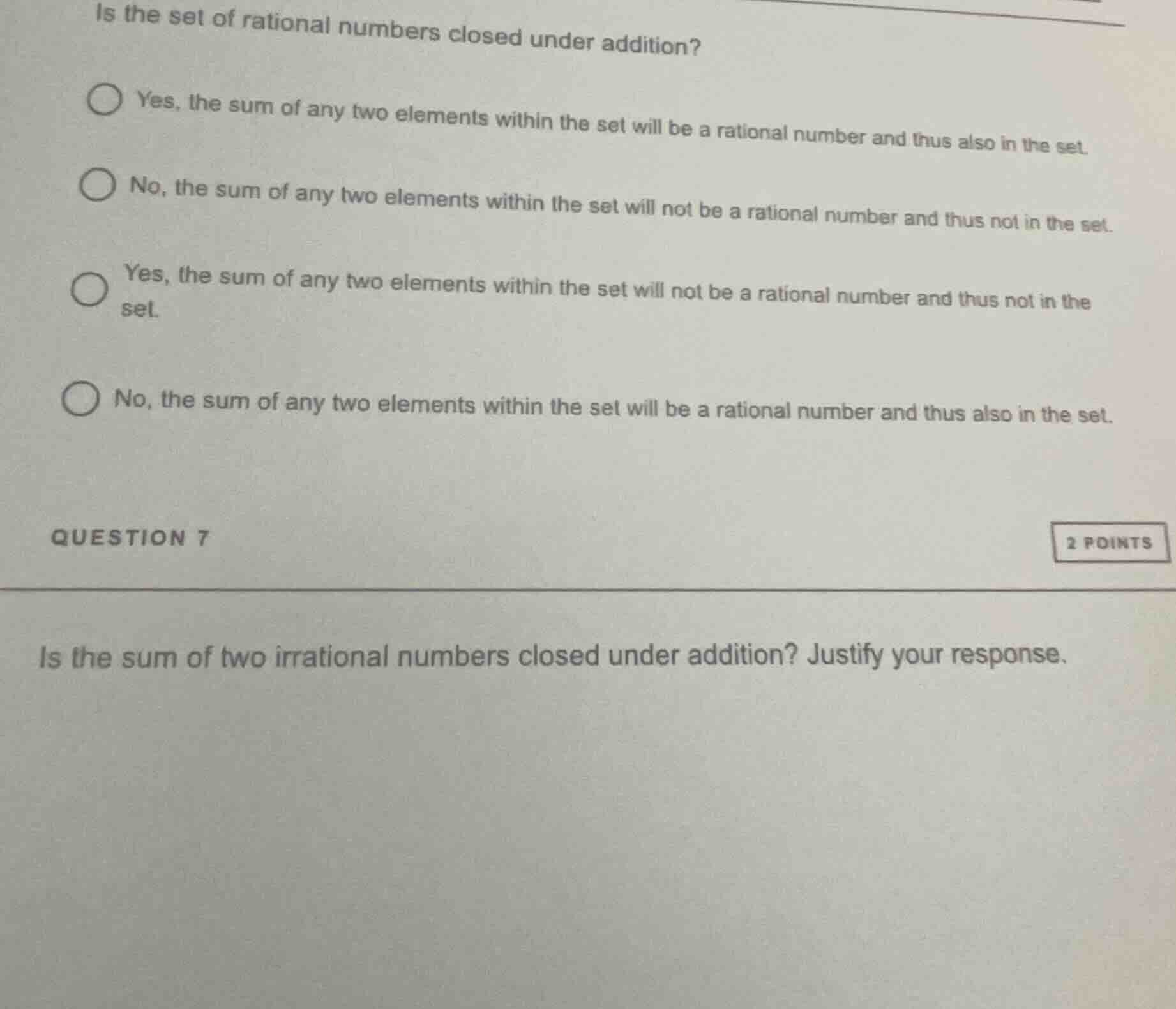
is the set of rational numbers closed under addition?
yes, the sum of any two elements within the set will be a rational number and thus also in the set.
no, the sum of any two elements within the set will not be a rational number and thus not in the set.
yes, the sum of any two elements within the set will not be a rational number and thus not in the set.
no, the sum of any two elements within the set will be a rational number and thus also in the set.
question 7
is the sum of two irrational numbers closed under addition? justify your response.
Analyze closure of rational numbers under addition
Using the Closure Under Addition and Rational Numbers knowledge points:
A set is closed under addition if adding any two elements in the set always results in an element that is also in the set.
The sum of any two rational numbers \(\frac{a}{b} + \frac{c}{d} = \frac{ad + bc}{bd}\) is always a rational number.
Thus, the set of rational numbers is closed under addition.
This matches the first option: "Yes, the sum of any two elements within the set will be a rational number and thus also in the set."
Analyze closure of irrational numbers under addition
Using the Closure Property and Irrational Numbers knowledge points:
To determine if irrational numbers are closed under addition, we look for a counterexample where the sum of two irrational numbers is rational.
Consider the two irrational numbers \(\sqrt{2}\) and \(-\sqrt{2}\).
Their sum is:
Since \(0\) is a rational number, the sum of these two irrational numbers is not irrational.
Therefore, the set of irrational numbers is not closed under addition.

Snap & solve any problem in the app
Get step-by-step solutions on Sovi AI
Photo-based solutions with guided steps
Explore more problems and detailed explanations
Question 1
- Yes, the sum of any two elements within the set will be a rational number and thus also in the set. (Correct answer)
- No, the sum of any two elements within the set will not be a rational number and thus not in the set.
- Yes, the sum of any two elements within the set will not be a rational number and thus not in the set.
- No, the sum of any two elements within the set will be a rational number and thus also in the set.
Question 2
No.