QUESTION IMAGE
Question
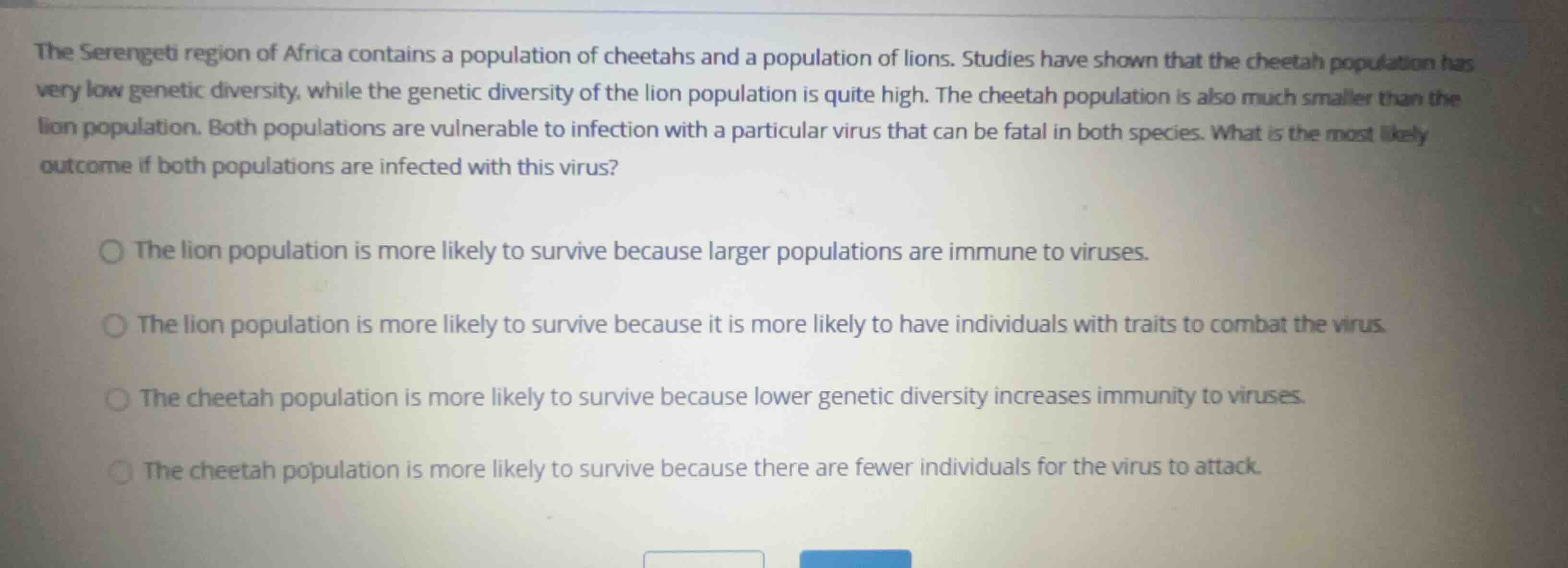
the serengeti region of africa contains a population of cheetahs and a population of lions. studies have shown that the cheetah population has very low genetic diversity, while the genetic diversity of the lion population is quite high. the cheetah population is also much smaller than the lion population. both populations are vulnerable to infection with a particular virus that can be fatal in both species. what is the most likely outcome if both populations are infected with this virus?
- the lion population is more likely to survive because larger populations are immune to viruses.
- the lion population is more likely to survive because it is more likely to have individuals with traits to combat the virus.
- the cheetah population is more likely to survive because lower genetic diversity increases immunity to viruses.
- the cheetah population is more likely to survive because there are fewer individuals for the virus to attack.
Analyze the given population characteristics
The problem describes two populations in the Serengeti:
- Cheetahs: Very low genetic diversity, much smaller population size.
- Lions: High genetic diversity, larger population size.
Both populations are vulnerable to a potentially fatal virus. We need to determine the most likely outcome if both are infected.
Evaluate the role of genetic diversity
Genetic diversity refers to the total number of genetic characteristics in the genetic makeup of a species. High genetic diversity within a population means there is a wider variety of alleles. When a new disease or virus infects a population, individuals with specific genetic variations may possess natural resistance or traits that allow them to combat and survive the pathogen.
Assess the impact on each population
- Lions: Because their genetic diversity is high, it is highly probable that some individuals carry gene variants that provide resistance to this specific virus. These individuals are more likely to survive, reproduce, and pass on their resistant traits, allowing the population to persist.
- Cheetahs: Because their genetic diversity is extremely low, almost all individuals are genetically very similar. If one cheetah is highly susceptible to the virus, it is highly likely that nearly all of them are equally susceptible, making the entire population highly vulnerable to extinction or severe decline.
Evaluate the given multiple-choice options
- Option 1: "The lion population is more likely to survive because larger populations are immune to viruses." This is incorrect because population size alone does not grant immunity to individuals.
- Option 2: "The lion population is more likely to survive because it is more likely to have individuals with traits to combat the virus." This aligns perfectly with the biological principles of genetic diversity and natural selection.
- Option 3: "The cheetah population is more likely to survive because lower genetic diversity increases immunity to viruses." This is incorrect; lower genetic diversity decreases a population's capacity to adapt to environmental pressures like diseases.
- Option 4: "The cheetah population is more likely to survive because there are fewer individuals for the virus to attack." This is incorrect; a smaller, genetically uniform population is much more vulnerable to being completely wiped out by an epidemic.

Snap & solve any problem in the app
Get step-by-step solutions on Sovi AI
Photo-based solutions with guided steps
Explore more problems and detailed explanations
- The lion population is more likely to survive because larger populations are immune to viruses.
- The lion population is more likely to survive because it is more likely to have individuals with traits to combat the virus. (Correct answer)
- The cheetah population is more likely to survive because lower genetic diversity increases immunity to viruses.
- The cheetah population is more likely to survive because there are fewer individuals for the virus to attack.