Sovi.AI - AI Math Tutor

Scan to solve math questions

QUESTION IMAGE

a sequence of transformations is described below. * a dilation about a …

Question

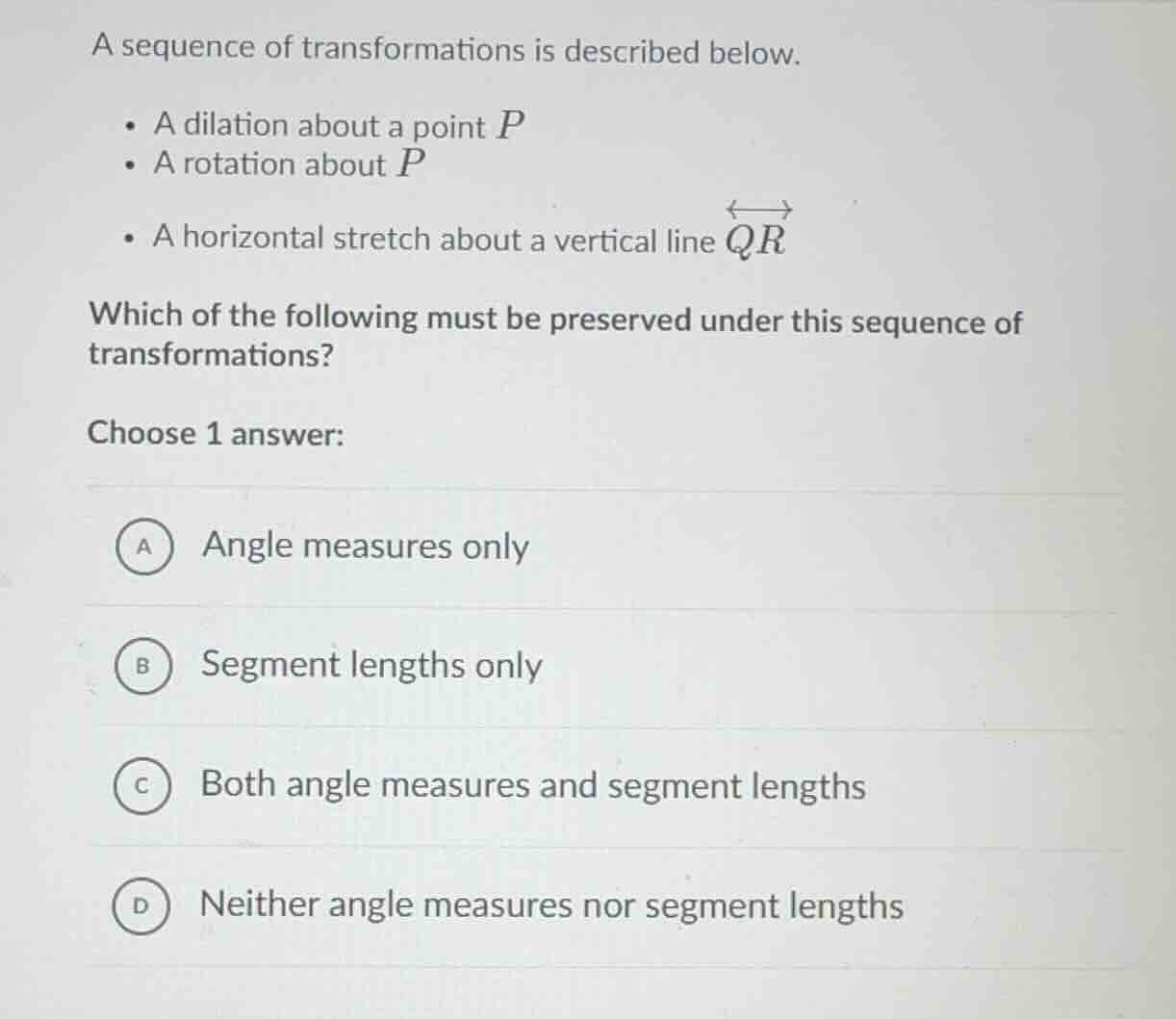
a sequence of transformations is described below.

  • a dilation about a point \\(p\\)
  • a rotation about \\(p\\)
  • a horizontal stretch about a vertical line \\(\overleftrightarrow{qr}\\)

which of the following must be preserved under this sequence of transformations?

choose 1 answer:

a angle measures only
b segment lengths only
c both angle measures and segment lengths
d neither angle measures nor segment lengths

Explanation:

Response

<pre_analysis>
{
"quality": "clear",
"question_count": 1,
"skills_matched": [
"direct_cot",
"multiple_choice_formatter",
"explain_then_answer",
"tutor",
"mastery_adaptive_brevity"
],
"needs_drawing": false,
"concepts_used": [
"Geometric Transformations",
"Rigid Transformations"
],
"new_concepts": [
"Non-rigid Transformations",
"Stretch Transformations"
],
"current_concepts": [
"Geometric Transformations",
"Rigid Transformations",
"Non-rigid Transformations",
"Stretch Transformations"
]
}
</pre_analysis>

<reasoning>

Analyze the first two transformations

Using the Geometric Transformations and Rigid Transformations knowledge points

  • A dilation about a point \(P\) preserves angle measures but changes segment lengths.
  • A rotation about \(P\) is a rigid transformation, preserving both angle measures and segment lengths.

Analyze the horizontal stretch

  • A horizontal stretch about a vertical line \(\overleftrightarrow{QR}\) scales coordinates in only one direction.
  • This non-rigid transformation distorts shapes, changing both segment lengths and angle measures.

Determine what is preserved overall

  • Since the horizontal stretch changes both angles and lengths, neither property is preserved by the entire sequence.

</reasoning>

<answer>
<mcq-option>(A) Angle measures only</mcq-option>
<mcq-option>(B) Segment lengths only</mcq-option>
<mcq-option>(C) Both angle measures and segment lengths</mcq-option>
<mcq-correct>(D) Neither angle measures nor segment lengths</mcq-correct>
</answer>

<post_analysis>
{
"subject": "Mathematics",
"question_type": "Multiple Choice",
"knowledge_point": [
"Mathematics",
"Geometry",
"Geometric Transformations"
]
}
</post_analysis>

Answer:

<pre_analysis>
{
"quality": "clear",
"question_count": 1,
"skills_matched": [
"direct_cot",
"multiple_choice_formatter",
"explain_then_answer",
"tutor",
"mastery_adaptive_brevity"
],
"needs_drawing": false,
"concepts_used": [
"Geometric Transformations",
"Rigid Transformations"
],
"new_concepts": [
"Non-rigid Transformations",
"Stretch Transformations"
],
"current_concepts": [
"Geometric Transformations",
"Rigid Transformations",
"Non-rigid Transformations",
"Stretch Transformations"
]
}
</pre_analysis>

<reasoning>

Analyze the first two transformations

Using the Geometric Transformations and Rigid Transformations knowledge points

  • A dilation about a point \(P\) preserves angle measures but changes segment lengths.
  • A rotation about \(P\) is a rigid transformation, preserving both angle measures and segment lengths.

Analyze the horizontal stretch

  • A horizontal stretch about a vertical line \(\overleftrightarrow{QR}\) scales coordinates in only one direction.
  • This non-rigid transformation distorts shapes, changing both segment lengths and angle measures.

Determine what is preserved overall

  • Since the horizontal stretch changes both angles and lengths, neither property is preserved by the entire sequence.

</reasoning>

<answer>
<mcq-option>(A) Angle measures only</mcq-option>
<mcq-option>(B) Segment lengths only</mcq-option>
<mcq-option>(C) Both angle measures and segment lengths</mcq-option>
<mcq-correct>(D) Neither angle measures nor segment lengths</mcq-correct>
</answer>

<post_analysis>
{
"subject": "Mathematics",
"question_type": "Multiple Choice",
"knowledge_point": [
"Mathematics",
"Geometry",
"Geometric Transformations"
]
}
</post_analysis>