QUESTION IMAGE
Question
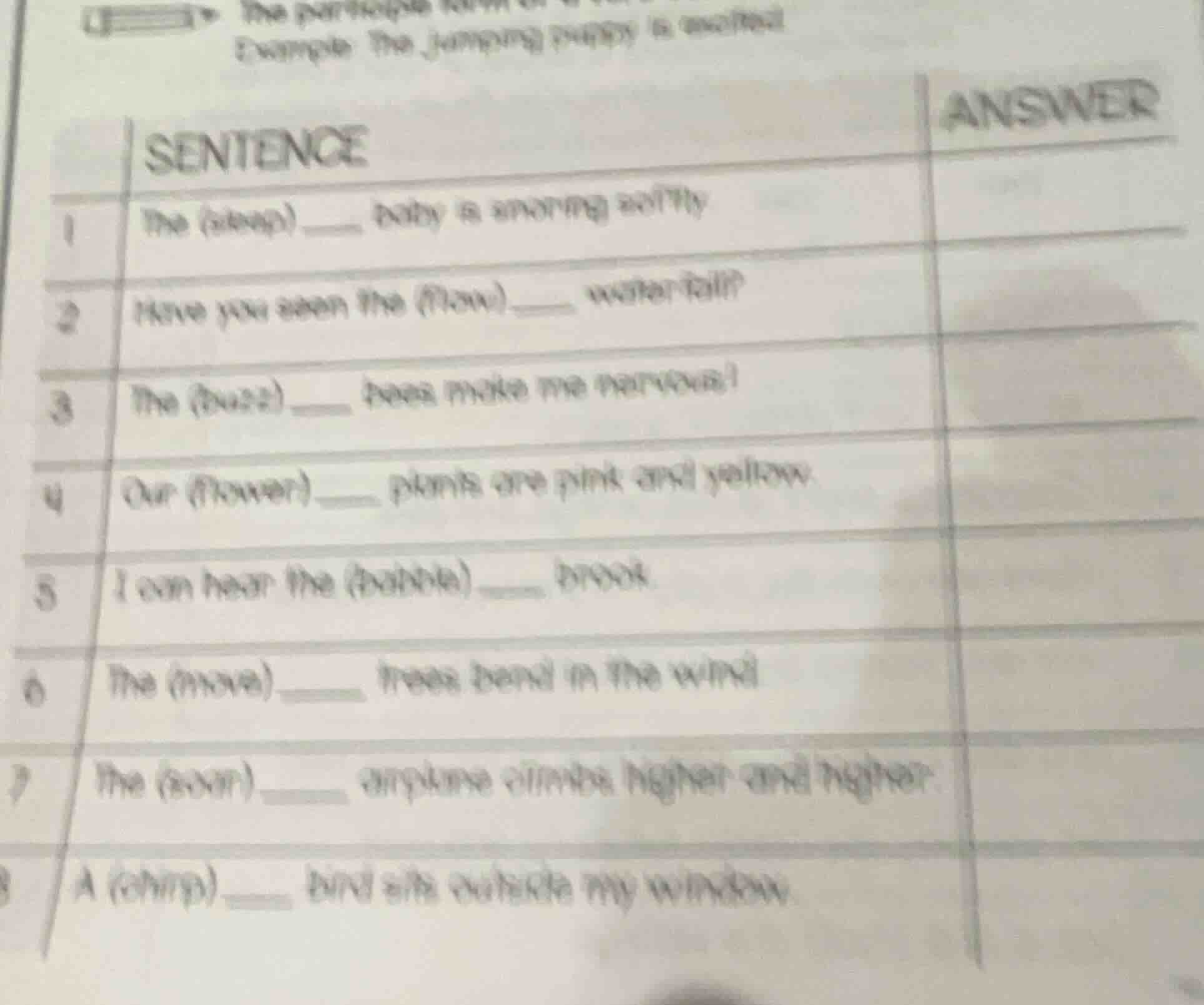
sentence answer
1 the (sleep) ____ baby is snoring softly
2 have you seen the (flow) ____ waterfall?
3 the (buzz) ____ bees make me nervous!
4 our (flower) ____ plants are pink and yellow.
5 i can hear the (bubble) ____ brook.
6 the (wave) ____ trees bend in the wind
7 the (roar) ____ airplane climbs higher and higher.
8 a (chirp) ____ bird sits outside my window.
To solve this, we need to convert the given verbs in parentheses into present participles (verb - ing form) to function as adjectives describing the nouns. The rule is to add “-ing” to the verb, and for some verbs, we might need to double the last consonant if they follow the short - vowel + consonant pattern (like “buzz”, “hum”, “move” has a silent “e” so we drop the “e” first, etc.).
1. For “The (sleep) ____ baby is snoring softly”
Step 1: Identify the verb and its transformation
The verb is “sleep”. To form the present participle, we just add “-ing” to “sleep”.
So, “sleep” becomes “sleeping”.
2. For “Have you seen the (flow) ____ waterfall?”
Step 1: Identify the verb and its transformation
The verb is “flow”. We add “-ing” to “flow” to get the present participle.
So, “flow” becomes “flowing”.
3. For “The (buzz) ____ bees make me nervous!”
Step 1: Identify the verb and its transformation
The verb is “buzz”. It follows the short - vowel + consonant (at the end) pattern, so we double the last consonant “z” and then add “-ing”.
So, “buzz” becomes “buzzing”.
4. For “Our (flower) ____ plants are pink and yellow.”
Step 1: Identify the verb and its transformation
The verb is “flower”. We add “-ing” to “flower” to get the present participle.
So, “flower” becomes “flowering”.
5. For “I can hear the (hum) ____ brook.”
Step 1: Identify the verb and its transformation
The verb is “hum”. It follows the short - vowel + consonant (at the end) pattern, so we double the last consonant “m” and then add “-ing”.
So, “hum” becomes “humming”.
6. For “The (move) ____ trees bend in the wind.”
Step 1: Identify the verb and its transformation
The verb is “move”. It has a silent “e” at the end, so we drop the “e” first and then add “-ing”.
So, “move” becomes “moving”.
7. For “The (soar) ____ airplane climbs higher and higher.”
Step 1: Identify the verb and its transformation
The verb is “soar”. We add “-ing” to “soar” to get the present participle.
So, “soar” becomes “soaring”.
8. For “A (chirp) ____ bird sits outside my window.”
Step 1: Identify the verb and its transformation
The verb is “chirp”. We add “-ing” to “chirp” to get the present participle.
So, “chirp” becomes “chirping”.

Snap & solve any problem in the app
Get step-by-step solutions on Sovi AI
Photo-based solutions with guided steps
Explore more problems and detailed explanations
s:
- sleeping
- flowing
- buzzing
- flowering
- humming
- moving
- soaring
- chirping