QUESTION IMAGE
Question
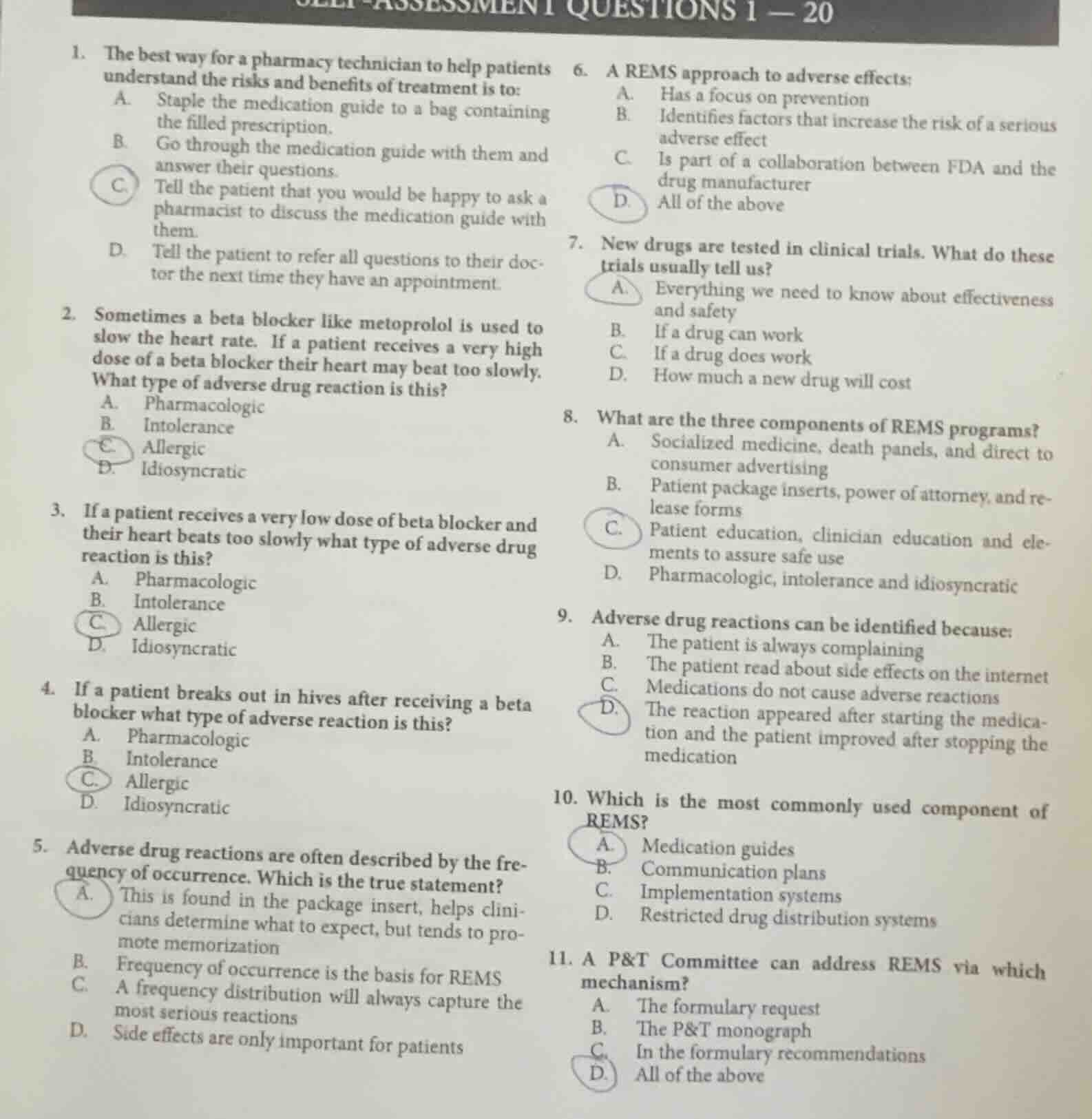
self-assessment questions 1 - 20
- the best way for a pharmacy technician to help patients understand the risks and benefits of treatment is to:
a. staple the medication guide to a bag containing the filled prescription.
b. go through the medication guide with them and answer their questions.
c. tell the patient that you would be happy to ask a pharmacist to discuss the medication guide with them.
d. tell the patient to refer all questions to their doctor the next time they have an appointment.
- sometimes a beta blocker like metoprolol is used to slow the heart rate. if a patient receives a very high dose of a beta blocker their heart may beat too slowly. what type of adverse drug reaction is this?
a. pharmacologic
b. intolerance
c. allergic
d. idiosyncratic
- if a patient receives a very low dose of beta blocker and their heart beats too slowly what type of adverse drug reaction is this?
a. pharmacologic
b. intolerance
c. allergic
d. idiosyncratic
- if a patient breaks out in hives after receiving a beta blocker what type of adverse reaction is this?
a. pharmacologic
b. intolerance
c. allergic
d. idiosyncratic
- adverse drug reactions are often described by the frequency of occurrence. which is the true statement?
a. this is found in the package insert, helps clinicians determine what to expect, but tends to promote memorization
b. frequency of occurrence is the basis for rems
c. a frequency distribution will always capture the most serious reactions
d. side effects are only important for patients
- a rems approach to adverse effects:
a. has a focus on prevention
b. identifies factors that increase the risk of a serious adverse effect
c. is part of a collaboration between fda and the drug manufacturer
d. all of the above
- new drugs are tested in clinical trials. what do these trials usually tell us?
a. everything we need to know about effectiveness and safety
b. if a drug can work
c. if a drug does work
d. how much a new drug will cost
- what are the three components of rems programs?
a. socialized medicine, death panels, and direct to consumer advertising
b. patient package inserts, power of attorney, and release forms
c. patient education, clinician education and elements to assure safe use
d. pharmacologic, intolerance and idiosyncratic
- adverse drug reactions can be identified because:
a. the patient is always complaining
b. the patient read about side effects on the internet
c. medications do not cause adverse reactions
d. the reaction appeared after starting the medication and the patient improved after stopping the medication
- which is the most commonly used component of rems?
a. medication guides
b. communication plans
c. implementation systems
d. restricted drug distribution systems
- a p&t committee can address rems via which mechanism?
a. the formulary request
b. the p&t monograph
c. in the formulary recommendations
d. all of the above
Analyze questions 1 to 4
- Question 1: A pharmacy technician's role is to assist, but clinical counseling on risks/benefits must be referred to the pharmacist. Thus, offering to ask a pharmacist is the best action. Correct: C.
- Question 2: A very high dose causing an exaggerated but expected pharmacological effect (bradycardia from beta-blocker) is a pharmacologic adverse reaction. Correct: A.
- Question 3: An abnormally low dose causing an exaggerated expected effect indicates low threshold/tolerance, which is intolerance. Correct: B.
- Question 4: Hives represent an immunologically mediated hypersensitivity reaction, which is allergic. Correct: C.
Analyze questions 5 to 8
- Question 5: Frequency of occurrence is found in the package insert to help clinicians know what to expect. Correct: A.
- Question 6: REMS (Risk Evaluation and Mitigation Strategies) focuses on prevention, identifies serious risks, and is a collaboration between FDA and manufacturers. Correct: D.
- Question 7: Clinical trials are designed to determine if a drug can work (efficacy) and does work (effectiveness) under specific conditions. Correct: B or C (typically "if a drug can work" in controlled trials).
- Question 8: The three components of REMS are patient education (Medication Guides), clinician education (Communication Plans), and elements to assure safe use (ETASU). Correct: C.
Analyze questions 9 to 11
- Question 9: Adverse drug reactions are identified by temporal relationship: appearing after starting and improving after stopping. Correct: D.
- Question 10: Medication guides are the most widely distributed and commonly used component of REMS. Correct: A.
- Question 11: A Pharmacy and Therapeutics (P&T) Committee addresses REMS through formulary requests, monographs, and recommendations. Correct: D.

Snap & solve any problem in the app
Get step-by-step solutions on Sovi AI
Photo-based solutions with guided steps
Explore more problems and detailed explanations
- (C)
- (A)
- (B)
- (C)
- (A)
- (D)
- (B)
- (C)
- (D)
- (A)
- (D)