QUESTION IMAGE
Question
select the correct answer.
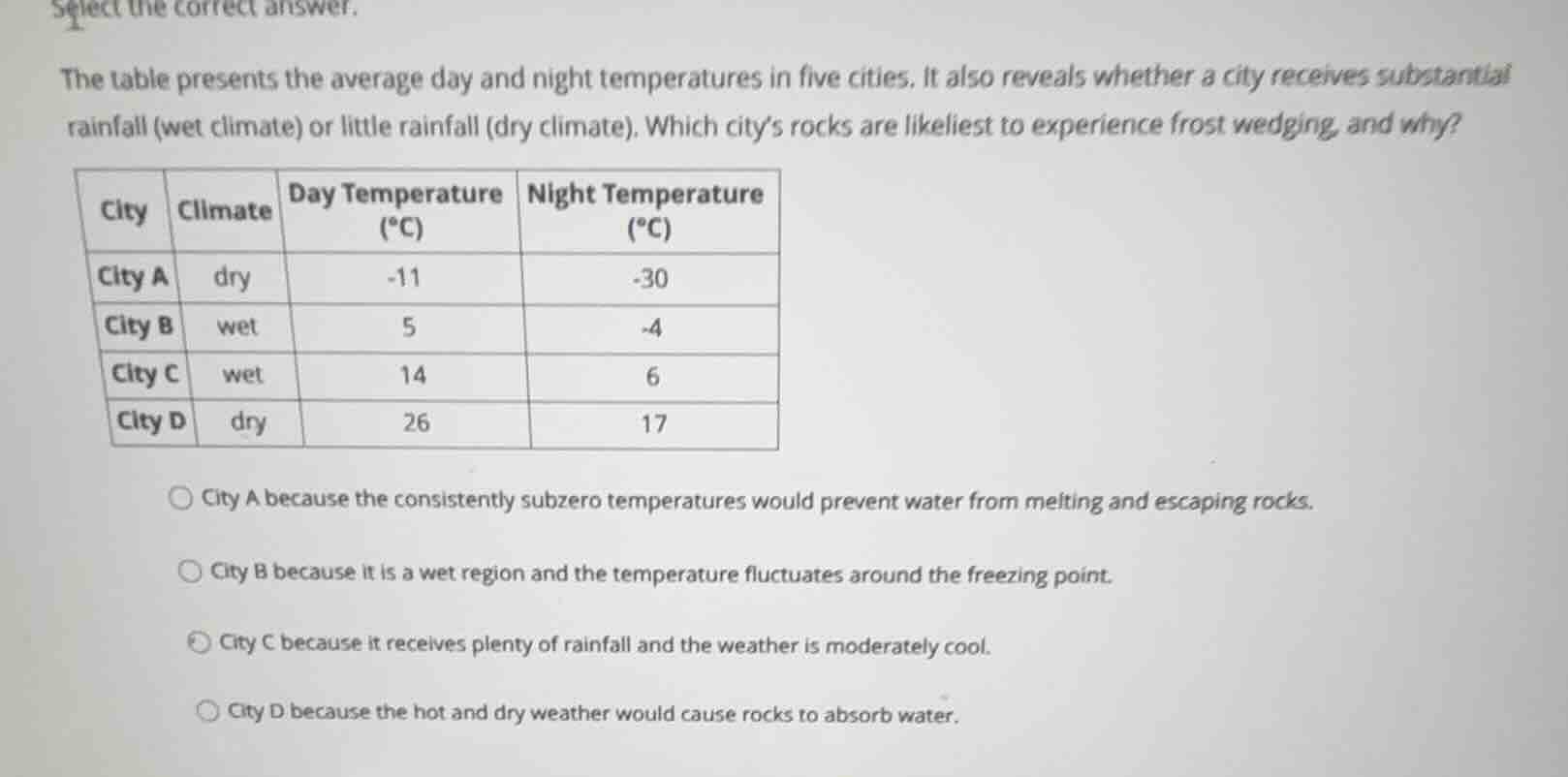
the table presents the average day and night temperatures in five cities. it also reveals whether a city receives substantial rainfall (wet climate) or little rainfall (dry climate). which citys rocks are likeliest to experience frost wedging, and why?
\
city a because the consistently subzero temperatures would prevent water from melting and escaping rocks.
city b because it is a wet region and the temperature fluctuates around the freezing point.
city c because it receives plenty of rainfall and the weather is moderately cool.
city d because the hot and dry weather would cause rocks to absorb water.
Requisitos para la gelifracción (frost wedging)
La gelifracción requiere la presencia de agua líquida (clima húmedo o "wet") y fluctuaciones de temperatura que crucen repetidamente el punto de congelación (\(0^\circ\text{C}\)) para permitir ciclos de congelación y descongelación.
Análisis de los datos de las ciudades
- Ciudad A: Clima seco ("dry"), temperaturas siempre bajo cero (\(-11^\circ\text{C}\) y \(-30^\circ\text{C}\)). Sin agua líquida ni ciclos de deshielo.
- Ciudad B: Clima húmedo ("wet"), la temperatura fluctúa cruzando el punto de congelación (\(5^\circ\text{C}\) de día, \(-4^\circ\text{C}\) de noche).
- Ciudad C: Clima húmedo ("wet"), temperaturas siempre sobre cero (\(14^\circ\text{C}\) y \(6^\circ\text{C}\)). Sin congelación.
- Ciudad D: Clima seco ("dry"), temperaturas cálidas (\(26^\circ\text{C}\) y \(17^\circ\text{C}\)).
Selección de la opción correcta
La Ciudad B cumple con ambas condiciones necesarias: disponibilidad de agua y temperaturas que oscilan por encima y por debajo de \(0^\circ\text{C}\).

Snap & solve any problem in the app
Get step-by-step solutions on Sovi AI
Photo-based solutions with guided steps
Explore more problems and detailed explanations
- City A because the consistently subzero temperatures would prevent water from melting and escaping rocks.
- City B because it is a wet region and the temperature fluctuates around the freezing point. (Correct answer)
- City C because it receives plenty of rainfall and the weather is moderately cool.
- City D because the hot and dry weather would cause rocks to absorb water.