QUESTION IMAGE
Question
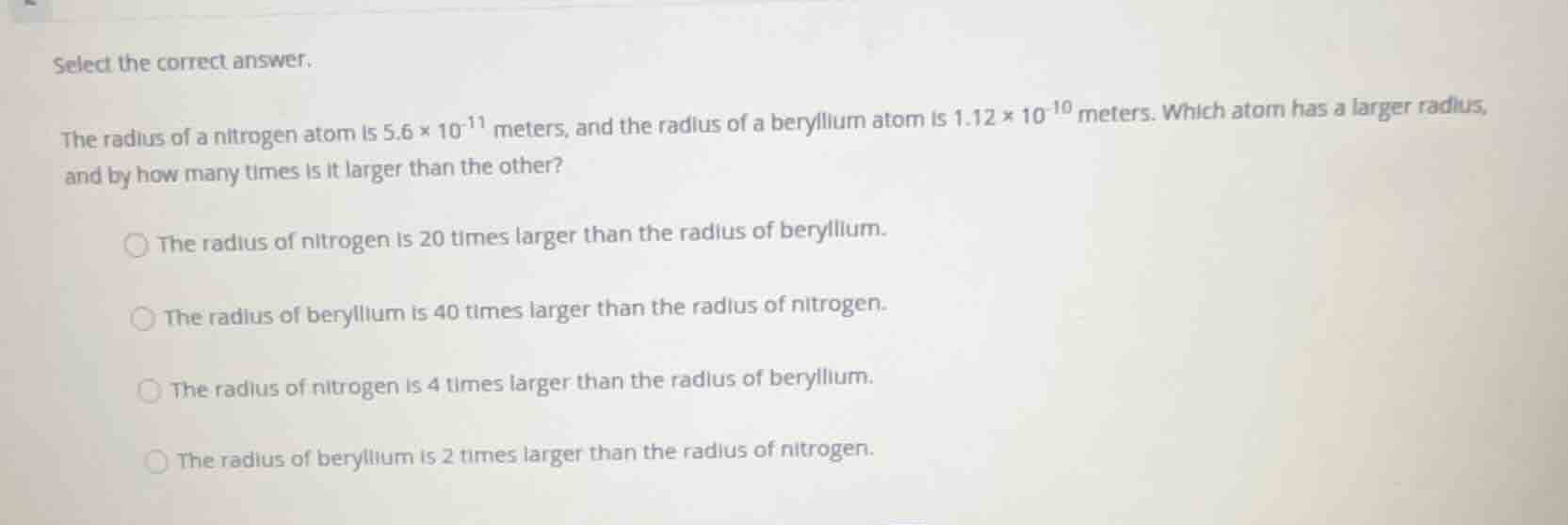
select the correct answer.
the radius of a nitrogen atom is \\(5.6 \times 10^{-11}\\) meters, and the radius of a beryllium atom is \\(1.12 \times 10^{-10}\\) meters. which atom has a larger radius, and by how many times is it larger than the other?
- the radius of nitrogen is 20 times larger than the radius of beryllium.
- the radius of beryllium is 40 times larger than the radius of nitrogen.
- the radius of nitrogen is 4 times larger than the radius of beryllium.
- the radius of beryllium is 2 times larger than the radius of nitrogen.
Identify the given values
We are given the following values:
- Radius of a nitrogen atom: \(R_N = 5.6 \times 10^{-11}\text{ meters}\)
- Radius of a beryllium atom: \(R_{Be} = 1.12 \times 10^{-10}\text{ meters}\)
Compare the magnitudes
Using the Scientific Notation knowledge point
$$
LATEXBLOCK0
$$
Calculate the ratio
Using the Quotient of Powers knowledge point
$$
LATEXBLOCK1
$$

Snap & solve any problem in the app
Get step-by-step solutions on Sovi AI
Photo-based solutions with guided steps
Explore more problems and detailed explanations
- The radius of nitrogen is 20 times larger than the radius of beryllium.
- The radius of beryllium is 40 times larger than the radius of nitrogen.
- The radius of nitrogen is 4 times larger than the radius of beryllium.
- The radius of beryllium is 2 times larger than the radius of nitrogen. (Correct answer)