QUESTION IMAGE
Question
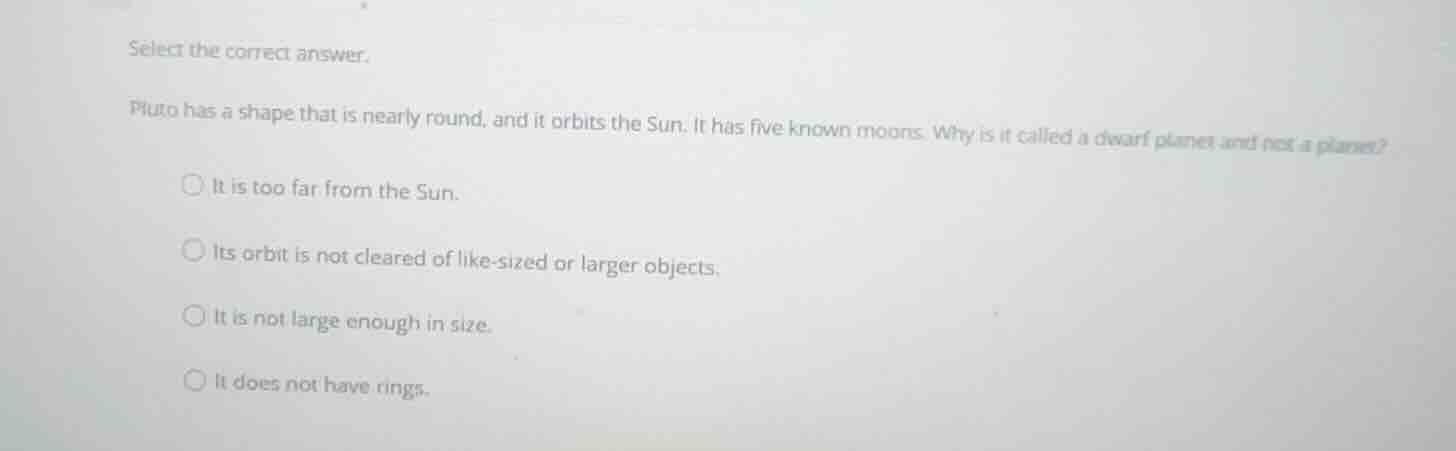
select the correct answer.
pluto has a shape that is nearly round, and it orbits the sun. it has five known moons. why is it called a dwarf planet and not a planet?
- it is too far from the sun.
- its orbit is not cleared of like-sized or larger objects.
- it is not large enough in size.
- it does not have rings.
<pre_analysis>
{
"quality": "clear",
"question_count": 1,
"skills_matched": [
"direct_cot",
"multiple_choice_formatter",
"explain_then_answer",
"tutor",
"mastery_adaptive_brevity"
],
"needs_drawing": false,
"concepts_used": [
"Dwarf Planets"
],
"new_concepts": [],
"current_concepts": [
"Dwarf Planets",
"Solar System Structure"
]
}
</pre_analysis>
<reasoning>
Define the criteria for a planet
According to the International Astronomical Union (IAU), a celestial body must meet three criteria to be classified as a planet:
- It must orbit the Sun.
- It must have sufficient mass to assume a nearly round shape (hydrostatic equilibrium).
- It must have "cleared the neighborhood" around its orbit of other objects.
Evaluate Pluto against the criteria
Using the Dwarf Planets knowledge point
- Pluto orbits the Sun and is nearly round, satisfying the first two criteria.
- However, Pluto shares its orbital zone in the Kuiper Belt with many other similar-sized icy bodies.
- Therefore, Pluto has not cleared its orbital neighborhood, which is why it is classified as a dwarf planet.
</reasoning>
<answer>
<mcq-option>(A) It is too far from the Sun.</mcq-option>
<mcq-correct>(B) Its orbit is not cleared of like-sized or larger objects.</mcq-correct>
<mcq-option>(C) It is not large enough in size.</mcq-option>
<mcq-option>(D) It does not have rings.</mcq-option>
</answer>
<post_analysis>
{
"subject": "Natural Science",
"question_type": "Multiple Choice",
"knowledge_point": [
"Natural Science",
"Astronomy",
"Dwarf Planets"
]
}
</post_analysis>
Snap & solve any problem in the app
Get step-by-step solutions on Sovi AI
Photo-based solutions with guided steps
Explore more problems and detailed explanations
<pre_analysis>
{
"quality": "clear",
"question_count": 1,
"skills_matched": [
"direct_cot",
"multiple_choice_formatter",
"explain_then_answer",
"tutor",
"mastery_adaptive_brevity"
],
"needs_drawing": false,
"concepts_used": [
"Dwarf Planets"
],
"new_concepts": [],
"current_concepts": [
"Dwarf Planets",
"Solar System Structure"
]
}
</pre_analysis>
<reasoning>
Define the criteria for a planet
According to the International Astronomical Union (IAU), a celestial body must meet three criteria to be classified as a planet:
- It must orbit the Sun.
- It must have sufficient mass to assume a nearly round shape (hydrostatic equilibrium).
- It must have "cleared the neighborhood" around its orbit of other objects.
Evaluate Pluto against the criteria
Using the Dwarf Planets knowledge point
- Pluto orbits the Sun and is nearly round, satisfying the first two criteria.
- However, Pluto shares its orbital zone in the Kuiper Belt with many other similar-sized icy bodies.
- Therefore, Pluto has not cleared its orbital neighborhood, which is why it is classified as a dwarf planet.
</reasoning>
<answer>
<mcq-option>(A) It is too far from the Sun.</mcq-option>
<mcq-correct>(B) Its orbit is not cleared of like-sized or larger objects.</mcq-correct>
<mcq-option>(C) It is not large enough in size.</mcq-option>
<mcq-option>(D) It does not have rings.</mcq-option>
</answer>
<post_analysis>
{
"subject": "Natural Science",
"question_type": "Multiple Choice",
"knowledge_point": [
"Natural Science",
"Astronomy",
"Dwarf Planets"
]
}
</post_analysis>