QUESTION IMAGE
Question
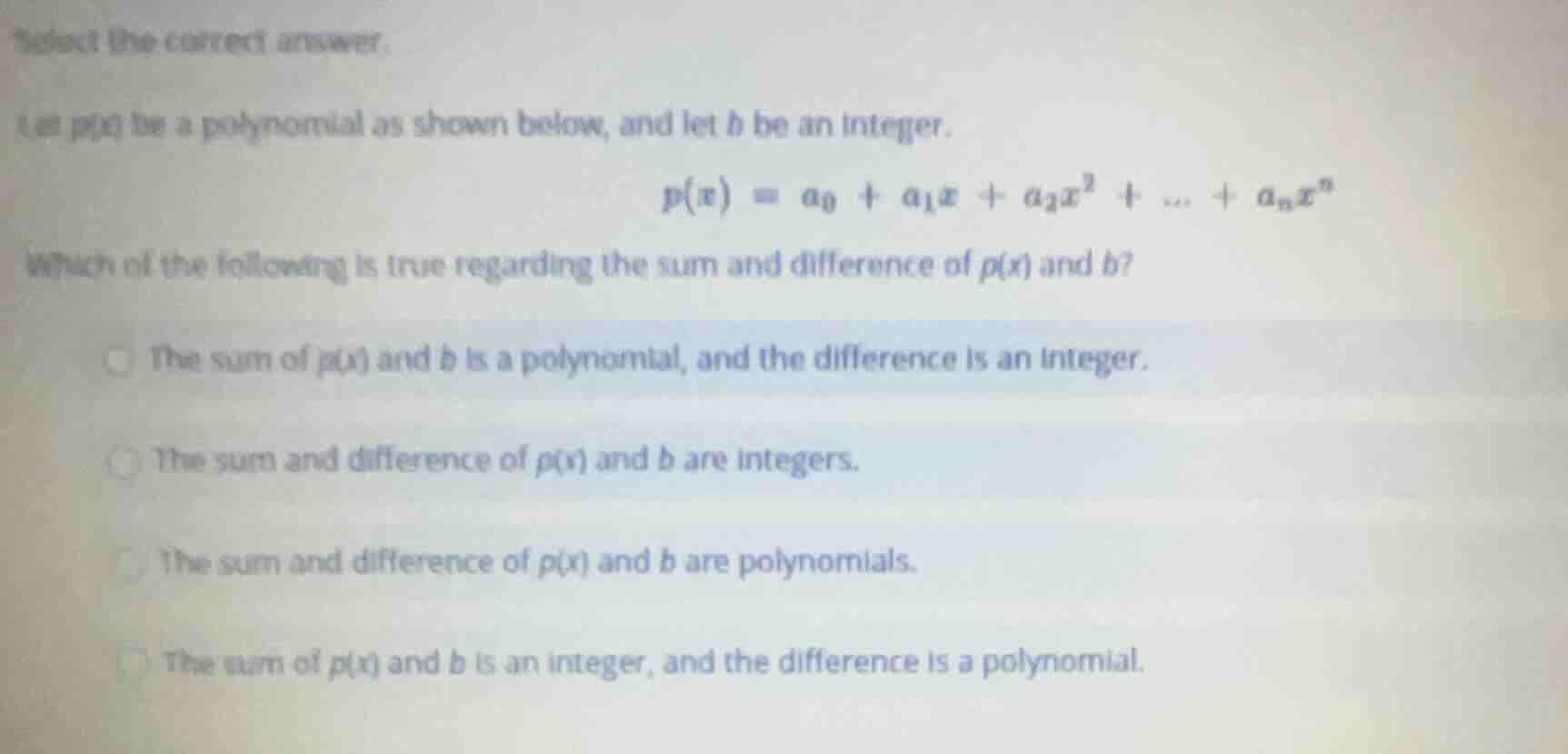
select the correct answer.
let \\(p(x)\\) be a polynomial as shown below, and let \\(b\\) be an integer.
\\p(x) = a_0 + a_1x + a_2x^2 + \dots + a_nx^n\\
which of the following is true regarding the sum and difference of \\(p(x)\\) and \\(b\\)?
- the sum of \\(p(x)\\) and \\(b\\) is a polynomial, and the difference is an integer.
- the sum and difference of \\(p(x)\\) and \\(b\\) are integers.
- the sum and difference of \\(p(x)\\) and \\(b\\) are polynomials.
- the sum of \\(p(x)\\) and \\(b\\) is an integer, and the difference is a polynomial.
Define the given expressions
We are given a polynomial \(p(x) = a_0 + a_1x + a_2x^2 + \dots + a_nx^n\) and an integer \(b\). An integer \(b\) can be considered a constant polynomial of degree 0, which is a specific type of polynomial.
Analyze the sum of the polynomial and the integer
Using the Polynomial Classification knowledge point, we express the sum of \(p(x)\) and \(b\):
Since \(a_0\) and \(b\) are constants, their sum \((a_0 + b)\) is also a constant. The resulting expression is still a polynomial.
Analyze the difference of the polynomial and the integer
Similarly, we express the difference of \(p(x)\) and \(b\):
Since \((a_0 - b)\) is a constant, this expression is also a polynomial.
Evaluate the given options
- Option 1: "The sum of \(p(x)\) and \(b\) is a polynomial, and the difference is an integer." (Incorrect, the difference is a polynomial)
- Option 2: "The sum and difference of \(p(x)\) and \(b\) are integers." (Incorrect, they are polynomials)
- Option 3: "The sum and difference of \(p(x)\) and \(b\) are polynomials." (Correct, both operations result in polynomials)
- Option 4: "The sum of \(p(x)\) and \(b\) is an integer, and the difference is a polynomial." (Incorrect)

Snap & solve any problem in the app
Get step-by-step solutions on Sovi AI
Photo-based solutions with guided steps
Explore more problems and detailed explanations
- The sum of p(x) and b is a polynomial, and the difference is an integer.
- The sum and difference of p(x) and b are integers.
- The sum and difference of p(x) and b are polynomials. (Correct answer)
- The sum of p(x) and b is an integer, and the difference is a polynomial.