Sovi.AI - AI Math Tutor

Scan to solve math questions

QUESTION IMAGE

select the correct answer from each drop-down menu. sugar plantations w…

Question

select the correct answer from each drop-down menu.

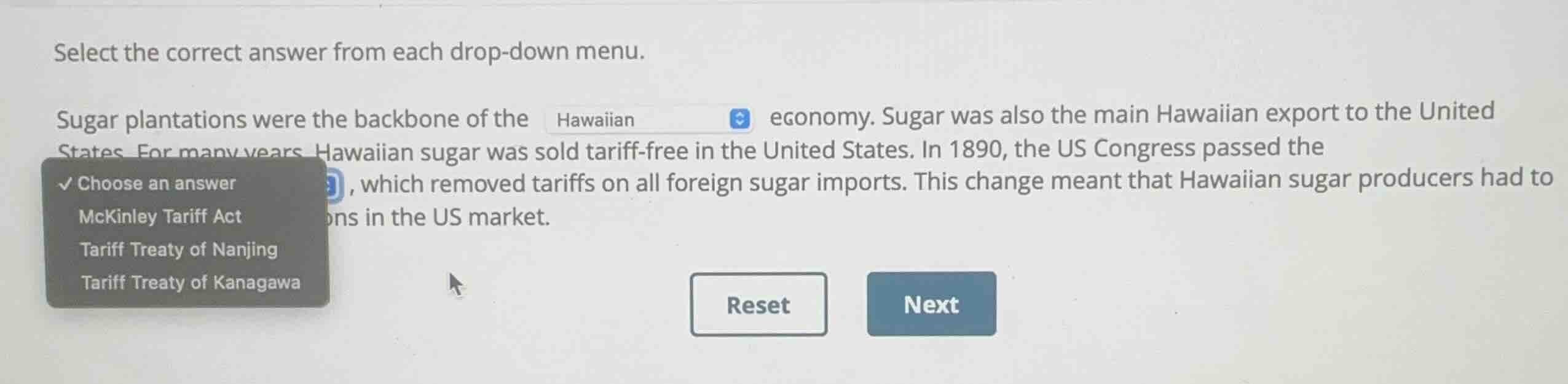
sugar plantations were the backbone of the hawaiian economy. sugar was also the main hawaiian export to the united states. for many years, hawaiian sugar was sold tariff-free in the united states. in 1890, the us congress passed the choose an answer, which removed tariffs on all foreign sugar imports. this change meant that hawaiian sugar producers had to ons in the us market.

Explanation:

Response

<pre_analysis>
{
"quality": "clear",
"question_count": 1,
"skills_matched": [
"direct_cot",
"blank_filling_formatter",
"explain_then_answer",
"quick"
],
"needs_drawing": false,
"concepts_used": [
"Annexation of Hawaii",
"McKinley Tariff"
],
"new_concepts": [],
"current_concepts": [
"Annexation of Hawaii",
"McKinley Tariff"
]
}
</pre_analysis>

<reasoning>

Identify the historical context

The passage discusses the Hawaiian economy, sugar exports to the United States, and a specific US tariff act passed in 1890 that removed tariffs on all foreign sugar imports, thereby eliminating the competitive advantage of Hawaiian sugar.

Evaluate the options

The options in the drop-down menu are:

  • McKinley Tariff Act
  • Tariff Treaty of Nanjing
  • Tariff Treaty of Kanagawa

The McKinley Tariff was passed by the US Congress in 1890. It raised average duties on imports but placed sugar on the free list, while providing a bounty to domestic US sugar producers, which severely impacted the Hawaiian sugar economy. The Treaty of Nanjing (1842) and the Treaty of Kanagawa (1854) are unrelated treaties involving China and Japan, respectively.

Fill the blanks

The first drop-down menu is already filled with "Hawaiian". The second drop-down menu must be filled with "McKinley Tariff Act".
</reasoning>

<answer>
Select the correct answer from each drop-down menu.

Sugar plantations were the backbone of the <blank>Hawaiian</blank> economy. Sugar was also the main Hawaiian export to the United States. For many years, Hawaiian sugar was sold tariff-free in the United States. In 1890, the US Congress passed the <blank>McKinley Tariff Act</blank>, which removed tariffs on all foreign sugar imports. This change meant that Hawaiian sugar producers had to face competition in the US market.
</answer>

<post_analysis>
{
"subject": "Social Science",
"question_type": "Fill-in-the-blank",
"knowledge_point": [
"Social Science",
"US History",
"Annexation of Hawaii"
]
}
</post_analysis>

Answer:

<pre_analysis>
{
"quality": "clear",
"question_count": 1,
"skills_matched": [
"direct_cot",
"blank_filling_formatter",
"explain_then_answer",
"quick"
],
"needs_drawing": false,
"concepts_used": [
"Annexation of Hawaii",
"McKinley Tariff"
],
"new_concepts": [],
"current_concepts": [
"Annexation of Hawaii",
"McKinley Tariff"
]
}
</pre_analysis>

<reasoning>

Identify the historical context

The passage discusses the Hawaiian economy, sugar exports to the United States, and a specific US tariff act passed in 1890 that removed tariffs on all foreign sugar imports, thereby eliminating the competitive advantage of Hawaiian sugar.

Evaluate the options

The options in the drop-down menu are:

  • McKinley Tariff Act
  • Tariff Treaty of Nanjing
  • Tariff Treaty of Kanagawa

The McKinley Tariff was passed by the US Congress in 1890. It raised average duties on imports but placed sugar on the free list, while providing a bounty to domestic US sugar producers, which severely impacted the Hawaiian sugar economy. The Treaty of Nanjing (1842) and the Treaty of Kanagawa (1854) are unrelated treaties involving China and Japan, respectively.

Fill the blanks

The first drop-down menu is already filled with "Hawaiian". The second drop-down menu must be filled with "McKinley Tariff Act".
</reasoning>

<answer>
Select the correct answer from each drop-down menu.

Sugar plantations were the backbone of the <blank>Hawaiian</blank> economy. Sugar was also the main Hawaiian export to the United States. For many years, Hawaiian sugar was sold tariff-free in the United States. In 1890, the US Congress passed the <blank>McKinley Tariff Act</blank>, which removed tariffs on all foreign sugar imports. This change meant that Hawaiian sugar producers had to face competition in the US market.
</answer>

<post_analysis>
{
"subject": "Social Science",
"question_type": "Fill-in-the-blank",
"knowledge_point": [
"Social Science",
"US History",
"Annexation of Hawaii"
]
}
</post_analysis>