QUESTION IMAGE
Question
select all the correct answers.
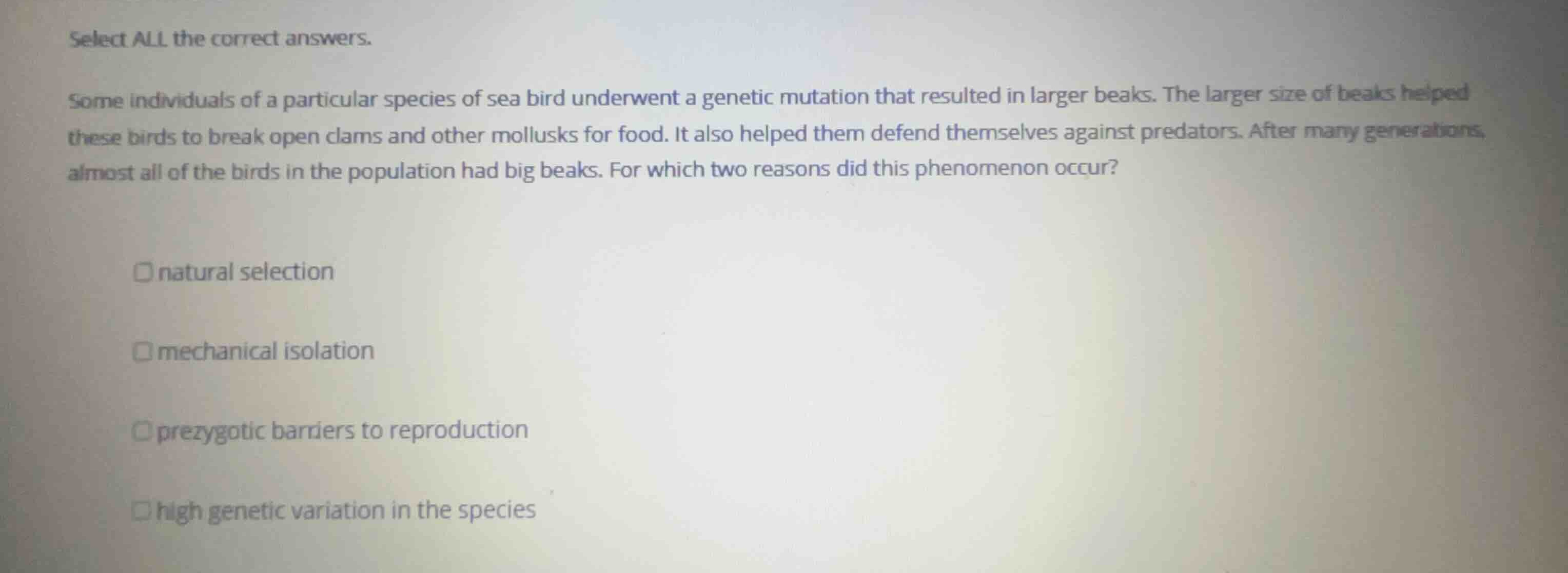
some individuals of a particular species of sea bird underwent a genetic mutation that resulted in larger beaks. the larger size of beaks helped these birds to break open clams and other mollusks for food. it also helped them defend themselves against predators. after many generations, almost all of the birds in the population had big beaks. for which two reasons did this phenomenon occur?
natural selection
mechanical isolation
prezygotic barriers to reproduction
high genetic variation in the species
Analyze the scenario
The prompt describes a scenario where a genetic mutation leads to larger beaks in a sea bird species. This trait provides clear survival advantages: obtaining food more easily (breaking open mollusks) and defending against predators. Over many generations, the trait becomes dominant in the population.
Evaluate natural selection
Using the Natural Selection knowledge point
Because the larger beak trait increases survival and reproductive success, individuals with this trait pass it on to their offspring, leading to an increase in its frequency over generations. Thus, natural selection is a primary reason for this phenomenon.
Evaluate reproductive barriers
The terms "mechanical isolation" and "prezygotic barriers to reproduction" refer to mechanisms that prevent different species from interbreeding. There is no mention of speciation, mating prevention, or reproductive incompatibility occurring in this single population. Therefore, these options are incorrect.
Evaluate genetic variation
For natural selection to act on a trait, there must be differences among individuals in the population. The introduction of a new mutation that alters beak size contributes to the genetic diversity of the species, allowing the environment to select for the more favorable phenotype. Thus, genetic variation is a necessary condition for this evolutionary change to occur.

Snap & solve any problem in the app
Get step-by-step solutions on Sovi AI
Photo-based solutions with guided steps
Explore more problems and detailed explanations
- natural selection (Correct answer)
- mechanical isolation
- prezygotic barriers to reproduction
- high genetic variation in the species (Correct answer)