QUESTION IMAGE
Question
select all that apply
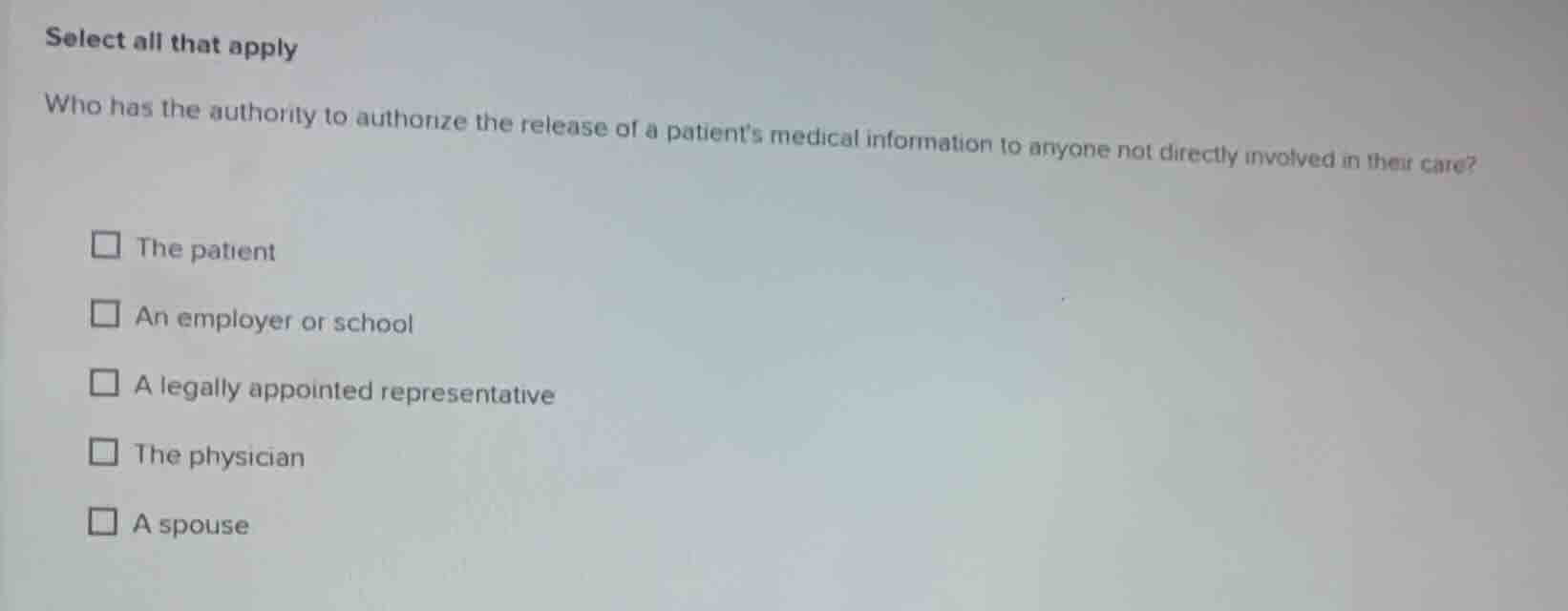
who has the authority to authorize the release of a patients medical information to anyone not directly involved in their care?
the patient
an employer or school
a legally appointed representative
the physician
a spouse
<pre_analysis>
{
"quality": "clear",
"question_count": 1,
"skills_matched": [
"direct_cot",
"multiple_choice_formatter",
"explain_then_answer",
"tutor"
],
"needs_drawing": false,
"concepts_used": [
"Patient Privacy Regulations"
],
"new_concepts": [
"Medical Information Release Authority"
],
"current_concepts": [
"Patient Privacy Regulations",
"Medical Information Release Authority"
]
}
</pre_analysis>
<reasoning>
Analyze the core question
The question asks who has the legal authority to authorize the release of a patient's medical information to individuals or entities not directly involved in their care. This is governed by healthcare privacy laws, specifically the Health Insurance Portability and Accountability Act (HIPAA) under Patient Privacy Regulations.
Evaluate each option
- The patient: Under standard Patient Privacy Regulations, competent adult patients have the primary legal right and authority to control their own Protected Health Information (PHI) and authorize its release.
- An employer or school: Employers and schools do not have inherent legal authority to authorize the release of a patient's medical records.
- A legally appointed representative: A legally authorized representative (such as a healthcare proxy, legal guardian, or power of attorney) holds the legal right to make medical decisions and authorize the release of records when the patient is unable to do so or has designated them.
- The physician: While physicians maintain and document medical records, they do not own the patient's privacy rights and cannot authorize the release of PHI to third parties without the patient's or representative's consent.
- A spouse: A spouse does not automatically have the legal authority to access or release a patient's medical records unless they are designated as a legally appointed representative (e.g., healthcare power of attorney).
</reasoning>
<answer>
<mcq-correct>The patient</mcq-correct>
<mcq-option>An employer or school</mcq-option>
<mcq-correct>A legally appointed representative</mcq-correct>
<mcq-option>The physician</mcq-option>
<mcq-option>A spouse</mcq-option>
</answer>
<post_analysis>
{
"subject": "Others",
"question_type": "Multiple Choice",
"knowledge_point": [
"Others",
"Medical Assistant Certification",
"Patient Privacy Regulations"
]
}
</post_analysis>
Snap & solve any problem in the app
Get step-by-step solutions on Sovi AI
Photo-based solutions with guided steps
Explore more problems and detailed explanations
<pre_analysis>
{
"quality": "clear",
"question_count": 1,
"skills_matched": [
"direct_cot",
"multiple_choice_formatter",
"explain_then_answer",
"tutor"
],
"needs_drawing": false,
"concepts_used": [
"Patient Privacy Regulations"
],
"new_concepts": [
"Medical Information Release Authority"
],
"current_concepts": [
"Patient Privacy Regulations",
"Medical Information Release Authority"
]
}
</pre_analysis>
<reasoning>
Analyze the core question
The question asks who has the legal authority to authorize the release of a patient's medical information to individuals or entities not directly involved in their care. This is governed by healthcare privacy laws, specifically the Health Insurance Portability and Accountability Act (HIPAA) under Patient Privacy Regulations.
Evaluate each option
- The patient: Under standard Patient Privacy Regulations, competent adult patients have the primary legal right and authority to control their own Protected Health Information (PHI) and authorize its release.
- An employer or school: Employers and schools do not have inherent legal authority to authorize the release of a patient's medical records.
- A legally appointed representative: A legally authorized representative (such as a healthcare proxy, legal guardian, or power of attorney) holds the legal right to make medical decisions and authorize the release of records when the patient is unable to do so or has designated them.
- The physician: While physicians maintain and document medical records, they do not own the patient's privacy rights and cannot authorize the release of PHI to third parties without the patient's or representative's consent.
- A spouse: A spouse does not automatically have the legal authority to access or release a patient's medical records unless they are designated as a legally appointed representative (e.g., healthcare power of attorney).
</reasoning>
<answer>
<mcq-correct>The patient</mcq-correct>
<mcq-option>An employer or school</mcq-option>
<mcq-correct>A legally appointed representative</mcq-correct>
<mcq-option>The physician</mcq-option>
<mcq-option>A spouse</mcq-option>
</answer>
<post_analysis>
{
"subject": "Others",
"question_type": "Multiple Choice",
"knowledge_point": [
"Others",
"Medical Assistant Certification",
"Patient Privacy Regulations"
]
}
</post_analysis>