QUESTION IMAGE
Question
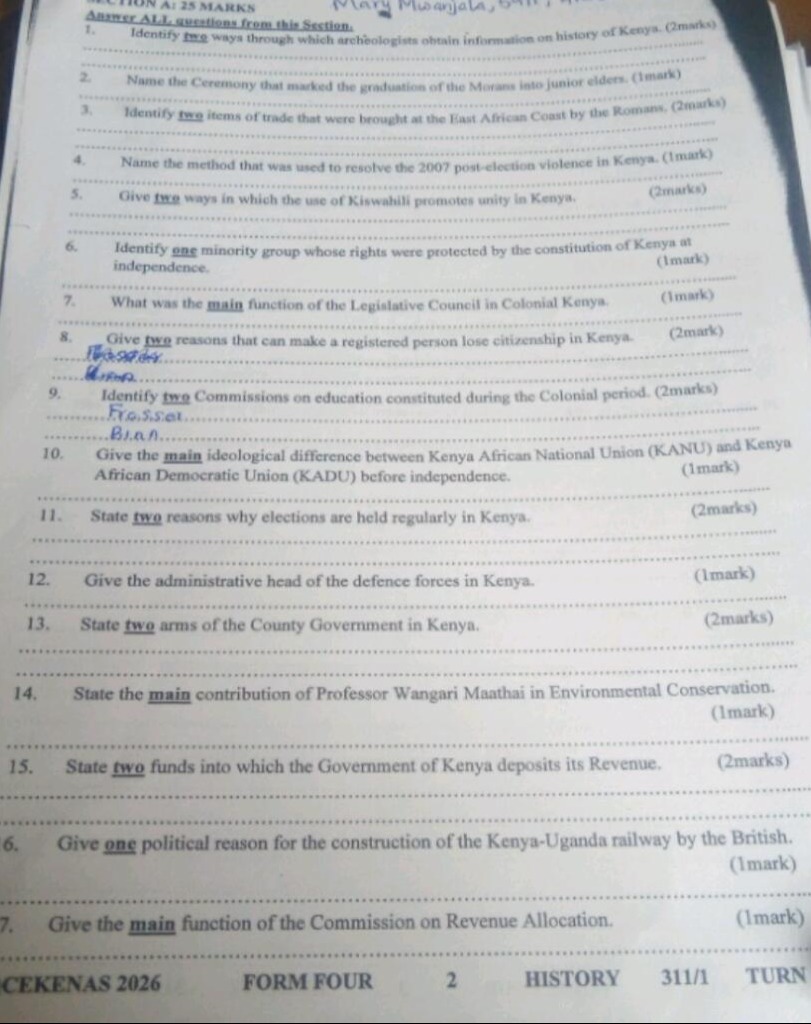
section a: 25 marks
answer all questions from this section.
- identify two ways through which archeologists obtain information on history of kenya. (2marks)
- name the ceremony that marked the graduation of the morans into junior elders. (1mark)
- identify two items of trade that were brought at the east african coast by the romans. (2marks)
- name the method that was used to resolve the 2007 post-election violence in kenya. (1mark)
- give two ways in which the use of kiswahili promotes unity in kenya. (2marks)
- identify one minority group whose rights were protected by the constitution of kenya at independence. (1mark)
- what was the main function of the legislative council in colonial kenya. (1mark)
- give two reasons that can make a registered person lose citizenship in kenya. (2marks)
- identify two commissions on education constituted during the colonial period. (2marks)
- give the main ideological difference between kenya african national union (kanu) and kenya african democratic union (kadu) before independence. (1mark)
- state two reasons why elections are held regularly in kenya. (2marks)
- give the administrative head of the defence forces in kenya. (1mark)
- state two arms of the county government in kenya. (2marks)
- state the main contribution of professor wangari maathai in environmental conservation. (1mark)
- state two funds into which the government of kenya deposits its revenue. (2marks)
- give one political reason for the construction of the kenya-uganda railway by the british. (1mark)
- give the main function of the commission on revenue allocation. (1mark)
🆕 New Concept Discovered: Kenyan History and Government
Analyzing historical events, constitutional developments, and governance structures in Kenya.
Step 1: Archaeological Sources of Kenyan History (Question 1)
Archaeologists reconstruct history by physically recovering and analyzing material remains left behind by past societies. Two primary ways they obtain information are:
- Excavating historical sites: Digging up buried artifacts, fossils, tools, and structural remains.
- Analyzing fossils and artifacts: Studying physical remains (such as bones, pottery, and stone tools) using scientific dating methods to understand human evolution and early lifestyles.
Step 2: Maasai Graduation Ceremony (Question 2)
In traditional Maasai society, the transition of warriors (Morans) into junior elders is marked by a major rite of passage.
- Eunoto ceremony: This sacred ceremony involves shaving the initiate's long hair and marks their transition to junior elder status.
Step 3: Roman Trade Items at the East African Coast (Question 3)
During the ancient Indian Ocean trade, Roman merchants visited the East African coast.
- Items brought by Romans: Glassware, wine, weapons/iron tools, and Roman coins.
Step 4: Resolution of the 2007 Post-Election Violence (Question 4)
The political crisis following the disputed 2007 presidential election was resolved through an internationally mediated process.
- Mediation / National Accord and Reconciliation Act: Led by Kofi Annan under the African Union Panel of Eminent African Personalities, resulting in a power-sharing coalition government.
Step 5: Kiswahili and National Unity (Question 5)
Kiswahili serves as both a national and official language in Kenya, fostering cohesion in several ways:
- Breaking down ethnic barriers: It provides a common medium of communication among Kenya's diverse ethnic groups.
- Promoting national identity: It fosters a sense of belonging and patriotism as a shared national language.
Step 6: Minority Groups Protected at Independence (Question 6)
The 1963 Independence Constitution (Lancaster Constitution) included provisions to protect smaller communities who feared domination by larger ethnic groups.
- Minority groups: Examples include the Asians, Europeans, or smaller indigenous communities like the Kalenjin, Maasai, Turkana, and Samburu (often represented politically by KADU).
Step 7: Function of the Legislative Council (LegCo) (Question 7)
The Legislative Council was established during the colonial era to serve as the primary legislative body.
- Main function: To make laws for the administration of colonial Kenya.
Step 8: Loss of Registered Citizenship (Question 8)
Under Kenyan law, a person who acquired citizenship by registration can lose it under specific constitutional conditions:
- Treason/Disloyalty: If the person is shown by act or speech to be disloyal or disaffected towards the Republic of Kenya.
- Assisting an enemy state: If the person trades with or assists an enemy state during a war in which Kenya is engaged.
- Fraud: If the citizenship was acquired by fraud, false representation, or concealment of any material fact.
Step 9: Colonial Education Commissions (Question 9)
During the colonial period, several commissions were established to review and make recommendations on the education system:
- Phelps-Stokes Commission (1924)
- Fraser Commission (1909)
- Beecher Committee/Commission (1949)
Step 10: Ideological Difference Between KANU and KADU (Question 10)
Before indepe…

Snap & solve any problem in the app
Get step-by-step solutions on Sovi AI
Photo-based solutions with guided steps
Explore more problems and detailed explanations
- Two ways archaeologists obtain information:
- Excavating historical sites to unearth physical remains.
- Analyzing fossils and artifacts using scientific dating methods.
- Ceremony marking graduation of Morans:
- The Eunoto ceremony.
- Two items of trade brought by Romans:
- Glassware and Roman coins (or wine/weapons).
- Method used to resolve the 2007 post-election violence:
- Mediation (The National Accord and Reconciliation process led by Kofi Annan).
- Two ways Kiswahili promotes unity:
- It serves as a common national language that bridges ethnic communication gaps.
- It fosters a shared national identity and patriotism among Kenyans.
- One minority group protected at independence:
- European/Asian minorities (or smaller indigenous communities represented by KADU, such as the Kalenjin or Maasai).
- Main function of the Legislative Council (LegCo):
- To make and pass laws for the administration of colonial Kenya.
- Two reasons a registered citizen can lose citizenship:
- If the citizenship was acquired through fraud, false representation, or concealment of material facts.
- If the person is shown to be disloyal to Kenya by supporting or trading with an enemy state during a war.
- Two colonial education commissions:
- The Phelps-Stokes Commission (1924).
- The Fraser Commission (1909) / Beecher Committee (1949).
- Main ideological difference between KANU and KADU:
- KANU advocated for a centralized unitary system of government, whereas KADU advocated for a decentralized federal system (Majimboism).
- Two reasons why elections are held regularly:
- To give citizens the democratic opportunity to exercise their sovereign power to elect leaders of their choice.
- To hold leaders accountable by providing a mechanism to replace those who underperform.
- Administrative head of the defence forces:
- The Chief of the Defence Forces (CDF).
- Two arms of the County Government:
- The County Executive.
- The County Assembly.
- Main contribution of Professor Wangari Maathai:
- Founding the Green Belt Movement to promote environmental conservation through massive tree-planting initiatives.
- Two funds into which the Government deposits revenue:
- The Consolidated Fund.
- The Equalisation Fund.
- One political reason for the construction of the Kenya-Uganda railway:
- To secure British strategic control over the source of the River Nile (Uganda) against rival European powers.
- Main function of the Commission on Revenue Allocation (CRA):
- To recommend the equitable sharing of national revenue between the national government and county governments, as well as among the 47 counties.