QUESTION IMAGE
Question
section 24.1 electric potential and potential difference
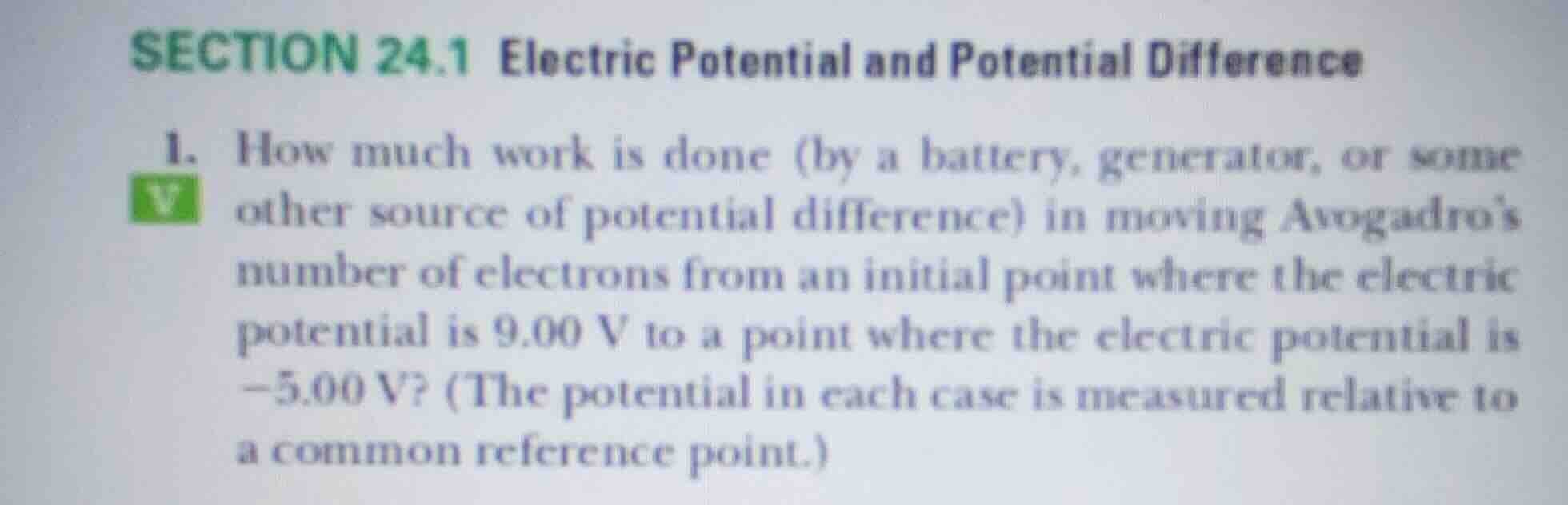
- how much work is done (by a battery, generator, or some other source of potential difference) in moving avogadros number of electrons from an initial point where the electric potential is \\(9.00\text{ v}\\) to a point where the electric potential is \\(-5.00\text{ v}\\)? (the potential in each case is measured relative to a common reference point.)
Identify given physical quantities
We are given:
- Number of charges: Avogadro's number of electrons, \(N = 6.022 \times 10^{23}\).
- Charge of one electron: \(q_e = -1.602 \times 10^{-19}\text{ C}\).
- Initial potential: \(V_i = 9.00\text{ V}\).
- Final potential: \(V_f = -5.00\text{ V}\).
Calculate the total charge moved
Using the Electrostatics concept, we find the total charge \(q\):
$$
q = N \cdot q_e = (6.022 \times 10^{23}) \cdot (-1.602 \times 10^{-19}\text{ C}) \approx -9.647 \times 10^4\text{ C}
$$
Determine the potential difference
The change in electric potential \(\Delta V\) is:
$$
\Delta V = V_f - V_i = -5.00\text{ V} - 9.00\text{ V} = -14.00\text{ V}
$$
Calculate the work done by the source
The work done by the external source (battery/generator) to move the charge is:
$$
W = q \Delta V
$$
$$
W = (-9.647 \times 10^4\text{ C}) \cdot (-14.00\text{ V}) \approx 1.35 \times 10^6\text{ J}
$$

Snap & solve any problem in the app
Get step-by-step solutions on Sovi AI
Photo-based solutions with guided steps
Explore more problems and detailed explanations
\(1.35 \times 10^6\text{ J}\) (or \(1.35\text{ MJ}\))